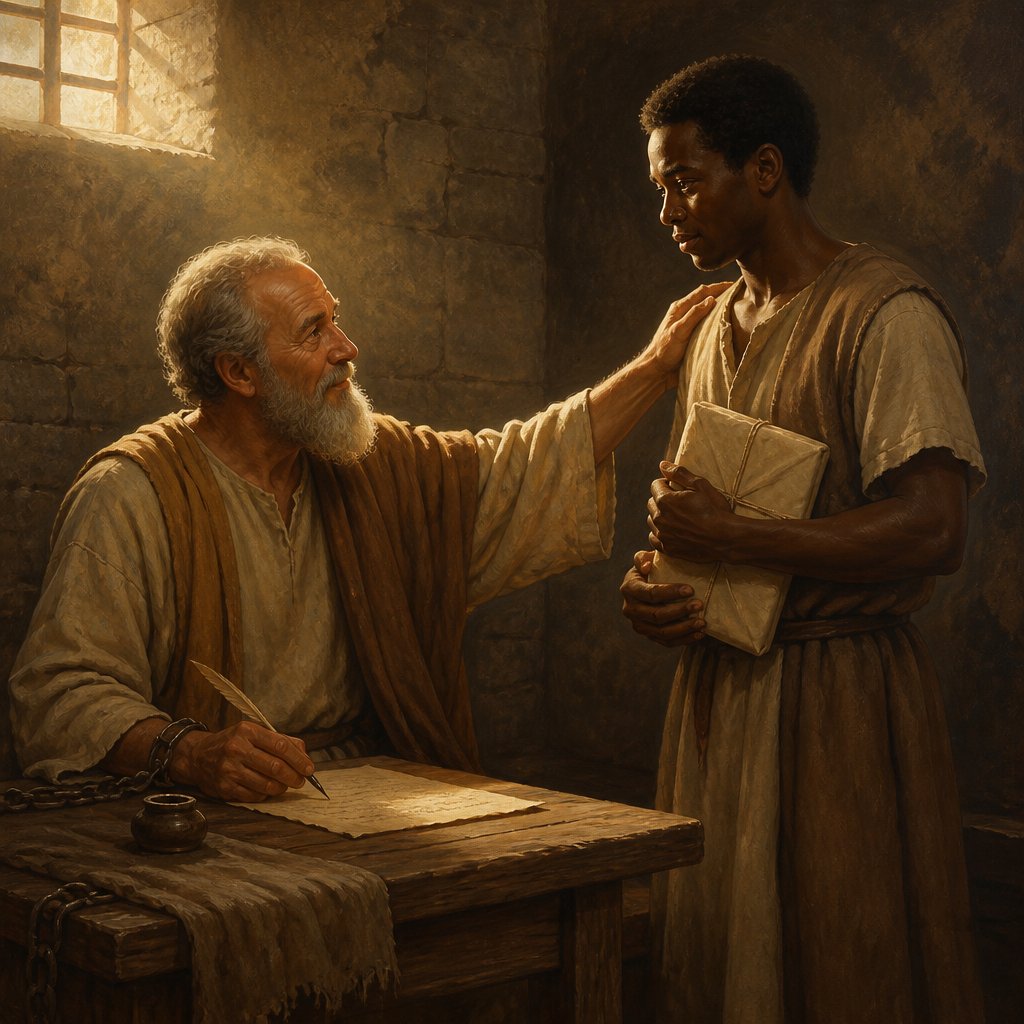
In the epistle to Philemon, Apostle Paul writes a heartfelt letter regarding Onesimus, a runaway slave who has found refuge in Paul’s company. The context surrounding this letter is laden with social implications, personal relationships, and a profound message about forgiveness and reconciliation. We glean significant insights from Philemon 1:8-20, especially when considering Paul’s assertion in verse 19: "I Paul have written it with mine own hand, I will repay it: albeit I do not say to thee how thou owest unto me even thine own self besides."
First and foremost, we must pause and reflect upon the gravity of this statement. Paul offers to repay Philemon for any loss incurred due to Onesimus's flight. Yet, he subtly layers the weight of an even deeper debt: Philemon owes his very salvation to Paul’s missionary work, evoking both gratitude and a sense of obligation. Herein lies a profound truth: forgiveness often carries a relational complexity that is intertwined with personal testimony and shared faith. Paul, through his letter, not only intercedes for Onesimus but emphasizes the spiritual bond he shares with Philemon.
This context beckons us to ask ourselves—how often do we harbor grievances against those who have wronged us? Often, life circumstances lead us into conflict, and we find ourselves suddenly estranged from those once close to us. Philemon, as a master of a slave, is presented with the challenge of dealing with Onesimus’s return. What would be his reaction? The expectation of justice, a demand for punishment, or the grace of forgiveness? Paul implicates that Onesimus has been transformed through Christ, becoming useful both to Paul and to Philemon.
In verse 16, Paul writes, "Not now as a servant, but above a servant, a brother beloved, specially to me, but how much more unto thee, both in the flesh, and in the Lord?" This powerful statement redefines how Philemon is encouraged to view Onesimus. He’s not simply a property but a brother in Christ. This is transformational; it invites us to transcend societal norms and recognize our shared identity in Christ.
As Christians, we are frequently reminded of our dual citizenship: we are citizens of heaven and are called to reflect the grace we have received. In light of this, Paul’s model offers a roadmap for dealing with conflict. He does not minimize Philemon's rights nor does he ignore the offense done to him. Instead, he appeals to Philemon's faith, kindness, and the common ground they share in Christ. Paul demonstrates that while the world may compel us to cling to justice, the Kingdom of God invites us to embrace mercy.
The Apostle’s desire for Philemon to receive Onesimus as a brother echoes through the corridors of our own lives. We must ask ourselves, "Who have I struggled to forgive? Who has wronged me in ways that feel too great to overlook?" In these moments, we are called to remember the ultimate sacrifice of Christ. He bore our sins and our debts ON Him, giving us a model of unconditional love.
In verses 17-20, Paul expresses hope that Philemon will welcome Onesimus not merely as a servant but as a loved brother. He lays himself as collateral in case of any wrongdoing, demonstrating real love and commitment to restoration. This selfless act reflects the heart of Jesus Christ, who paid our debts with His life, beckoning us to likewise extend grace.
As we end our contemplation on this profound letter, let us commit to fostering forgiveness in our hearts. Let us be challenged to consider not just the actions of others but the grace we've received. May our relationships be characterized by redemption rather than retribution. In doing so, we reflect the love that Christ has shown us—a love that seeks to reconcile rather than divide. In embracing restoration, we imitate our Savior, foster unity in the body of Christ, and exemplify the true essence of forgiveness.
Get our apps


Artwork for Philemon 1:8-20

Philemon 1:8-20 - "Therefore, although in Christ I could be bold and order you to do what you ought to do, yet I prefer to appeal to you on the basis of love. It is as none other than Paul—an old man and now also a prisoner of Christ Jesus— that I appeal to you for my son Onesimus, who became my son while I was in chains. Formerly he was useless to you, but now he has become useful both to you and to me. I am sending him—who is my very heart—back to you. I would have liked to keep him with me so that he could take your place in helping me while I am in chains for the gospel. But I did not want to do anything without your consent, so that any favor you do would not seem forced but would be voluntary. Perhaps the reason he was separated from you for a little while was that you might have him back forever— no longer as a slave, but better than a slave, as a beloved brother. He is very dear to me but even dearer to you, both as a fellow man and as a brother in the Lord. So if you consider me a partner, welcome him as you would welcome me. If he has done you any wrong or owes you anything, charge it to me. I, Paul, am writing this with my own hand. I will pay it back—not to mention that you owe me your very self."
"Therefore, although in Christ I could be bold and order you to do what you ought to do, yet I prefer to appeal to you on the basis of love. It is as none other than Paul—an old man and now also a prisoner of Christ Jesus— that I appeal to you for my son Onesimus, who became my son while I was in chains. Formerly he was useless to you, but now he has become useful both to you and to me. I am sending him—who is my very heart—back to you. I would have liked to keep him with me so that he could take your place in helping me while I am in chains for the gospel. But I did not want to do anything without your consent, so that any favor you do would not seem forced but would be voluntary. Perhaps the reason he was separated from you for a little while was that you might have him back forever— no longer as a slave, but better than a slave, as a beloved brother. He is very dear to me but even dearer to you, both as a fellow man and as a brother in the Lord. So if you consider me a partner, welcome him as you would welcome me. If he has done you any wrong or owes you anything, charge it to me. I, Paul, am writing this with my own hand. I will pay it back—not to mention that you owe me your very self." - Philemon 1:8-20

Philemon 1:20 - "Yea, brother, let me have joy of thee in the Lord: refresh my bowels in the Lord."

Philemon 1:8 - "Wherefore, though I might be much bold in Christ to enjoin thee that which is convenient,"

Philemon 1:1 - "Paul, a prisoner of Jesus Christ, and Timothy our brother, unto Philemon our dearly beloved, and fellowlabourer, 2 And to our beloved Apphia, and Archippus our fellowsoldier, and to the church in thy house:"

"Yea, brother, let me have joy of thee in the Lord: refresh my bowels in the Lord." - Philemon 1:20

"Wherefore, though I might be much bold in Christ to enjoin thee that which is convenient," - Philemon 1:8

Philemon 1:4-7

Philemon 1:24 - "Marcus, Aristarchus, Demas, Lucas, my fellowlabourers."

Philemon 1:23 - "There salute thee Epaphras, my fellowprisoner in Christ Jesus;"

Philemon 1:17 - "If thou count me therefore a partner, receive him as myself."

Philemon 1:25 - "The grace of our Lord Jesus Christ be with your spirit. Amen."

Philemon 1:11 - "Which in time past was to thee unprofitable, but now profitable to thee and to me:"

Philemon 1:15 - "For perhaps he therefore departed for a season, that thou shouldest receive him for ever;"

Philemon 1:3 - "Grace to you, and peace, from God our Father and the Lord Jesus Christ."

Philemon 1:4 - "I thank my God, making mention of thee always in my prayers,"

Philemon 1:18 - "If he hath wronged thee, or oweth thee ought, put that on mine account;"

Philemon 1:10 - "I beseech thee for my son Onesimus, whom I have begotten in my bonds:"

Philemon 1:12 - "Whom I have sent again: thou therefore receive him, that is, mine own bowels:"

Philemon 1:5 - "Hearing of thy love and faith, which thou hast toward the Lord Jesus, and toward all saints;"

Philemon 1:14 - "But without thy mind would I do nothing; that thy benefit should not be as it were of necessity, but willingly."

Philemon 1:7 - "For we have great joy and consolation in thy love, because the bowels of the saints are refreshed by thee, brother."

"Marcus, Aristarchus, Demas, Lucas, my fellowlabourers." - Philemon 1:24

Philemon 1:6 - "That the communication of thy faith may become effectual by the acknowledging of every good thing which is in you in Christ Jesus."

"Paul, a prisoner of Jesus Christ, and Timothy our brother, unto Philemon our dearly beloved, and fellowlabourer, 2 And to our beloved Apphia, and Archippus our fellowsoldier, and to the church in thy house:" - Philemon 1:1

Philemon 1:22 - "But withal prepare me also a lodging: for I trust that through your prayers I shall be given unto you."

Philemon 1:16 - "Not now as a servant, but above a servant, a brother beloved, specially to me, but how much more unto thee, both in the flesh, and in the Lord?"

1 Chronicles 8:20 - "And Elienai, and Zilthai, and Eliel,"

"There salute thee Epaphras, my fellowprisoner in Christ Jesus;" - Philemon 1:23

Philemon 1:9 - "Yet for love's sake I rather beseech thee, being such an one as Paul the aged, and now also a prisoner of Jesus Christ."