The Loving Discipline of a Father
"He that spareth his rod hateth his son: but he that loveth him chasteneth him betimes." - Proverbs 13:24

**He that spareth his rod hateth his son: but he that loveth him chasteneth him betimes. - Proverbs 13:24 (KJV)**
In our modern society, discussions around discipline can often elicit strong feelings and differing opinions. As we approach Proverbs 13:24, it is essential to explore the wisdom of this verse within the context of love, discipline, and the responsibilities of parenthood.
This verse articulates a truth that might seem stark or even harsh at first glance: the comparison between sparing the rod and loving one’s son. To spare the rod can imply neglect or failure to provide necessary guidance, while to chasten, or discipline, is seen as an act of love. In a world where 'love' is often equated with unrestricted freedom, this biblical view establishes a pivotal understanding of true love and its demands.
The imagery of a rod conjures thoughts of authority and correction. It symbolizes a parent’s duty to guide their children toward righteousness and wisdom. The purpose of this ‘rod’ is not to invoke fear or to damage the child’s spirit, but rather to mold and shape the young heart, teaching them about consequences and accountability. Just as a gardener prunes a tree to ensure its healthy growth, so too must a parent sometimes apply the appropriate discipline to foster growth and maturity in their children.
The phrase “hateth his son” is striking. The emotional weight of this statement cannot be understated. It encourages parents to reflect deeply on their actions and choices regarding discipline. If a parent neglects to discipline their child, it may stem from a desire to be liked or to avoid conflict. However, this avoidance can lead to more significant issues down the line—growing children who lack boundaries, respect for authority, and an understanding of right and wrong. Love is not merely permissiveness; it is providing safety and guidance.
Discipline manifests in various forms, not just physical correction. It can be verbal admonishment, setting boundaries, and instilling consequences for actions. The key is to ensure that it is rooted in love and designed to teach rather than to punish. True love involves a commitment to a child’s well-being, which may sometimes mean making the difficult choice to discipline even when it is uncomfortable.
The latter part of the verse—“but he that loveth him chasteneth him betimes”—invites us to consider the timing and intent of our actions. "Betimes" suggests a proactive approach to discipline. This implies an ongoing commitment to correct and guide continually rather than a reactive measure to misbehavior. When discipline is administered promptly and consistently, children have a more profound understanding of their actions and learn more effectively the principles of love and respect.
Moreover, it is helpful to view discipline from the perspective of our relationship with God. He, too, disciplines His children out of love. Hebrews 12:6 reinforces this: "For whom the Lord loveth he chasteneth, and scourgeth every son whom he receiveth." Just as our Heavenly Father seeks to correct us for our growth, we as earthly parents are to model that same approach.
In today's world, let us reflect upon our parenting styles and the messages we are conveying to our children. Are we sparing our rods in the hope that they will simply figure it out on their own? Or are we engaging in the necessary hard work of love that may look like discipline but ultimately leads them to become responsible, loving, and wise adults?
Remember, discipline rooted in love leads to a fruitful harvest. When we choose to initiate conversations about accountability, set boundaries, and correct behaviors that can lead to destruction, we are operating in the fullness of God’s design for parenting. Let us honor God by nurturing our children with the love that demands discipline and be encouraged that true love often manifests in the most intentional ways.
Want to reflect more on Proverbs 13:24?
Continue your spiritual journey with Bible Chat — an AI-powered tool for exploring God's Word through conversation. Ask questions, discover connections, and deepen your understanding.
Get Our Apps


Proverbs 13:24 Artwork

Proverbs 13:24 - "He that spareth his rod hateth his son: but he that loveth him chasteneth him betimes."

"He that spareth his rod hateth his son: but he that loveth him chasteneth him betimes." - Proverbs 13:24

Proverbs 24:13 - "My son, eat thou honey, because it is good; and the honeycomb, which is sweet to thy taste:"
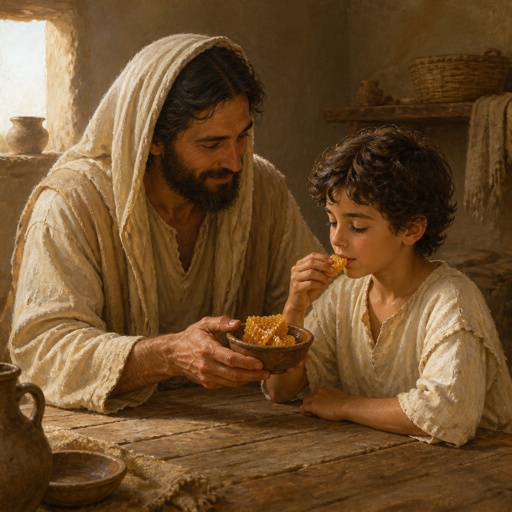
"My son, eat thou honey, because it is good; and the honeycomb, which is sweet to thy taste:" - Proverbs 24:13

Proverbs 24:13-14 KJV (13) My son, eat thou honey, because it is good; and the honeycomb, which is sweet to thy taste: (14) So shall the knowledge of wisdom be unto thy soul: when thou hast found it, then there shall be a reward, and thy expectation shall not be cut off.

Proverbs 24:13-14 KJV (13) My son, eat thou honey, because it is good; and the honeycomb, which is sweet to thy taste: (14) So shall the knowledge of wisdom be unto thy soul: when thou hast found it, then there shall be a reward, and thy expectation shall not be cut off.

Proverbs 24:3 - "Through wisdom is an house builded; and by understanding it is established:"

Proverbs 24:2 - "For their heart studieth destruction, and their lips talk of mischief."

Proverbs 24:24 - "He that saith unto the wicked, Thou art righteous; him shall the people curse, nations shall abhor him:"

Proverbs 24:9 - "The thought of foolishness is sin: and the scorner is an abomination to men."

Proverbs 14:24 - "The crown of the wise is their riches: but the foolishness of fools is folly."

Proverbs 27:24 - "For riches are not for ever: and doth the crown endure to every generation?"

Proverbs 24:10 - "If thou faint in the day of adversity, thy strength is small."

Proverbs 16:24 - "Pleasant words are as an honeycomb, sweet to the soul, and health to the bones."

Proverbs 13:13 - "Whoso despiseth the word shall be destroyed: but he that feareth the commandment shall be rewarded."

Proverbs 24:30 - "I went by the field of the slothful, and by the vineyard of the man void of understanding;"

Proverbs 24:1 - "Be not thou envious against evil men, neither desire to be with them."

Proverbs 24:5 - "A wise man is strong; yea, a man of knowledge increaseth strength."

Proverbs 24:8 - "He that deviseth to do evil shall be called a mischievous person."

Proverbs 30:24 - "There be four things which are little upon the earth, but they are exceeding wise:"

Proverbs 24:4 - "And by knowledge shall the chambers be filled with all precious and pleasant riches."

Proverbs 25:24 - "It is better to dwell in the corner of the housetop, than with a brawling woman and in a wide house."

Proverbs 11:24 - "There is that scattereth, and yet increaseth; and there is that withholdeth more than is meet, but it tendeth to poverty."

Proverbs 24:22 - "For their calamity shall rise suddenly; and who knoweth the ruin of them both?"

Proverbs 24:19 - "Fret not thyself because of evil men, neither be thou envious at the wicked;"

Proverbs 22:24 - "Make no friendship with an angry man; and with a furious man thou shalt not go:"

Proverbs 24:32 - "Then I saw, and considered it well: I looked upon it, and received instruction."

Proverbs 17:24 - "Wisdom is before him that hath understanding; but the eyes of a fool are in the ends of the earth."

Proverbs 24:20 - "For there shall be no reward to the evil man; the candle of the wicked shall be put out."

Proverbs 24:26 - "Every man shall kiss his lips that giveth a right answer."