The Perils of Self-Righteousness: Submitting to God’s True Righteousness
“For they being ignorant of God’s righteousness, and going about to establish their own righteousness, have not submitted themselves unto the righteousness of God.” — Romans 10:3
In Romans 10:3, the Apostle Paul writes, "For they being ignorant of God's righteousness, and going about to establish their own righteousness, have not submitted themselves unto the righteousness of God." This verse succinctly captures a fundamental struggle that humanity has faced since the fall: the tendency to rely on our own understanding of righteousness rather than submitting to the divine righteousness of God.
In the context of Romans chapter 10, Paul is addressing the Jewish people who had zeal for God but were misguided in their approach to attaining righteousness. Their fervor led them to cling to the Law and their own works as a means of establishing their own righteousness. This speaks volumes about human nature. Desperately wanting to be right or justified, we often seek to define righteousness in a way that aligns with our own understanding, capabilities, or desires. The irony lies in our attempts to earn what can only be received as a gift.
What Paul highlights is a profound ignorance - not just a lack of knowledge, but a refusal to accept God's righteousness. This is an ignorance that does not stem merely from lack of exposure to God’s word but from a heart that finds it hard to surrender. The world’s definition of righteousness is very much about achievement and moral superiority – what can be seen and measured. It is about being right in one's own eyes. However, God’s righteousness encapsulates mercy, grace, and justice, portrayed most brilliantly in the sacrifice of Jesus Christ.
The struggle for self-righteousness is further complicated by our human attitudes and societal pressures. Culture often applauds those who strive to ‘make it on their own,’ crafting a narrative that inadvertently undermines the need for grace. Pursuing one’s own righteousness can result in a false sense of security and superiority over others who appear less righteous. We may adopt a mindset of comparison, using our own 'successes' to gauge the worthiness of others. Yet, Paul reminds us that this is a futile endeavor.
The danger is that in attempting to achieve righteousness on our own, we become blinded to the reality that we fall short of God’s standards. Isaiah 64:6 reminds us, "But we are all as an unclean thing, and all our righteousnesses are as filthy rags; and we all do fade as a leaf; and our iniquities, like the wind, have taken us away." This litany of pretense does not usher us closer to God but serves only as a barrier.
To submit to the righteousness of God means recognizing that our efforts, no matter how well-intentioned, can never bridge the gap that sin has created between us and a holy God. Only by accepting Christ’s sacrifice are we washed clean and clothed in His righteousness. This act of submission involves humility, an acknowledgment of our need for God’s grace, and a readiness to lay aside our self-constructed facades. It is a challenge, no doubt. Trusting in God’s righteousness requires relinquishing our pride and surrendering the need to control our own narrative.
In practical terms, how do we submit to God’s righteousness? It begins with prayer and reflection on Scripture. We must ask God to reveal the areas of our lives where we might be trying to do it ourselves. It involves being open to correction and willing to change our understanding of what it means to be righteous in His eyes. It means allowing that righteousness to affect our lives profoundly, transforming our actions, thoughts, and attitudes.
As we embrace our inadequacy and submit to God’s righteousness, we become partakers of His grace, learning that true righteousness is found not in ourselves but in a relationship with Him. Let us strive to abandon our self-righteous pursuits and instead seek the wealth found in His unfathomable grace. May we be known, not for our own righteousness, but for the righteousness that is gifted to us through faith in Jesus Christ.
Get our apps


Artwork for Romans 10:3
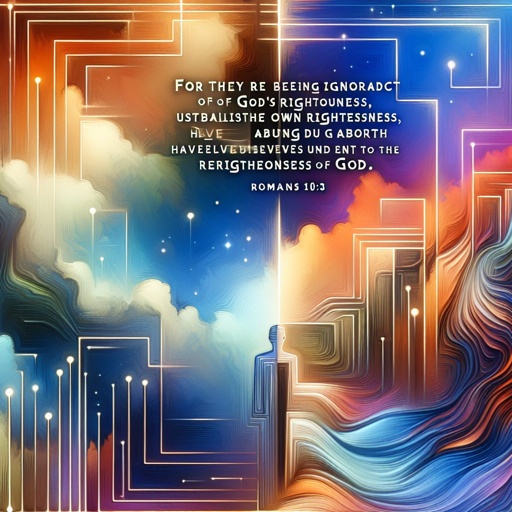
Romans 10:3 - "For they being ignorant of God's righteousness, and going about to establish their own righteousness, have not submitted themselves unto the righteousness of God."

"For they being ignorant of God's righteousness, and going about to establish their own righteousness, have not submitted themselves unto the righteousness of God." - Romans 10:3

Romans 3:10 - "As it is written, There is none righteous, no, not one:"

"As it is written, There is none righteous, no, not one:" - Romans 3:10

Romans 10

Romans 10:17

Romans 10:17

Romans 10:17

Romans 10:17

Romans 10:17

Romans 10:17

Romans 10:17

Romans 10:14

Romans 10:17

Romans 10:9

Romans 10:9

Romans 10:13-15

Romans 10:10 - "For with the heart man believeth unto righteousness; and with the mouth confession is made unto salvation."

Romans 4:3

Romans 3:24

Romans 3:16 - "Destruction and misery are in their ways:"
Romans 3:17 - "And the way of peace have they not known:"

Romans 3:15 - "Their feet are swift to shed blood:"

Romans 3:18 - "There is no fear of God before their eyes."

Romans 3:3 - "For what if some did not believe? shall their unbelief make the faith of God without effect?"

Romans 3:14 - "Whose mouth is full of cursing and bitterness:"

Romans 10:4 - "For Christ is the end of the law for righteousness to every one that believeth."

Romans 10:11 - "For the scripture saith, Whosoever believeth on him shall not be ashamed."

Romans 10:17 - "So then faith cometh by hearing, and hearing by the word of God."

Romans 7:10 - "And the commandment, which was ordained to life, I found to be unto death."