Descending into the Deep: A Reflection on Romans 10:7
“Or, Who shall descend into the deep? ( that is, to bring up Christ again from the dead.)” — Romans 10:7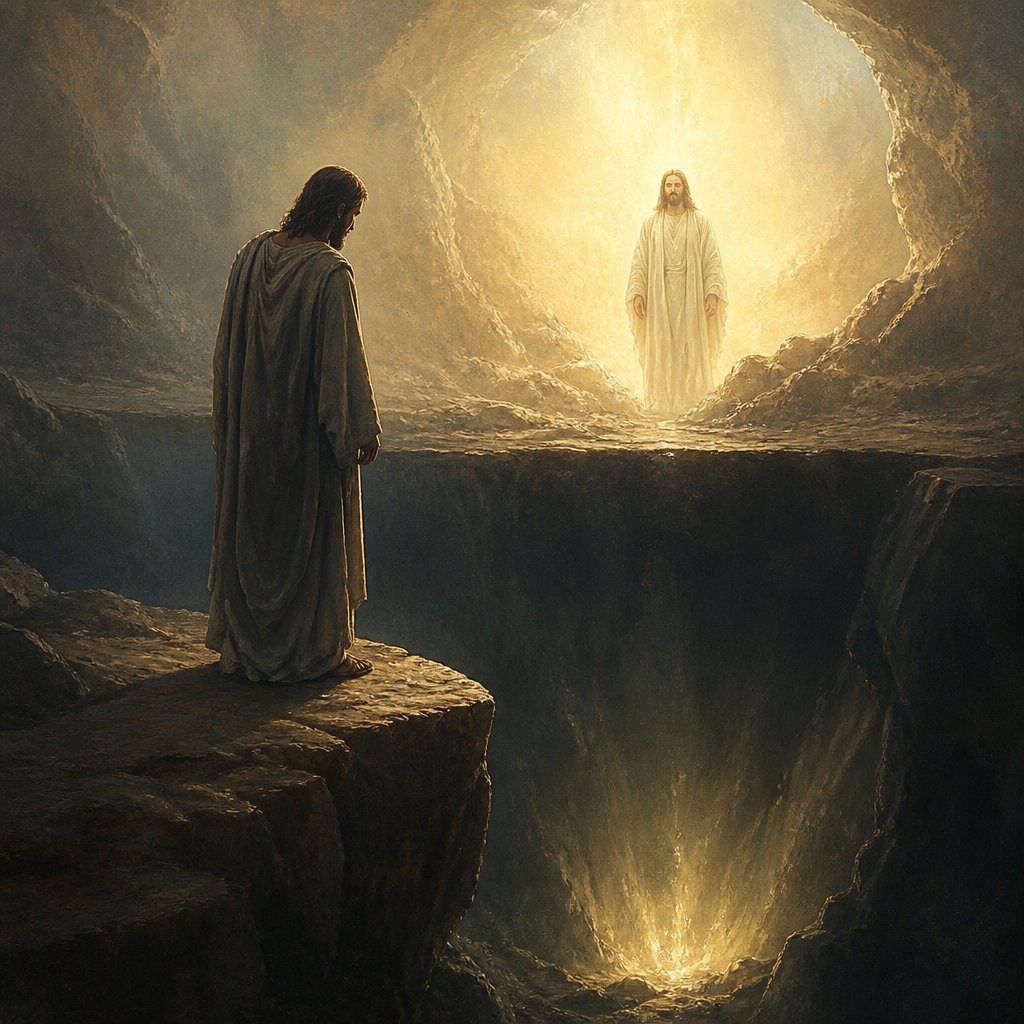
The apostle Paul, in his writings to the Romans, encapsulates an essential element of the Christian faith in Romans 10:7: "Or, Who shall descend into the deep? (that is, to bring up Christ again from the dead.)" This verse challenges us to contemplate the depth of Jesus' resurrection and the profound implications it has for our lives as believers.
To fully appreciate this passage, we must first explore the context in which it's written. Paul's intent, throughout the 10th chapter of Romans, is to articulate the relationship between faith and salvation. He draws the reader into a deeper understanding of what it means to truly believe in the gospel message. He emphasizes that salvation is accessible, not through lofty endeavors or mountainous achievements, but rather through faith—a faith that believes in the resurrection of Christ.
When Paul speaks of descending into the deep—this metaphor of ‘the deep’ evokes images of the abyss, the grave, or even hell. It highlights the gravity of what it means to confront death, to face the finality that such encounters can impose. It's an echo of the psalmist’s cry, their descent into the depths of despair or separation from God. Yet, for Paul, this descent is not merely about the darkness of death itself, but also a challenge to acknowledge the miracle of resurrection. If you were to physically descend into the depths with the sole purpose of bringing Christ back from the dead, it symbolizes the impossibility of reversing death without God’s divine intervention.
This brings us to the crux of our faith: Christ’s resurrection is not a mere event but the cornerstone of our hope. Paul’s rhetorical question serves to remind us that it is not by our own strength or actions that we bring about salvation; rather, it is entirely by the grace of God. Those who would seek to bring Christ up from the grave must recognize that this act of resurrection is a work only God could accomplish. It nullifies any notion that human efforts could ever reach God or undo the grave on their own.
When we apply this passage to our own lives, we find a profound reassurance foreshadowed in Paul’s question. Every personal struggle, every hopeless circumstance—these may feel like descending into the deep. We may experience times when it feels as if we have lost our grasp on hope. Such experiences are resonate with the feelings of despair and abandonment. Yet, just as Christ was resurrected from the deep, we, too, are invited into that same resurrection power. These moments teach us that we don’t have to descend into our trials alone. Instead, we ‘bring up’ our struggles to God, entrusting to Him the very depths of our hearts.
In connecting this with our daily lives, the question Paul raises prompts us to reflect upon the nature of our faith. Do we act like those who feel the need to control every aspect of our salvation, seeking to grasp God through our own efforts? Or do we surrender our struggles, our fears, and our failures to Him, recognizing that it was never about what we could accomplish but rather about His all-encompassing grace?
Ultimately, Romans 10:7 beckons us to embrace the truth of resurrection—not merely as a historical fact but as an ongoing reality influencing how we live. In every despairing moment, we are invited to recognize the resurrection power of Christ working within us. We don't have to descend into the deep alone; we can rise with Him. As we reflect on this verse, may we be encouraged to put our complete trust in God who triumphed over death, bringing life and hope from the depths.
As believers, let us confess with our mouths that Jesus is Lord and believe in our hearts that God raised Him from the dead (Romans 10:9). Instead of considering the deep as a place of despair, let us regard it as an opportunity to experience God's mighty hand lifting us up to new heights through Christ's resurrection.
Get our apps


Artwork for Romans 10:7

Romans 10:7 - "Or, Who shall descend into the deep? (that is, to bring up Christ again from the dead.)"
"Or, Who shall descend into the deep? (that is, to bring up Christ again from the dead.)" - Romans 10:7

Romans 7:10 - "And the commandment, which was ordained to life, I found to be unto death."

"And the commandment, which was ordained to life, I found to be unto death." - Romans 7:10

Combine the authority theme described in Romans 13:1-7 and Revelation 13:1-10.

Show the Divine Order seen in Romans 131:7 with the Beastly Rule seen in Revelation 13:1-10.

Show the Divine Order seen in Romans 131:7 with the Beastly Rule seen in Revelation 13:1-10.

Show the Divine Order seen in Romans 131:7 with the Beastly Rule seen in Revelation 13:1-10.

Show the Divine Order seen in Romans 131:7 with the Beastly Rule seen in Revelation 13:1-10.

Show the Divine Order of government authority seen in Romans 131:7 contrasted with the Beastly Rule faced in Revelation 13:1-10.

Romans 10

Romans 10:17

Romans 10:17

Romans 10:17

Romans 10:17

Romans 10:17

Romans 10:17

Romans 10:17

Romans 10:14

Romans 10:17

Romans 10:9

Romans 10:9

Romans 7:19

Romans 7:12

Romans 10:13-15

Romans 10:10 - "For with the heart man believeth unto righteousness; and with the mouth confession is made unto salvation."

Romans 3:10 - "As it is written, There is none righteous, no, not one:"

Romans 6:7 - "For he that is dead is freed from sin."

Romans 10:4 - "For Christ is the end of the law for righteousness to every one that believeth."

Romans 10:11 - "For the scripture saith, Whosoever believeth on him shall not be ashamed."