Inheritance of Faith: A Look at Romans 4:13
“For the promise, that he should be the heir of the world, was not to Abraham, or to his seed, through the law, but through the righteousness of faith.” — Romans 4:13
In Romans 4:13, the Apostle Paul brings forth a profound truth that reshapes our understanding of God’s promises and the legacy of faith. The verse reads, “For the promise, that he should be the heir of the world, was not to Abraham, or to his seed, through the law, but through the righteousness of faith.” Here, Paul elaborates on the distinction between the law and faith, cementing a foundational principle of our Christian walk.
The backdrop of this verse is rich with history. Abraham is often regarded as the father of faith, a model for believers who seek to live righteously before God. The promise that he would be the heir of the world signifies an inheritance that extends far beyond any earthly claim or legalistic adherence to the law. In fact, it establishes a new paradigm—faith, not law, is the conduit through which divine promises flow.
To grasp the weight of this promise, we must first understand what it means to be an heir. An heir receives an inheritance, which is a gift conferred not based on merit but rather on relationship. Abraham’s righteousness was not earned through strict adherence to the law, which had not yet been given in its fullest form, but through his unwavering faith in God’s ability to fulfill His promise.
This principle echoes throughout Scripture, resounding as a clarion call to all believers. The law, given to Moses, aimed to reveal sin and guide God’s people, but it could not impart righteousness. In contrast, faith in God opens the door to a profound relationship where we become heirs—not just of earthly promises, but of spiritual blessings beyond comprehension.
Consider the implications of being an heir of the world. This denotes a vast inheritance; it is not limited by geography, heritage, or human restrictions. When you read this promise through the lens of faith, it becomes clear that your identity in Christ transcends the boundaries set by worldly systems. You are part of a divine lineage. Every believer is woven into this narrative, receiving the same promise that was first given to Abraham.
Moreover, the righteousness of faith points to something incredibly liberating. In a culture that often equates worth with performance, we find freedom in faith. We do not have to strive endlessly to prove our worth to God. Instead, we respond to His gift of grace with belief that activates the promises He has made. This truth should inspire us to cultivate a deep trust in God’s character, setting aside fears of inadequacy that can be stifling.
As we reflect on our own lives, consider areas where fear and doubt might be overshadowing faith. What promises has God made to you? Perhaps it is an assurance of peace in the storm, restoration in brokenness, or provision in need. Like Abraham, we can echo his declaration of faith: “I believe You, God!” When we anchor ourselves in faith, we align with the promises of God, becoming joint heirs with Christ.
In practical terms, living out this inheritance means walking boldly into our calling. Being an heir encourages us to dream big, not for ourselves alone but for the world around us. It compels us to believe in the transformative power of the Gospel that reclaims not just individual lives, but entire communities, nations, and society as a whole.
Every time we act out of faith—whether through service, worship, or sharing love—we are participating in the unfolding of God’s kingdom. The world is ours to inherit, not as a claim of entitlement, but as a manifestation of God’s grace through us. Let us embrace the righteousness of faith and the incredible legacy of promise that is our inheritance in Christ.
Get our apps


Artwork for Romans 4:13

Romans 4:13 - "For the promise, that he should be the heir of the world, was not to Abraham, or to his seed, through the law, but through the righteousness of faith."

Romans 4:13-14 - "For the promise to Abraham and his offspring that he would be heir of the world did not come through the law but through the righteousness of faith. For if it is the adherents of the law who are to be the heirs, faith is null and the promise is void."

"For the promise, that he should be the heir of the world, was not to Abraham, or to his seed, through the law, but through the righteousness of faith." - Romans 4:13

"For the promise to Abraham and his offspring that he would be heir of the world did not come through the law but through the righteousness of faith. For if it is the adherents of the law who are to be the heirs, faith is null and the promise is void." - Romans 4:13-14

Romans 13:4 - "For he is the minister of God to thee for good. But if thou do that which is evil, be afraid; for he beareth not the sword in vain: for he is the minister of God, a revenger to execute wrath upon him that doeth evil."

Romans 13:8

Romans 13:8

Romans 10:13-15

Romans 13:13 - "Let us walk honestly, as in the day; not in rioting and drunkenness, not in chambering and wantonness, not in strife and envying."

Romans 2:4

Romans 4:3

Romans 4:4 - "Now to him that worketh is the reward not reckoned of grace, but of debt."

Romans 12:13 - "Distributing to the necessity of saints; given to hospitality."

Romans 15:4-6
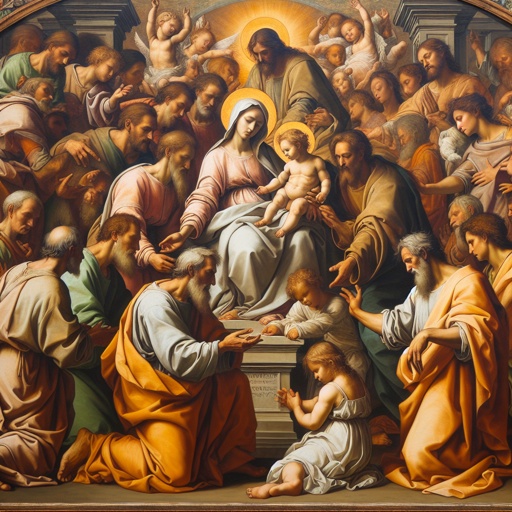
romans 12: 4-5

Romans 16:13 - "Salute Rufus chosen in the Lord, and his mother and mine."

depict the theme of Romans 13:8-14

Romans 5:4 - "And patience, experience; and experience, hope:"

Romans 4:22 - "And therefore it was imputed to him for righteousness."

Romans 10:13 - "For whosoever shall call upon the name of the Lord shall be saved."

Romans 5:13 - "(For until the law sin was in the world: but sin is not imputed when there is no law."

Romans 13:10 - "Love worketh no ill to his neighbour: therefore love is the fulfilling of the law."

Romans 2:13 - "(For not the hearers of the law are just before God, but the doers of the law shall be justified."

Romans 9:13 - "As it is written, Jacob have I loved, but Esau have I hated."

Combine the authority theme described in Romans 13:1-7 and Revelation 13:1-10.

Romans 13:5 - "Wherefore ye must needs be subject, not only for wrath, but also for conscience sake."

Romans 4:8 - "Blessed is the man to whom the Lord will not impute sin."

Romans 4:15 - "Because the law worketh wrath: for where no law is, there is no transgression."

Romans 3:13 - "Their throat is an open sepulchre; with their tongues they have used deceit; the poison of asps is under their lips:"

Romans 10:4 - "For Christ is the end of the law for righteousness to every one that believeth."