What does 1 Chronicles 10:12 mean?
“They arose, all the valiant men, and took away the body of Saul, and the bodies of his sons, and brought them to Jabesh, and buried their bones under the oak in Jabesh, and fasted seven days.” — 1 Chronicles 10:12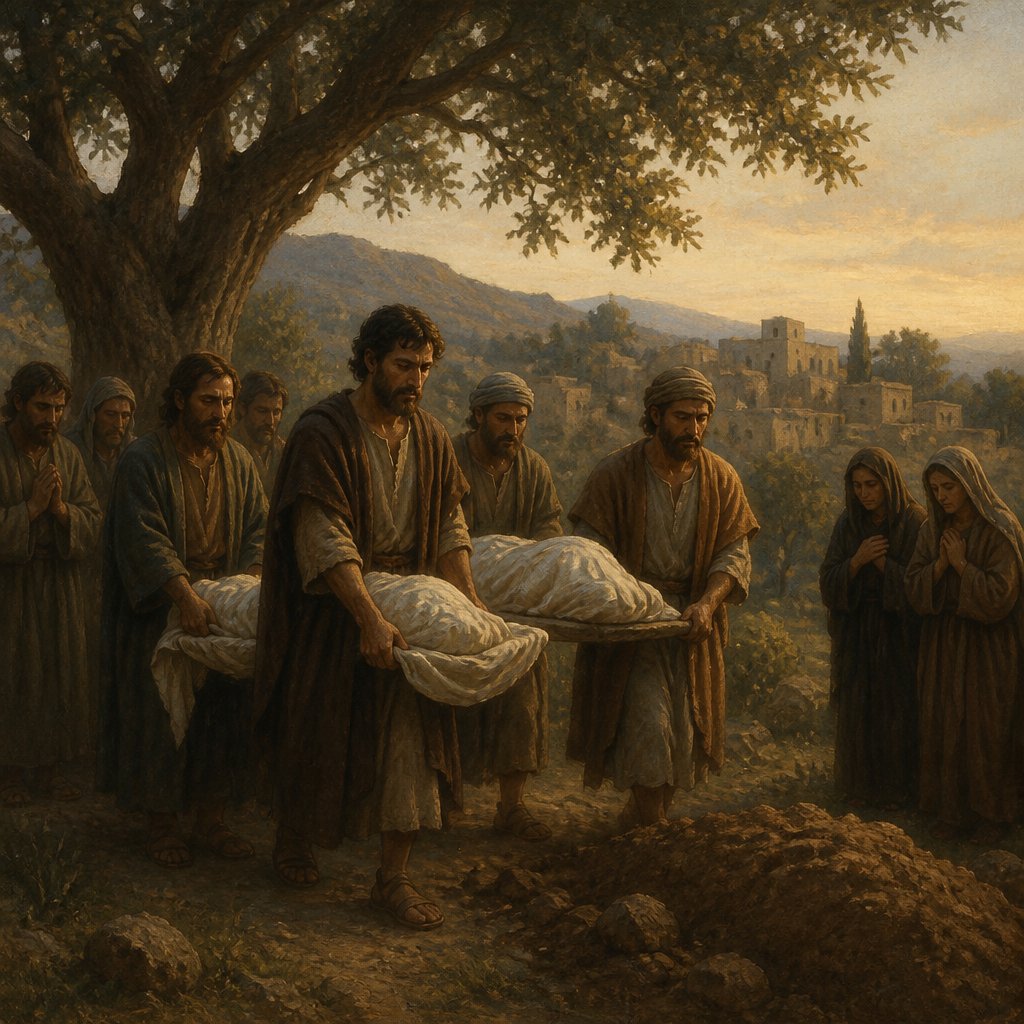
1 Chronicles 10:12 (KJV) states, "They arose, all the valiant men, and took away the body of Saul, and the bodies of his sons, and brought them to Jabesh, and buried their bones under the oak in Jabesh, and fasted seven days." This verse is found at the end of the story of the death of King Saul, the first king of Israel. The verse depicts an act of honor and respect for the fallen king and his sons, even in their defeat.
The verse is set in the context of the battle between the Israelites, led by King Saul, and the Philistines. The battle culminated with the deaths of Saul and his sons, Jonathan, Abinadab, and Malchshua. The Philistines, upon discovering the bodies of Saul and his sons, dishonored them by beheading them and displaying their bodies on the wall of Beth-shan. The valiant men mentioned in the verse were the inhabitants of Jabesh-gilead, who were known for their bravery and loyalty to Saul. They risked their lives to retrieve the bodies of Saul and his sons from the wall of Beth-shan and give them a proper burial.
The act of retrieving the bodies of Saul and his sons signifies an act of respect and honor, even in defeat. Despite Saul's shortcomings and failures as a king, the valiant men honored his position as the anointed king of Israel. This act also reflects the importance of honoring the dead and providing them with a dignified burial, which is a prevalent theme throughout the Bible.
The location of the burial is also significant. Jabesh-gilead was a city known for its bravery and loyalty, as seen in the story of the concubine in Judges 19-21. By burying Saul and his sons in Jabesh-gilead, the valiant men sought to honor their king in a place known for its loyalty and bravery. The oak mentioned in the verse symbolizes strength and endurance, serving as a fitting final resting place for the fallen king and his sons.
Furthermore, the act of fasting for seven days after the burial demonstrates a period of mourning and reflection. Fasting was a common practice in ancient Israel as a sign of repentance, mourning, and seeking God's guidance. The seven-day period reflects the deep sorrow and lamentation over the loss of King Saul and the tragic outcome of the battle.
In a broader context, this verse also highlights the consequences of disobedience and the end of Saul's reign as king. Saul's death marked the transition of power to David, who would become the greatest king of Israel. This transition of power was a pivotal moment in Israel's history and laid the foundation for the future of the nation.
In conclusion, 1 Chronicles 10:12 portrays a powerful and poignant moment in the history of Israel. It exemplifies the importance of honoring the dead, showing respect and loyalty, and the consequences of disobedience. The verse serves as a reminder of the values of honor and loyalty, even in defeat, and the significance of providing a dignified burial for the deceased. It also paves the way for the new chapter in Israel's history with the rise of King David.
Get our apps


Artwork for 1 Chronicles 10:12

1 Chronicles 10:12 - "They arose, all the valiant men, and took away the body of Saul, and the bodies of his sons, and brought them to Jabesh, and buried their bones under the oak in Jabesh, and fasted seven days."
"They arose, all the valiant men, and took away the body of Saul, and the bodies of his sons, and brought them to Jabesh, and buried their bones under the oak in Jabesh, and fasted seven days." - 1 Chronicles 10:12

1 Chronicles 12:10 - "Mishmannah the fourth, Jeremiah the fifth,"

"Mishmannah the fourth, Jeremiah the fifth," - 1 Chronicles 12:10

1 Chronicles 12:12 - "Johanan the eighth, Elzabad the ninth,"

2 Chronicles 10:12 - "So Jeroboam and all the people came to Rehoboam on the third day, as the king bade, saying, Come again to me on the third day."

1 Chronicles 1:12 - "And Pathrusim, and Casluhim, (of whom came the Philistines,) and Caphthorim."

1 chronicles 12:8

1 Chronicles 4 : 10

1 Chronicles 12:11 - "Attai the sixth, Eliel the seventh,"

1 Chronicles 10:10 - "And they put his armour in the house of their gods, and fastened his head in the temple of Dagon."

1 Chronicles 12:13 - "Jeremiah the tenth, Machbanai the eleventh."

1 Chronicles 24:12 - "The eleventh to Eliashib, the twelfth to Jakim,"

1 Chronicles 9:10 - "¶ And of the priests; Jedaiah, and Jehoiarib, and Jachin,"

1 Chronicles 1:10 - "And Cush begat Nimrod: he began to be mighty upon the earth."

"Johanan the eighth, Elzabad the ninth," - 1 Chronicles 12:12

1 Chronicles 24:10 - "The seventh to Hakkoz, the eighth to Abijah,"

1 Chronicles 12:7 - "And Joelah, and Zebadiah, the sons of Jeroham of Gedor."

1 Chronicles 10:6 - "So Saul died, and his three sons, and all his house died together."

1 Chronicles 6:12 - "And Ahitub begat Zadok, and Zadok begat Shallum,"

1 Chronicles 12:26 - "Of the children of Levi four thousand and six hundred."

1 Chronicles 12:9 - "Ezer the first, Obadiah the second, Eliab the third,"

1 Chronicles 12:6 - "Elkanah, and Jesiah, and Azareel, and Joezer, and Jashobeam, the Korhites,"

1 Chronicles 12:5 - "Eluzai, and Jerimoth, and Bealiah, and Shemariah, and Shephatiah the Haruphite,"

1 Chronicles 2:12 - "And Boaz begat Obed, and Obed begat Jesse,"

1 Kings 12:10

1 Kings 12:10

2 Chronicles 12:10 - "Instead of which king Rehoboam made shields of brass, and committed them to the hands of the chief of the guard, that kept the entrance of the king's house."

Psalm 10:12-18

1 Kings 12:10