What does 1 Chronicles 11:13 mean?
“He was with David at Pas-dammim, and there the Philistines were gathered together to battle, where was a parcel of ground full of barley; and the people fled from before the Philistines.” — 1 Chronicles 11:13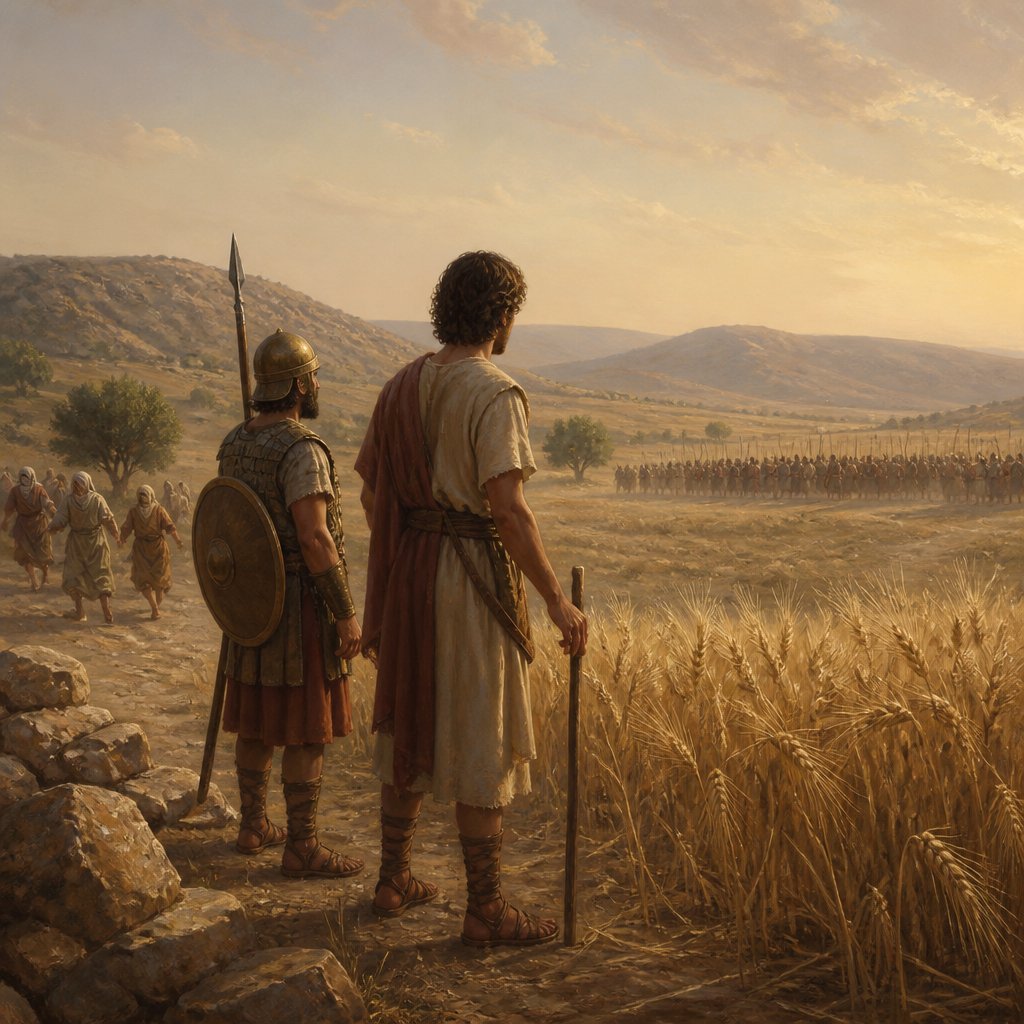
1-chronicles-11:13 (KJV) states: "He was with David at Pasdammim, and there the Philistines were gathered together to battle, where was a parcel of ground full of barley; and the people fled from before the Philistines."
This verse is a part of the Old Testament and is from the book of 1 Chronicles, which is a historical narrative of the people of Israel. The verse is situated in a section that describes the mighty men who served King David. In this particular verse, the focus is on a man who stood with David, as they faced the Philistines in battle at Pasdammim.
To fully understand the significance of this verse, it's important to consider the broader context in which it appears. King David, one of the most revered figures in the Bible, is known for his bravery and military prowess. The men who served under him, often referred to as "David's mighty men," were renowned for their loyalty, courage, and exceptional skills in battle. The passage in which 1 Chronicles 11:13 appears specifically highlights the acts of these extraordinary warriors.
It's also significant to note the historical context in which this verse is situated. The Philistines were a constant threat to the Israelites during this time, and battles between the two groups were common. The mention of the Philistines in this verse underscores the ongoing struggle for power and territory in the region.
The verse itself provides a vivid picture of the setting in which the battle took place. It mentions a parcel of ground full of barley, which serves to emphasize the agricultural nature of the land. This detail not only sets the scene but also underscores the importance of the battle, as it took place in an area vital for sustenance and survival.
The mention of the people fleeing from before the Philistines conveys the intense fear and threat that the enemy posed. Despite the overwhelming nature of the situation, the man mentioned in the verse stood alongside David, reflecting his unwavering loyalty and courage in the face of danger.
Symbolically, this verse can be seen as a representation of steadfastness and bravery in the midst of adversity. The man mentioned in the verse exemplifies the qualities of a true warrior – he does not waver in the face of danger but stands firm with his leader, even when others are fleeing. This unwavering commitment and courage are qualities that are highly valued in the biblical narrative.
Thematically, this verse ties into broader biblical themes of faithfulness, loyalty, and the enduring struggle between good and evil. It highlights the importance of standing strong in the face of opposition and the valor of those who remain steadfast in their convictions.
In conclusion, 1 Chronicles 11:13 is a powerful and evocative verse that captures a moment of intense conflict and the unwavering courage of a man standing alongside King David. It serves to underscore the larger themes of loyalty and bravery that are woven throughout the biblical narrative and provides a poignant example of the strength and resilience required in the face of adversity.
Get our apps


Artwork for 1 Chronicles 11:13

1 Chronicles 11:13 - "He was with David at Pas-dammim, and there the Philistines were gathered together to battle, where was a parcel of ground full of barley; and the people fled from before the Philistines."
"He was with David at Pas-dammim, and there the Philistines were gathered together to battle, where was a parcel of ground full of barley; and the people fled from before the Philistines." - 1 Chronicles 11:13

1 Chronicles 13:11 - "And David was displeased, because the LORD had made a breach upon Uzza: wherefore that place is called Perez-uzza to this day."

2 Chronicles 11:13 - "¶ And the priests and the Levites that were in all Israel resorted to him out of all their coasts."

1 kings 11:11-13

1 Kings 11:11-13

1 Kings 11:11-13

1 Chronicles 1:13 - "And Canaan begat Zidon his firstborn, and Heth,"

1 Chronicles 1:11 - "And Mizraim begat Ludim, and Anamim, and Lehabim, and Naphtuhim,"

1 Chronicles 13:1 - "And David consulted with the captains of thousands and hundreds, and with every leader."

Nehemiah 11:13

1 Chronicles 24:13 - "The thirteenth to Huppah, the fourteenth to Jeshebeab,"

1 Chronicles 12:13 - "Jeremiah the tenth, Machbanai the eleventh."

1 Chronicles 11:29 - "Sibbecai the Hushathite, Ilai the Ahohite,"

1 Chronicles 12:11 - "Attai the sixth, Eliel the seventh,"

1 Chronicles 11:40 - "Ira the Ithrite, Gareb the Ithrite,"

1 Chronicles 24:11 - "The ninth to Jeshua, the tenth to Shecaniah,"

1 Chronicles 11:27 - "Shammoth the Harorite, Helez the Pelonite,"

1 Chronicles 11:36 - "Hepher the Mecherathite, Ahijah the Pelonite,"

1 Chronicles 11:47 - "Eliel, and Obed, and Jasiel the Mesobaite."

1 Chronicles 11:33 - "Azmaveth the Baharumite, Eliahba the Shaalbonite,"

1 Chronicles 8:11 - "And of Hushim he begat Abitub, and Elpaal."

1 Chronicles 11:43 - "Hanan the son of Maachah, and Joshaphat the Mithnite,"
1 Samuel 13:11

1 Chronicles 11:32 - "Hurai of the brooks of Gaash, Abiel the Arbathite,"

1 Chronicles 11:41 - "Uriah the Hittite, Zabad the son of Ahlai,"

1 Chronicles 11:37 - "Hezro the Carmelite, Naarai the son of Ezbai,"

1 Kings 11:13

1 Kings 11:13

1 Chronicles 6:13 - "And Shallum begat Hilkiah, and Hilkiah begat Azariah,"