What does 1 Chronicles 11:20 mean?
"¶ And Abishai the brother of Joab, he was chief of the three: for lifting up his spear against three hundred, he slew them, and had a name among the three." - 1 Chronicles 11:20
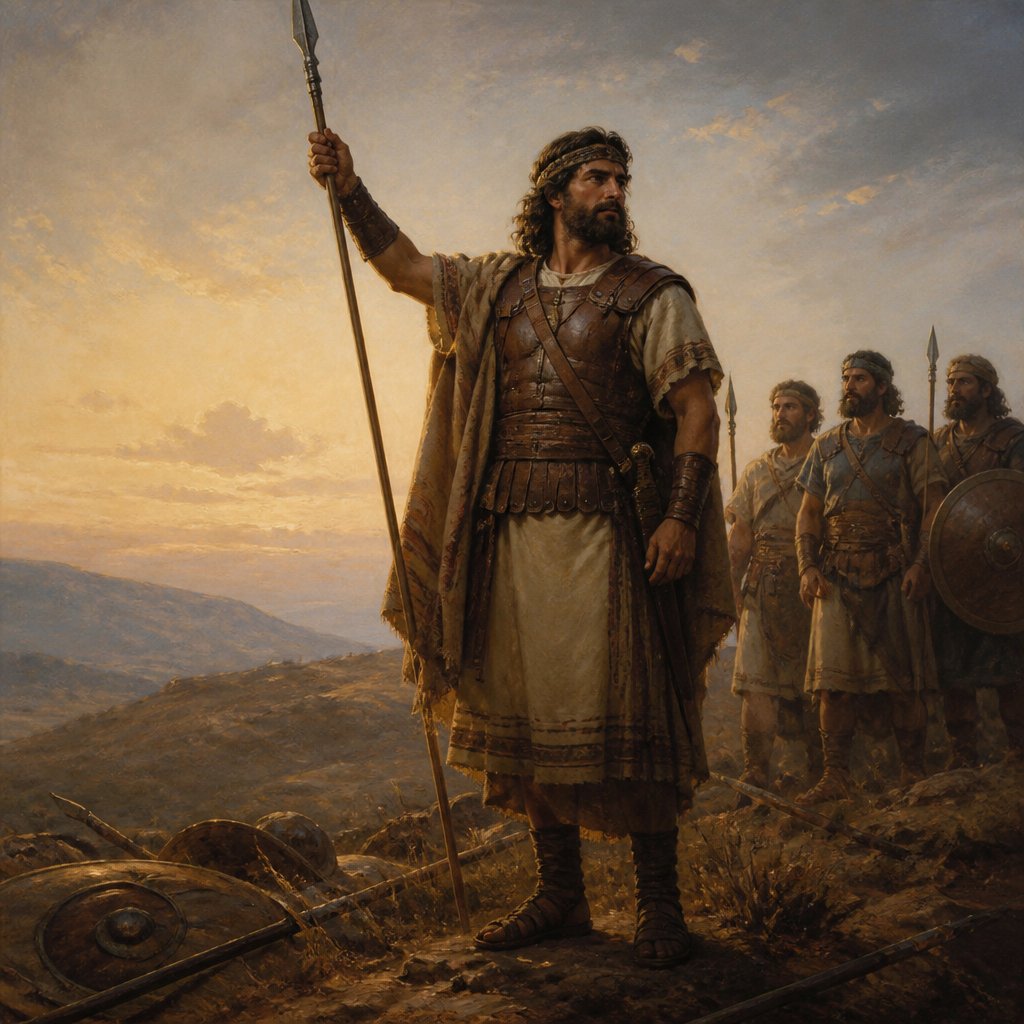
1 Chronicles 11:20 (KJV) - "And Abishai the brother of Joab, he was chief of the three: for lifting up his spear against three hundred, he slew them, and had a name among the three."
The book of 1 Chronicles, which is believed to have been written by the prophet Ezra, is a historical account of the genealogy of the Israelites, from the earliest times to the Babylonian exile. In particular, chapters 11 and 12 focus on the establishment of King David's monarchy and highlight the exploits of his mighty men, who were valiant warriors that served alongside David.
In this verse, the focus is on Abishai, the brother of Joab, who is credited as being one of the "chief of the three." This is significant because it showcases Abishai's exceptional prowess as a warrior. It is important to note that Abishai is not acting alone, but rather he is part of an elite group of three mighty warriors, who are highly esteemed in David's army.
The verse goes on to recount a specific feat of Abishai's bravery in battle, noting that he lifted up his spear against three hundred soldiers and single-handedly slew them. This display of incredible strength and skill in combat earned Abishai a prominent reputation among the three mighty men, solidifying his place as one of the most esteemed warriors in David's army.
The theme of courage and bravery in the face of overwhelming odds is central to this verse. Abishai's courageous act of taking on a large number of enemies and emerging victorious speaks to the unwavering faith and determination that characterized David's mighty men. Their willingness to confront seemingly insurmountable challenges demonstrates their complete trust in the Lord's provision and their commitment to serving Him wholeheartedly.
Furthermore, the verse emphasizes the importance of individual excellence and leadership within the context of a larger group. While Abishai is recognized as one of the three chief warriors, he is still part of a larger army led by King David. This highlights the importance of both individual skill and teamwork in achieving victory on the battlefield. Abishai's actions demonstrate the impact that one person's bravery and skill can have within a larger collective, inspiring others to similarly rise to the occasion.
The symbolism of Abishai's spear serves as a representation of his strength and prowess as a warrior. In ancient warfare, the spear was a versatile and deadly weapon, and Abishai's ability to wield it effectively against overwhelming odds speaks to his exceptional proficiency in combat. Additionally, the spear can also symbolize courage and protection, as it was used to defend oneself and others in battle.
In a broader sense, the verse can also be seen as a testament to the power of faith and God's assistance in the face of adversity. Despite facing a daunting challenge, Abishai's unwavering trust in the Lord enabled him to achieve a remarkable victory. This serves as a reminder of the Lord's faithfulness in equipping his servants with the strength and skill needed to overcome all obstacles.
Overall, 1 Chronicles 11:20 highlights the valor and prowess of Abishai, one of David's mighty men, and underscores the themes of courage, leadership, and faith that are integral to the narrative of King David's monarchy. It serves as a poignant reminder of the impact that individual bravery and skill can have within the context of a larger collective, and the enduring faith in the Lord's provision that sustained God's chosen people throughout their history.
Have questions about 1 Chronicles 11:20?
Dive deeper into this scripture with Bible Chat — an AI-powered tool for exploring God's Word through conversation. Ask questions, get context, and grow in your understanding of the Bible.
Get Our Apps


1 Chronicles 11:20 Artwork

1 Chronicles 11:20 - "¶ And Abishai the brother of Joab, he was chief of the three: for lifting up his spear against three hundred, he slew them, and had a name among the three."
"¶ And Abishai the brother of Joab, he was chief of the three: for lifting up his spear against three hundred, he slew them, and had a name among the three." - 1 Chronicles 11:20

2 Chronicles 11:20

1 Chronicles 1:20 - "And Joktan begat Almodad, and Sheleph, and Hazarmaveth, and Jerah,"

1 Chronicles 8:20 - "And Elienai, and Zilthai, and Eliel,"

Acts 20:11

2 Chronicles 11:20 - "And after her he took Maachah the daughter of Absalom; which bare him Abijah, and Attai, and Ziza, and Shelomith."

1 Chronicles 1:11 - "And Mizraim begat Ludim, and Anamim, and Lehabim, and Naphtuhim,"

1 Chronicles 23:20 - "Of the sons of Uzziel; Michah the first, and Jesiah the second."

1 Chronicles 2:20 - "And Hur begat Uri, and Uri begat Bezaleel."

1 Chronicles 11:29 - "Sibbecai the Hushathite, Ilai the Ahohite,"

1 Chronicles 12:11 - "Attai the sixth, Eliel the seventh,"

1 Chronicles 11:40 - "Ira the Ithrite, Gareb the Ithrite,"

1 Chronicles 24:11 - "The ninth to Jeshua, the tenth to Shecaniah,"

1 Chronicles 11:27 - "Shammoth the Harorite, Helez the Pelonite,"

1 Chronicles 11:36 - "Hepher the Mecherathite, Ahijah the Pelonite,"

1 Chronicles 3:20 - "And Hashubah, and Ohel, and Berechiah, and Hasadiah, Jushab-hesed, five."

1 Chronicles 11:47 - "Eliel, and Obed, and Jasiel the Mesobaite."

1 Chronicles 11:33 - "Azmaveth the Baharumite, Eliahba the Shaalbonite,"

1 Chronicles 8:11 - "And of Hushim he begat Abitub, and Elpaal."

1 Chronicles 11:43 - "Hanan the son of Maachah, and Joshaphat the Mithnite,"

2 Chronicles 20:11 - "Behold, I say, how they reward us, to come to cast us out of thy possession, which thou hast given us to inherit."

1 Chronicles 11:32 - "Hurai of the brooks of Gaash, Abiel the Arbathite,"

1 Chronicles 11:41 - "Uriah the Hittite, Zabad the son of Ahlai,"

1 Chronicles 11:37 - "Hezro the Carmelite, Naarai the son of Ezbai,"

1 Chronicles 6:11 - "And Azariah begat Amariah, and Amariah begat Ahitub,"

1 Chronicles 11:30 - "Maharai the Netophathite, Heled the son of Baanah the Netophathite,"

1 Chronicles 2:11 - "And Nahshon begat Salma, and Salma begat Boaz,"

1 Chronicles 25:20 - "The thirteenth to Shubael, he, his sons, and his brethren, were twelve:"

"And Elienai, and Zilthai, and Eliel," - 1 Chronicles 8:20