What does 1 Chronicles 18:4 mean?
“And David took from him a thousand chariots, and seven thousand horsemen, and twenty thousand footmen: David also houghed all the chariot horses, but reserved of them an hundred chariots.” — 1 Chronicles 18:4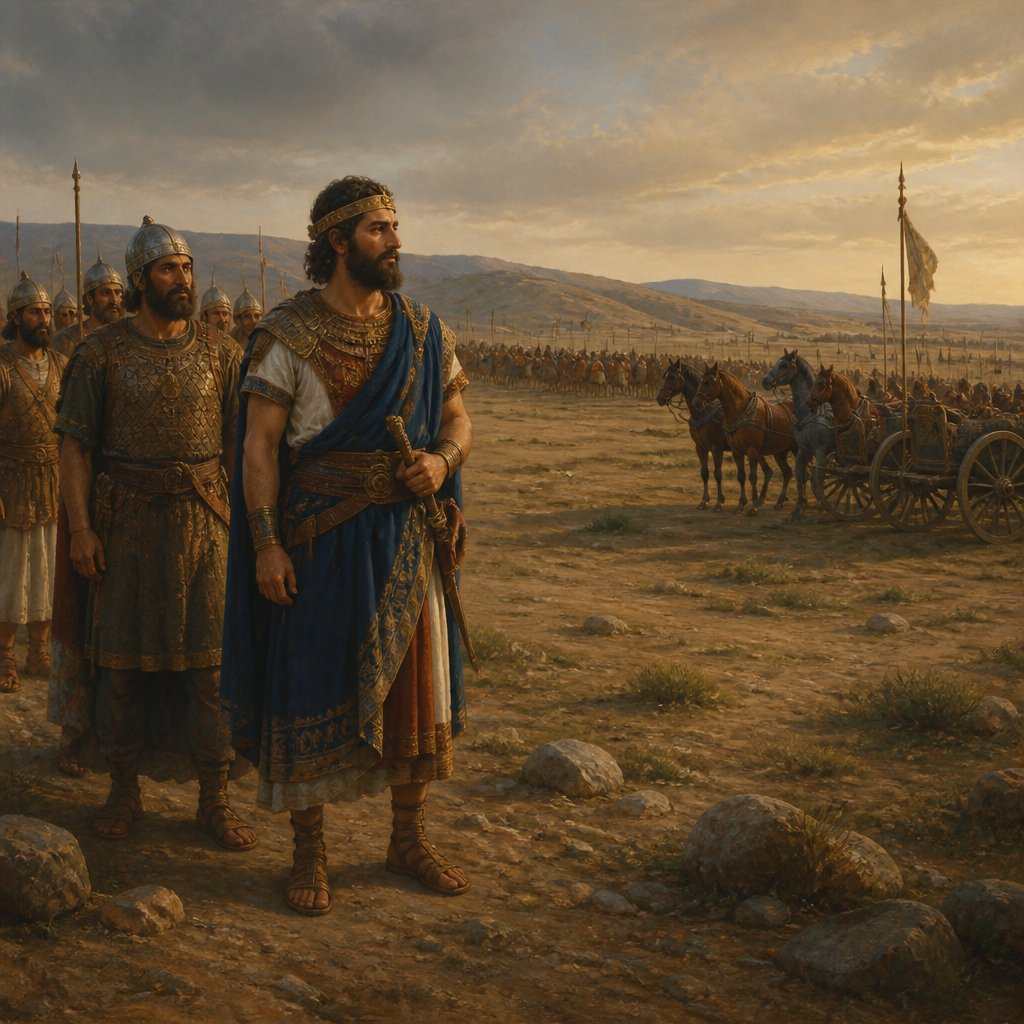
1 Chronicles 18:4 (KJV): "And David took from him a thousand chariots, and seven thousand horsemen, and twenty thousand footmen: David also houghed all the chariot horses, but reserved of them an hundred chariots."
The book of 1 Chronicles, written by Ezra, details the history of the Israelites, focusing on the reign of King David. This particular verse comes from a passage where David has achieved great military success and conquest. He has defeated the Philistines, Moabites, Ammonites, Edomites, and the king of Zobah. In the verse, David is described as having taken 1,000 chariots, 7,000 horsemen, and 20,000 footmen from his enemies, and he also houghed (hamstrung) the chariot horses, reserving only 100 chariots.
At first glance, this verse may seem to simply be a historical account of military victories. However, when the verse is examined within its broader context and its significance within the narrative of 1 Chronicles, several important themes and messages emerge.
One of the key themes highlighted in this verse is the idea of God's power and providence. Throughout the book of 1 Chronicles, we see that David's success in battle is attributed to the Lord's help and guidance. In the preceding verses, it is mentioned that "the Lord preserved David withersoever he went" (1 Chronicles 18:6, KJV). This highlights the belief that David's victories were not solely due to his own military prowess, but rather were a result of God's favor and intervention. This serves to reinforce the idea that the Israelites were a chosen people and that their success in battle was ultimately due to their relationship with God.
Another important theme that can be gleaned from this verse is the idea of David as a powerful and successful leader. The large numbers of chariots, horsemen, and footmen mentioned in the verse indicate the extent of David's military strength and the scope of his conquests. This serves to highlight David's status as a formidable and triumphant ruler, and it helps to establish his legacy and authority as the King of Israel. Additionally, the act of houghing the chariot horses symbolizes David's strategic foresight and his desire to weaken the military capabilities of his enemies.
Furthermore, this verse serves as a reflection of the military culture and practices of the ancient Near East. The mention of chariots, horsemen, and footmen reflects the typical composition of ancient armies, and the act of houghing the chariot horses was a common practice in warfare to disable enemy forces and prevent their future use in battle. This verse provides insight into the tactics and strategies employed by ancient military leaders, and it demonstrates David's understanding of and ability to effectively neutralize his opponents.
Symbolically, the prevalence of chariots, horsemen, and footmen in this verse may also represent the various threats and challenges that David faced as a leader. The mention of these different types of military units serves as a reminder of the diverse and numerous adversaries that David had to overcome in order to secure his kingdom and establish his reign. Additionally, the act of houghing the chariot horses may symbolize David's determination to ensure the long-term security and stability of his kingdom by weakening the military strength of his enemies.
Overall, 1 Chronicles 18:4 provides valuable insight into the themes of divine providence, leadership, military culture, and strategic warfare within the context of ancient Israel. This verse serves as a testament to David's military victories and his role as a powerful and successful king, while also conveying important messages about the significance of God's assistance and the challenges inherent in leading a nation.
Get our apps


Artwork for 1 Chronicles 18:4

1 Chronicles 18:4 - "And David took from him a thousand chariots, and seven thousand horsemen, and twenty thousand footmen: David also houghed all the chariot horses, but reserved of them an hundred chariots."
"And David took from him a thousand chariots, and seven thousand horsemen, and twenty thousand footmen: David also houghed all the chariot horses, but reserved of them an hundred chariots." - 1 Chronicles 18:4

1 Chronicles 4:18 - "And his wife Jehudijah bare Jered the father of Gedor, and Heber the father of Socho, and Jekuthiel the father of Zanoah. And these are the sons of Bithiah the daughter of Pharaoh, which Mered took."

2 Chronicles 18:4 - "¶ And Jehoshaphat said unto the king of Israel, Enquire, I pray thee, at the word of the LORD to day."

1 Chronicles 1:18 - "And Arphaxad begat Shelah, and Shelah begat Eber."

1 Chronicles 23:18 - "Of the sons of Izhar; Shelomith the chief."

2 Chronicles 4:18 - "Thus Solomon made all these vessels in great abundance: for the weight of the brass could not be found out."

1 Chronicles 1:4 - "Noah, Shem, Ham, and Japheth."

1 Chronicles 8:18 - "Ishmerai also, and Jezliah, and Jobab, the sons of Elpaal;"

1 Chronicles 24:18 - "The three and twentieth to Delaiah, the four and twentieth to Maaziah."

1 Chronicles 26:18 - "At Parbar westward, four at the causeway, and two at Parbar."

1 Chronicles 3:18 - "Malchiram also, and Pedaiah, and Shenazar, Jecamiah, Hoshama, and Nedabiah."

1 Chronicles 7:18 - "And his sister Hammoleketh bare Ishod, and Abiezer, and Mahalah."

2 Chronicles 4:22

1 Chronicles 6:18 - "And the sons of Kohath were, Amram, and Izhar, and Hebron, and Uzziel."

1 Chronicles 4 : 10
1 Samuel 4:18

1 Chronicles 4:29 - "And at Bilhah, and at Ezem, and at Tolad,"

1 Chronicles 4:30 - "And at Bethuel, and at Hormah, and at Ziklag,"

1 Chronicles 8:4 - "And Abishua, and Naaman, and Ahoah,"

Luke 8:4-18

2 Corinthians 4:18
1 Samuel 4:18

1 Chronicles 4:1 - "The sons of Judah; Pharez, Hezron, and Carmi, and Hur, and Shobal."
1 Samuel 4:18

1 John 4:18

1 John 4:18

1 Chronicles 27:18 - "Of Judah, Elihu, one of the brethren of David: of Issachar, Omri the son of Michael:"

1 Chronicles 25:18 - "The eleventh to Azareel, he, his sons, and his brethren, were twelve:"

2 Chronicles 18:1 - "Now Jehoshaphat had riches and honour in abundance, and joined affinity with Ahab."