What does 1 Chronicles 18:7 mean?
“And David took the shields of gold that were on the servants of Hadarezer, and brought them to Jerusalem.” — 1 Chronicles 18:7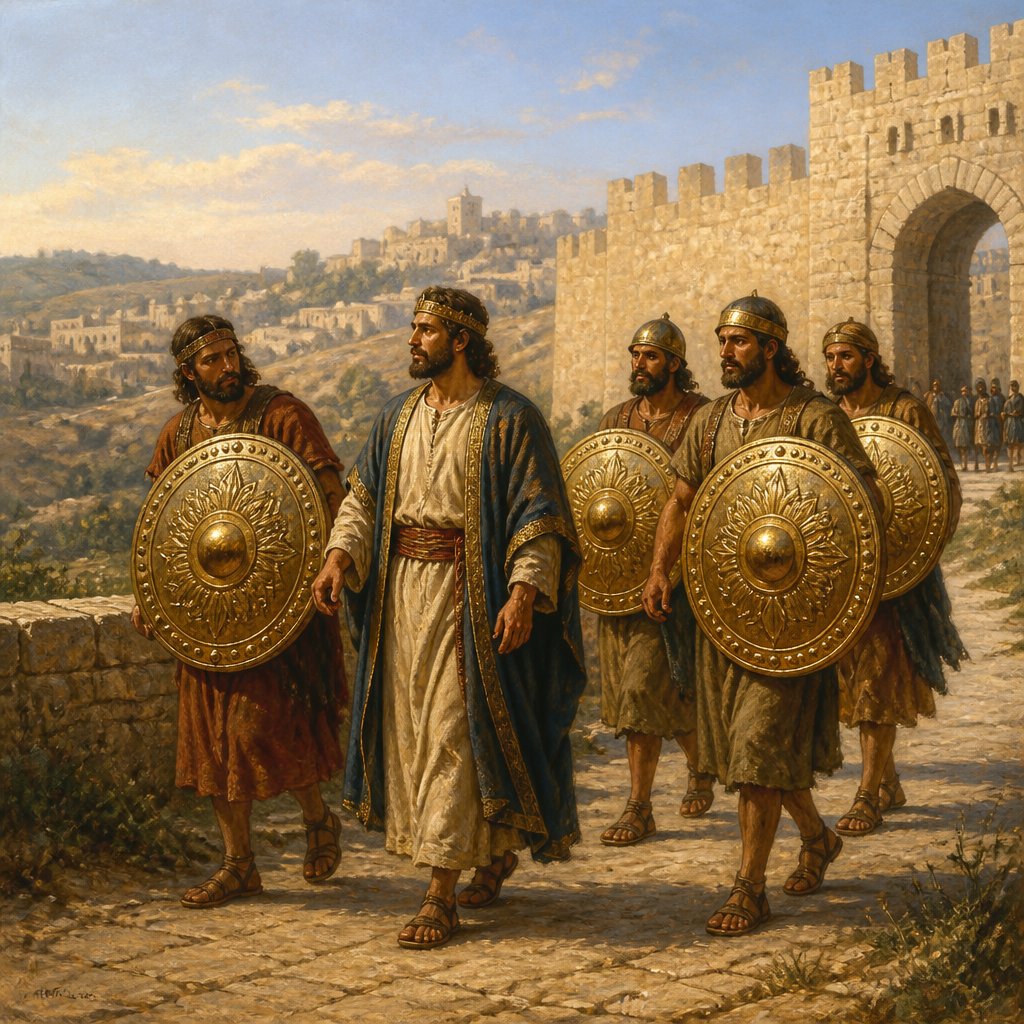
1 Chronicles 18:7 (KJV) states: "And David took the shields of gold that were on the servants of Hadarezer, and brought them to Jerusalem."
This verse is part of a larger passage that describes King David's military victories and the spoils of war that he brought back to Jerusalem. In order to fully understand the significance of this verse, it is important to examine its context within the broader narrative of 1 Chronicles 18.
In the preceding verses, we learn that King David has been successful in his military campaigns against the Philistines, Moabites, and Syrians. These victories have solidified his reign and expanded the territory of Israel. In 1 Chronicles 18:3-6, we read about the plunder that David took from these conquered nations, including chariots, horsemen, and shields. The shields of gold mentioned in verse 7 are a specific example of the valuable spoils that David brought back to Jerusalem.
From a historical perspective, the mention of golden shields in this passage serves as a tangible representation of the wealth and power that David acquired through his military conquests. The inclusion of this detail emphasizes the magnitude of David's victories and the splendor of the treasures that he brought back to the capital city. It also highlights the symbolic significance of Jerusalem as the center of David's kingdom and the repository for the spoils of war.
Symbolically, the shields of gold can be interpreted as a representation of divine protection and favor. In ancient Near Eastern cultures, shields were not only practical weapons of war, but they also held symbolic significance as symbols of strength, security, and divine protection. The fact that David took these shields of gold from the servants of Hadarezer and brought them to Jerusalem underscores the idea that God was with him in battle, granting him victory and bestowing upon him the spoils of war.
Furthermore, the act of bringing these golden shields to Jerusalem can be seen as an offering or tribute to God. By bringing these valuable items to the capital city, David is not only showcasing his military triumphs, but he is also acknowledging the role of God in granting him success. This act of bringing the spoils of war to Jerusalem aligns with the broader theme of David's desire to honor and glorify God through his reign as king.
In a broader theological sense, this passage can also be interpreted as a foreshadowing of the greater spiritual battles and victories that are recounted throughout the Bible. The imagery of shields and military conquests can be seen as a metaphor for the ongoing spiritual warfare that believers face, and the ultimate triumph that is achieved through faith in God.
In conclusion, 1 Chronicles 18:7 is a verse that holds both historical and symbolic significance within the broader narrative of King David's military victories. It serves as a reminder of the wealth and power that David acquired through his conquests, as well as a symbol of divine protection and favor. Additionally, it underscores the theme of honoring God and giving thanks for His role in granting victory. This verse can serve as a source of encouragement and inspiration for believers as they navigate their own spiritual battles, trusting in God's ultimate triumph.
Get our apps


Artwork for 1 Chronicles 18:7

1 Chronicles 18:7 - "And David took the shields of gold that were on the servants of Hadarezer, and brought them to Jerusalem."
"And David took the shields of gold that were on the servants of Hadarezer, and brought them to Jerusalem." - 1 Chronicles 18:7

1 Chronicles 7:18 - "And his sister Hammoleketh bare Ishod, and Abiezer, and Mahalah."
"And his sister Hammoleketh bare Ishod, and Abiezer, and Mahalah." - 1 Chronicles 7:18

1 Chronicles 1:18 - "And Arphaxad begat Shelah, and Shelah begat Eber."

1 Chronicles 23:18 - "Of the sons of Izhar; Shelomith the chief."

1 Chronicles 8:18 - "Ishmerai also, and Jezliah, and Jobab, the sons of Elpaal;"

1 Chronicles 1:7 - "And the sons of Javan; Elishah, and Tarshish, Kittim, and Dodanim."

1 Chronicles 24:18 - "The three and twentieth to Delaiah, the four and twentieth to Maaziah."

1 Chronicles 26:18 - "At Parbar westward, four at the causeway, and two at Parbar."

1 Chronicles 14:7 - "And Elishama, and Beeliada, and Eliphalet."

1 Chronicles 3:7 - "And Nogah, and Nepheg, and Japhia,"

1 Chronicles 3:18 - "Malchiram also, and Pedaiah, and Shenazar, Jecamiah, Hoshama, and Nedabiah."

1 Chronicles 6:18 - "And the sons of Kohath were, Amram, and Izhar, and Hebron, and Uzziel."

1 Chronicles 23:7 - "¶ Of the Gershonites were, Laadan, and Shimei."

1 Chronicles 7:39 - "And the sons of Ulla; Arah, and Haniel, and Rezia."

1 Chronicles 7:38 - "And the sons of Jether; Jephunneh, and Pispah, and Ara."

1 Chronicles 12:7 - "And Joelah, and Zebadiah, the sons of Jeroham of Gedor."

1 Chronicles 7:1 - "Now the sons of Issachar were, Tola, and Puah, Jashub, and Shimron, four."

1 Chronicles 27:18 - "Of Judah, Elihu, one of the brethren of David: of Issachar, Omri the son of Michael:"

1 Chronicles 25:18 - "The eleventh to Azareel, he, his sons, and his brethren, were twelve:"

2 Chronicles 18:1 - "Now Jehoshaphat had riches and honour in abundance, and joined affinity with Ahab."

1 Chronicles 18:2 - "And he smote Moab; and the Moabites became David's servants, and brought gifts."

1 Chronicles 18:15 - "And Joab the son of Zeruiah was over the host; and Jehoshaphat the son of Ahilud, recorder."

1 Chronicles 7:6 - "¶ The sons of Benjamin; Bela, and Becher, and Jediael, three."

1 Chronicles 7:34 - "And the sons of Shamer; Ahi, and Rohgah, Jehubbah, and Aram."

1 Chronicles 4:7 - "And the sons of Helah were, Zereth, and Jezoar, and Ethnan."

1 Chronicles 6:7 - "Meraioth begat Amariah, and Amariah begat Ahitub,"

2 Chronicles 7:18 - "Then will I stablish the throne of thy kingdom, according as I have covenanted with David thy father, saying, There shall not fail thee a man to be ruler in Israel."

1 Chronicles 18:16 - "And Zadok the son of Ahitub, and Abimelech the son of Abiathar, were the priests; and Shavsha was scribe;"