What does 1 Chronicles 29:28 mean?
“And he died in a good old age, full of days, riches, and honour: and Solomon his son reigned in his stead.” — 1 Chronicles 29:28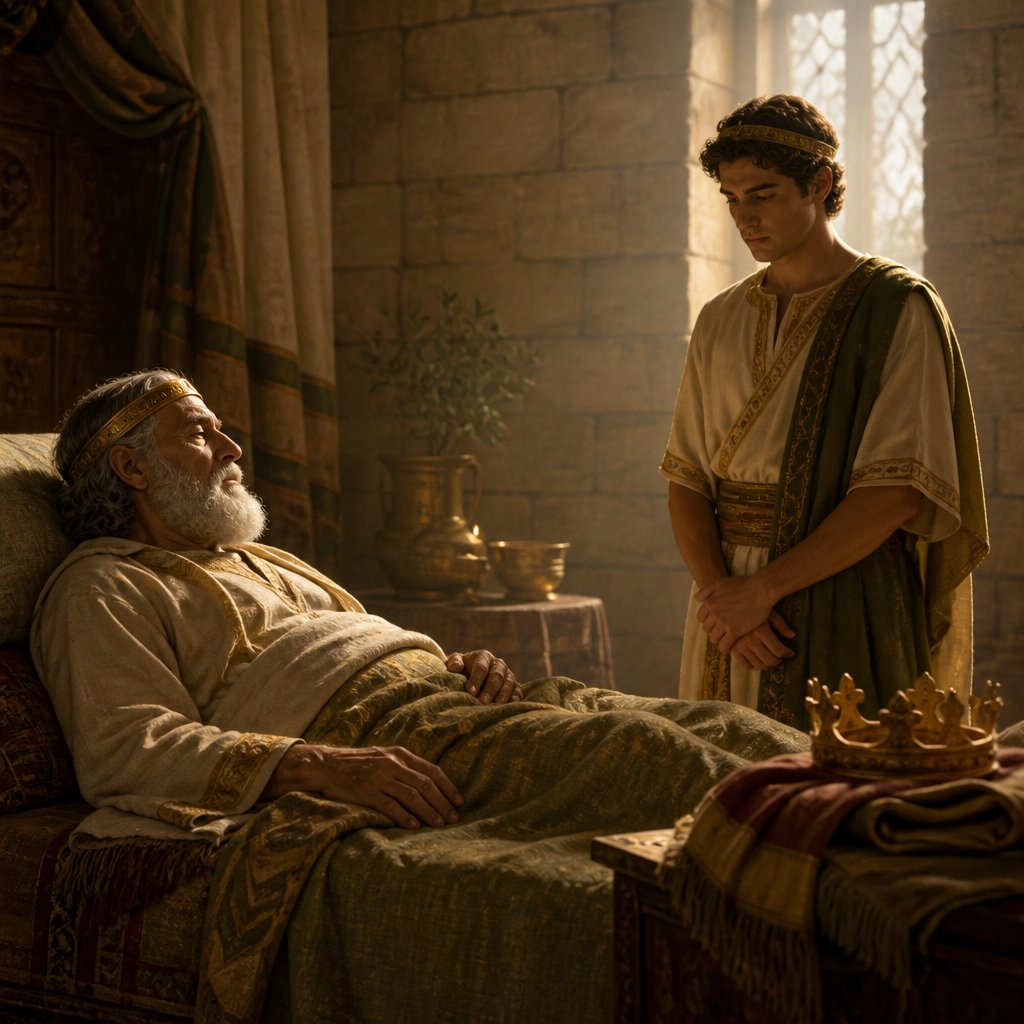
The verse 1 Chronicles 29:28 in the King James Version of the Bible reads, "And he died in a good old age, full of days, riches, and honour: and Solomon his son reigned in his stead."
This verse is a concise description of the end of King David's life and the transition of power to his son, Solomon. The verse highlights a few key themes such as the concept of a "good old age," the accumulation of wealth and honor, and the passing of leadership from one generation to the next. It also provides an important context for the reign of Solomon and the legacy of King David.
The phrase "good old age" is significant because it emphasizes the idea of a life well-lived and the blessings of long life. In the context of ancient Israel, reaching old age was often seen as a sign of God's favor and a reward for righteous living. This idea is echoed in other verses throughout the Bible, such as Psalm 91:16 which says, "With long life will I satisfy him and show him my salvation." Therefore, when David is said to have died in a good old age, it reflects the belief that he had lived a life pleasing to God and had been rewarded with a long and fulfilling existence.
The mention of "riches and honour" further underscores the idea of God's favor and blessings. David, who started out as a shepherd boy, had risen to become the king of Israel and had amassed great wealth and power. Throughout his reign, he had enjoyed numerous military victories, expanded the territory of Israel, and had established Jerusalem as its capital. All of these accomplishments had brought him immense honor and riches, which again were seen as a sign of divine favor. This theme of God's provision and the rewards of righteousness is a recurring motif in the Old Testament, and it serves to underscore the importance of faithfulness and obedience.
The verse then proceeds to note that "Solomon his son reigned in his stead," signifying the passing of leadership from David to his successor. This transition of power is a crucial moment in the history of Israel, as it marks the beginning of Solomon's reign, which is characterized by peace, prosperity, and the construction of the Temple in Jerusalem. It also reflects the broader theme of generational succession, where one leader gives way to the next, ensuring the continuity and stability of the nation. This theme is also reflected in other parts of the Bible, such as the transfer of authority from Moses to Joshua and from Elijah to Elisha, highlighting the importance of a smooth and orderly transfer of power.
Symbolically, this verse can also be interpreted as a reflection of the broader human experience. It portrays the natural progression of life, from the vigor of youth to the wisdom of old age and the passing of the baton to the next generation. It reminds the reader of the cyclical nature of existence, where each generation builds upon the accomplishments of the one before, laying the foundation for the future.
In conclusion, 1 Chronicles 29:28 encapsulates the themes of a life well-lived, the blessings of God, and the passing of leadership. It provides important context for understanding the reign of Solomon and the legacy of King David. Moreover, it offers deeper insights into the broader human experience and the cyclical nature of life. Through its concise and poignant language, the verse resonates with readers across generations, imparting timeless wisdom and lessons for living a fulfilling and God-honoring life.
Get our apps


Artwork for 1 Chronicles 29:28

1 Chronicles 29:28 - "And he died in a good old age, full of days, riches, and honour: and Solomon his son reigned in his stead."
"And he died in a good old age, full of days, riches, and honour: and Solomon his son reigned in his stead." - 1 Chronicles 29:28

2 Chronicles 29:28 - "And all the congregation worshipped, and the singers sang, and the trumpeters sounded: and all this continued until the burnt offering was finished."

Exodus 23:28-29

1 Chronicles 1:28 - "The sons of Abraham; Isaac, and Ishmael."

1 Chronicles 4:29 - "And at Bilhah, and at Ezem, and at Tolad,"

1 Chronicles 1:29 - "¶ These are their generations: The firstborn of Ishmael, Nebaioth; then Kedar, and Adbeel, and Mibsam,"

1 Chronicles 11:29 - "Sibbecai the Hushathite, Ilai the Ahohite,"

1 Chronicles 24:29 - "Concerning Kish: the son of Kish was Jerahmeel."

1 Chronicles 6:28 - "And the sons of Samuel; the firstborn Vashni, and Abiah."

1 Chronicles 4:28 - "And they dwelt at Beer-sheba, and Moladah, and Hazar-shual,"

1 Chronicles 24:28 - "Of Mahli came Eleazar, who had no sons."

1 Chronicles 11:28 - "Ira the son of Ikkesh the Tekoite, Abiezer the Antothite,"

1 Chronicles 29:29 - "Now the acts of David the king, first and last, behold, they are written in the book of Samuel the seer, and in the book of Nathan the prophet, and in the book of Gad the seer,"

1 Chronicles 29:26 - "¶ Thus David the son of Jesse reigned over all Israel."

1 Chronicles 8:29 - "And at Gibeon dwelt the father of Gibeon; whose wife's name was Maachah:"

"The sons of Abraham; Isaac, and Ishmael." - 1 Chronicles 1:28

"And at Bilhah, and at Ezem, and at Tolad," - 1 Chronicles 4:29

1 Chronicles 2:29 - "And the name of the wife of Abishur was Abihail, and she bare him Ahban, and Molid."

1 Chronicles 8:28 - "These were heads of the fathers, by their generations, chief men. These dwelt in Jerusalem."

1 Corinthians 1:28-29 - "God chose what is low and despised in the world, even things that are not, to bring to nothing things that are, so that no human being might boast in the presence of God."

1 Chronicles 25:29 - "The two and twentieth to Giddalti, he, his sons, and his brethren, were twelve:"

1 Chronicles 2:28 - "And the sons of Onam were, Shammai, and Jada. And the sons of Shammai; Nadab, and Abishur."

1 Chronicles 16:29 – "Ascribe to the Lord the glory due his name; bring an offering and come before him."

1 Chronicles 29:13 - "Now therefore, our God, we thank thee, and praise thy glorious name."

1 Chronicles 26:29 - "¶ Of the Izharites, Chenaniah and his sons were for the outward business over Israel, for officers and judges."

1 Chronicles 25:28 - "The one and twentieth to Hothir, he, his sons, and his brethren, were twelve:"

"Sibbecai the Hushathite, Ilai the Ahohite," - 1 Chronicles 11:29

1 Chronicles 6:29 - "The sons of Merari; Mahli, Libni his son, Shimei his son, Uzza his son,"

1 Kings 14:29 - "¶ Now the rest of the acts of Rehoboam, and all that he did, are they not written in the book of the chronicles of the kings of Judah?"