What does 1 Chronicles 2:55 mean?
“And the families of the scribes which dwelt at Jabez; the Tirathites, the Shimeathites, and Suchathites. These are the Kenites that came of Hemath, the father of the house of Rechab.” — 1 Chronicles 2:55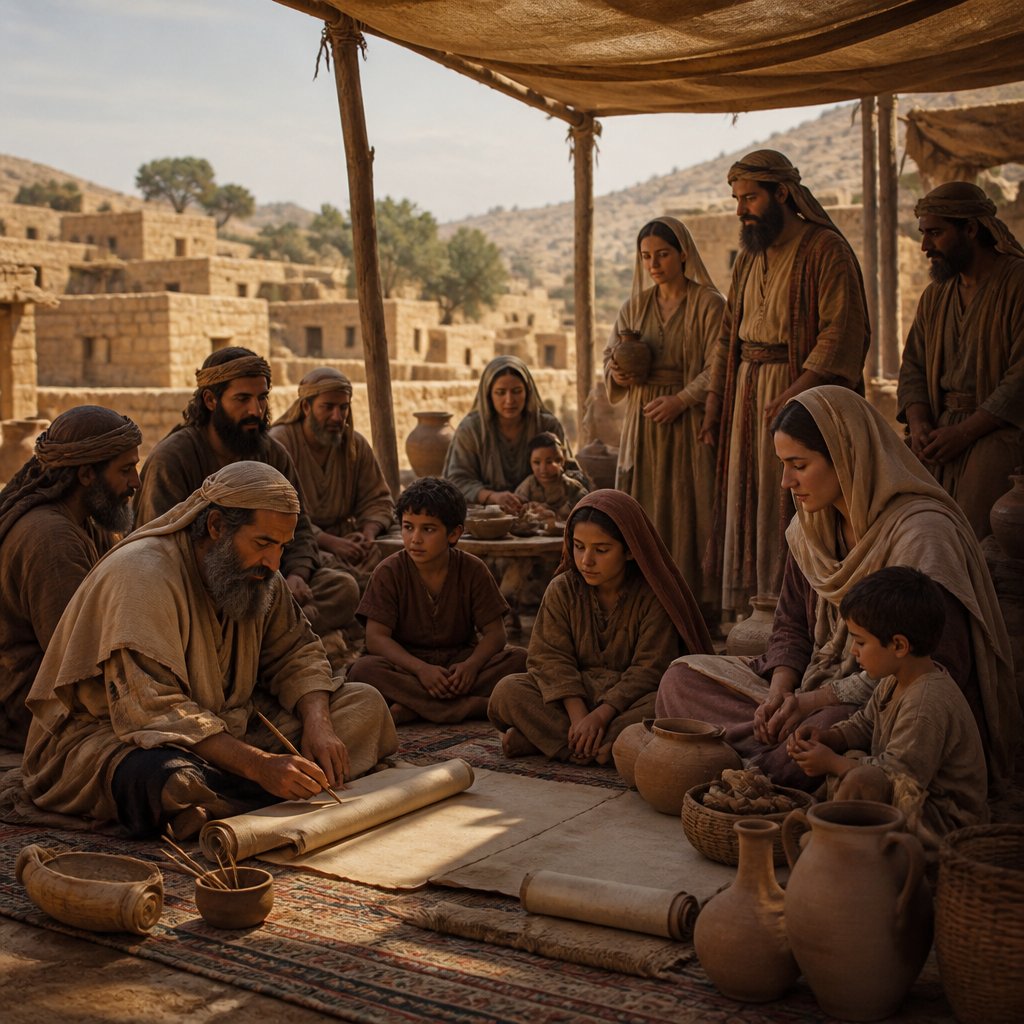
The verse 1 Chronicles 2:55 from the King James Version of the Bible reads: "And the families of the scribes which dwelt at Jabez; the Tirathites, the Shimeathites, and Suchathites. These are the Kenites that came of Hemath, the father of the house of Rechab."
This particular verse is part of a genealogical record found in the first book of Chronicles, which is a detailed account of the genealogy of the tribes of Israel. This verse specifically mentions the families of the scribes who lived in the town of Jabez, and it provides some information as to their ancestral lineage and heritage. To understand the full context and deeper meaning of this verse, it is important to look at the broader themes, context, and symbolism present within the book of Chronicles and the greater biblical narrative.
The book of 1 Chronicles is primarily concerned with tracing the lineage of the Israelite tribes, particularly the twelve sons of Jacob who became the heads of the twelve tribes of Israel. It seeks to establish the continuity and legitimacy of the Davidic monarchy and to provide a historical and genealogical foundation for the people of Israel. Genealogy was of great importance in ancient Israel as it established one's heritage, tribal affiliations, and inheritance rights. It also served to connect the present generation with their ancestors and with the promises and covenants made by God.
In the broader context of the Bible, genealogical records are also significant in establishing the lineage of Jesus Christ, who was believed to be the long-awaited Messiah and the fulfillment of Old Testament prophecies. The genealogy of Jesus is traced back to King David and ultimately to Adam, emphasizing his royal and divine lineage as well as his connection to the whole human race. Therefore, the mention of the families of the scribes in 1 Chronicles 2:55 has implications for understanding the lineage and heritage of the people of Israel, as well as their ultimate connection to the promised Messiah.
In terms of symbolism, the presence of the scribes in the town of Jabez signifies the importance of literacy, education, and record-keeping within ancient Israel. The scribes were responsible for preserving and maintaining the written records, laws, and traditions of the people. Their role was crucial in the transmission of religious and cultural knowledge from one generation to the next. The fact that these families of scribes are specifically mentioned in the genealogical record indicates their significance in the overall narrative of Israel's history and heritage.
The mention of the Kenites who came from Hemath, the father of the house of Rechab, also holds symbolic and historical significance. The Kenites were a nomadic tribe associated with the Midianites and were known for their skills in metalworking and their alliance with the Israelites. The house of Rechab, on the other hand, was a clan known for their strict adherence to a vow of asceticism, abstaining from wine, living in tents, and refusing to own land or engage in agricultural pursuits. Their commitment to this vow was commended by the Lord through the prophet Jeremiah (Jeremiah 35:18-19).
In conclusion, 1 Chronicles 2:55, like other genealogical records in the Bible, serves to establish the historical, cultural, and spiritual heritage of the people of Israel. It underscores the importance of lineage, ancestry, and tribal affiliations in understanding God's covenantal relationship with his people. It also highlights the significance of literacy, record-keeping, and the transmission of knowledge through the scribes. Furthermore, the mention of the Kenites and the house of Rechab adds another layer of complexity to the narrative, emphasizing the diversity and uniqueness of the various tribes and clans within Israel. Overall, this verse contributes to the rich tapestry of Israel's history and identity, which ultimately points to the redemptive work of Jesus Christ, the promised Messiah.
Get our apps


Artwork for 1 Chronicles 2:55

1 Chronicles 2:55 - "And the families of the scribes which dwelt at Jabez; the Tirathites, the Shimeathites, and Suchathites. These are the Kenites that came of Hemath, the father of the house of Rechab."
"And the families of the scribes which dwelt at Jabez; the Tirathites, the Shimeathites, and Suchathites. These are the Kenites that came of Hemath, the father of the house of Rechab." - 1 Chronicles 2:55

1 Chronicles 6:55 - "And they gave them Hebron in the land of Judah, and the suburbs thereof round about it."
"And they gave them Hebron in the land of Judah, and the suburbs thereof round about it." - 1 Chronicles 6:55

Isaiah 55:11

Luke 1:54-55

1 Chronicles 2:48 - "Maachah, Caleb's concubine, bare Sheber, and Tirhanah."
Ezra 2:55 - "¶ The children of Solomon's servants: the children of Sotai, the children of Sophereth, the children of Peruda,"

1 Chronicles 2:8 - "And the sons of Ethan; Azariah."

1 Chronicles 2:38 - "And Obed begat Jehu, and Jehu begat Azariah,"

1 Chronicles 2:41 - "And Shallum begat Jekamiah, and Jekamiah begat Elishama."

1 Chronicles 2:36 - "And Attai begat Nathan, and Nathan begat Zabad,"

1 Chronicles 2:11 - "And Nahshon begat Salma, and Salma begat Boaz,"

1 Chronicles 2:39 - "And Azariah begat Helez, and Helez begat Eleasah,"

1 Chronicles 2:15 - "Ozem the sixth, David the seventh:"

1 Chronicles 2:14 - "Nethaneel the fourth, Raddai the fifth,"

1 Chronicles 2:5 - "The sons of Pharez; Hezron, and Hamul."

Luke 1:55 - "As he spake to our fathers, to Abraham, and to his seed for ever."

Psalms 55:1 - "Give ear to my prayer, O God; and hide not thyself from my supplication."

1 Chronicles 1:2 - "Kenan, Mahalaleel, Jered,"

1 Chronicles 2:2 - "Dan, Joseph, and Benjamin, Naphtali, Gad, and Asher."

1 Chronicles 2:20 - "And Hur begat Uri, and Uri begat Bezaleel."

1 Chronicles 2:40 - "And Eleasah begat Sisamai, and Sisamai begat Shallum,"

1 Chronicles 2:37 - "And Zabad begat Ephlal, and Ephlal begat Obed,"

1 Chronicles 2:12 - "And Boaz begat Obed, and Obed begat Jesse,"

Psalms 55:2 - "Attend unto me, and hear me: I mourn in my complaint, and make a noise;"

"And the sons of Ethan; Azariah." - 1 Chronicles 2:8

"Nethaneel the fourth, Raddai the fifth," - 1 Chronicles 2:14

1 Chronicles 5:5 - "Micah his son, Reaia his son, Baal his son,"

1 Kings 8:55 - "And he stood, and blessed all the congregation of Israel with a loud voice, saying,"