What does 1 Corinthians 13:2 mean?
“And though I have the gift of prophecy, and understand all mysteries, and all knowledge; and though I have all faith, so that I could remove mountains, and have not charity, I am nothing.” — 1 Corinthians 13:2
“1 Corinthians 13:2” in the King James Version reads, “And though I have the gift of prophecy, and understand all mysteries, and all knowledge; and though I have all faith, so that I could remove mountains, and have not charity, I am nothing.”
In its setting, this sentence stands in the heart of Paul’s larger teaching to the church at Corinth about spiritual gifts and Christian maturity. The Corinthians were a gifted congregation, but they were also troubled by divisions, rivalry, and a tendency to measure spirituality by dramatic abilities—what a person could do, say, or display. Just before this chapter, Paul discusses diverse gifts given by the Spirit and stresses that the body of Christ has many members with different functions. Immediately after, he will speak again of gifts and their proper use. Between those two discussions he places this chapter as the interpretive center: whatever gifts a believer has, “charity” must govern them, or the gifts lose their true value.
The verse gathers several of the most exalted spiritual capacities a person might claim. “The gift of prophecy” is not merely prediction of future events; in biblical usage it includes speaking God’s truth faithfully, declaring His counsel, and bringing His word to bear on human hearts. It is the kind of gift that could impress a congregation because it sounds authoritative and carries spiritual weight. Paul then intensifies the hypothetical: “and understand all mysteries, and all knowledge.” In Scripture, “mysteries” often refer to truths God must reveal—realities once hidden but made known by His Spirit—rather than puzzles solved by human cleverness. “Knowledge,” especially in Corinth, could easily become a badge of superiority, yet Paul imagines the extremity of it: not some insight, but “all” mysteries and “all” knowledge, the very summit of theological and spiritual comprehension.
He presses further: “and though I have all faith, so that I could remove mountains.” Here Paul draws on the language used by the Lord Jesus Christ about faith and mountains, an image of what is humanly immovable becoming movable by trust in God’s power. The mountain, as symbolism, stands for massive obstacles, impossible circumstances, the kinds of burdens that dominate the landscape of life. To “remove mountains” is to possess a faith that seems to command the impossible. Paul’s point is not that believers should chase spectacle, but that even the most remarkable spiritual confidence and effectiveness—faith that accomplishes what others would call miracles—can exist in a person’s life in a way that still falls short of what God counts as true greatness.
Then comes the decisive contrast: “and have not charity.” In the KJV, “charity” is not a shallow sentiment, and it is not merely almsgiving. It names the God-shaped love that seeks another’s good, that chooses patience, humility, and mercy; the same love Paul will describe in the verses that follow as suffering long, being kind, not envying, not vaunting itself, not being puffed up. In this chapter, charity is the moral and spiritual substance of Christian life, the inward reality that gives outward gifts their right aim. Without charity, gifts can become instruments of self-exaltation, control, or performance; they may still appear impressive, but they no longer reflect the character of Christ or the intent of the Spirit who gives gifts for edification.
The conclusion is stark: “I am nothing.” Paul does not merely say his gifts are less useful or that he has missed an opportunity; he says that without charity, he himself, in terms of true spiritual worth and standing in the purpose of God, amounts to nothing. The language is meant to shock a gift-focused culture into rethinking the measure of spiritual life. The emphasis is personal and existential: it is possible to possess extraordinary abilities and yet, lacking charity, to be spiritually hollow. The verse therefore overturns the assumption that spiritual power or spiritual insight automatically equals spiritual maturity.
In significance, 1 Corinthians 13:2 teaches that love is not an optional ornament added to Christian giftedness but the very essence that makes giftedness meaningful. Prophecy without charity can become harshness dressed as truth. Knowledge without charity can become pride masquerading as wisdom. Faith without charity can become self-assurance that forgets people while chasing outcomes. Charity is the governing reality that aligns truth, power, and understanding with God’s heart. In the economy of the kingdom of God, the greatest spiritual height is not the ability to speak mysteries, master knowledge, or move mountains, but to reflect the love that “never faileth.”
Get our apps


Artwork for 1 Corinthians 13:2
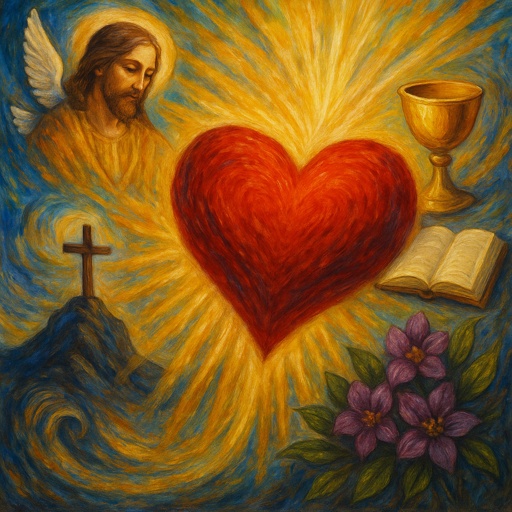
"And though I have the gift of prophecy, and understand all mysteries, and all knowledge; and though I have all faith, so that I could remove mountains, and have not charity, I am nothing." - 1 Corinthians 13:2
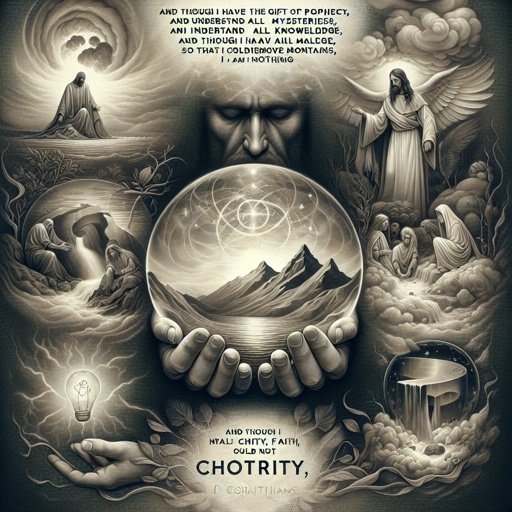
1 Corinthians 13:2 - "And though I have the gift of prophecy, and understand all mysteries, and all knowledge; and though I have all faith, so that I could remove mountains, and have not charity, I am nothing."

"And though I have the gift of prophecy, and understand all mysteries, and all knowledge; and though I have all faith, so that I could remove mountains, and have not charity, I am nothing." - 1 Corinthians 13:2
![1 Corinthians 13:13
1 Corinthians 13:13
[13] So now faith, hope, and love abide, these three; but the greatest of these is love. (ESV)](https://media.bible.art/3da57222-9f49-4158-a2a3-7a49b5dc4437-thumbnail.jpg)
1 Corinthians 13:13 1 Corinthians 13:13 [13] So now faith, hope, and love abide, these three; but the greatest of these is love. (ESV)

2 Corinthians 13:13 - "All the saints salute you."

1 Corinthians 13:13

1 Corinthians 13 :13

1 Corinthians 13

2 Corinthians 13:1 - "This is the third time I am coming to you. In the mouth of two or three witnesses shall every word be established."

2 Corinthians 13

1 Corinthians 13:4-6

1 Corinthians 13:4-6

1 Corinthians 13:4-6

1 Corinthians 13:4-6

1 Corinthians 13:4-6

1 Corinthians 13:4-6

1 Corinthians 13:4-6

1 Corinthians 13:4-6

1 Corinthians 13:4-7

1 Corinthians 13:4-7

1 Corinthians 13:4-7

1 Corinthians 13:4-7

1 Corinthians 2:13 - "Which things also we speak, not in the words which man's wisdom teacheth, but which the Holy Ghost teacheth; comparing spiritual things with spiritual."

1 Corinthians 10:13

1 Corinthians 13:13 - "And now abideth faith, hope, charity, these three; but the greatest of these is charity."

1 Corinthians 10:13

1 Corinthians 10:13

2 Corinthians 1:13 - "For we write none other things unto you, than what ye read or acknowledge; and I trust ye shall acknowledge even to the end;"

2 Corinthians 13:12 - "Greet one another with an holy kiss."

"All the saints salute you." - 2 Corinthians 13:13