What does 1 John 2:1-2 mean?
“My little children, these things write I unto you, that ye sin not. And if any man sin, we have an advocate with the Father, Jesus Christ the righteous: And he is the propitiation for our sins: and not for ours only, but also for the sins of the whole world.” — 1 John 2:1-2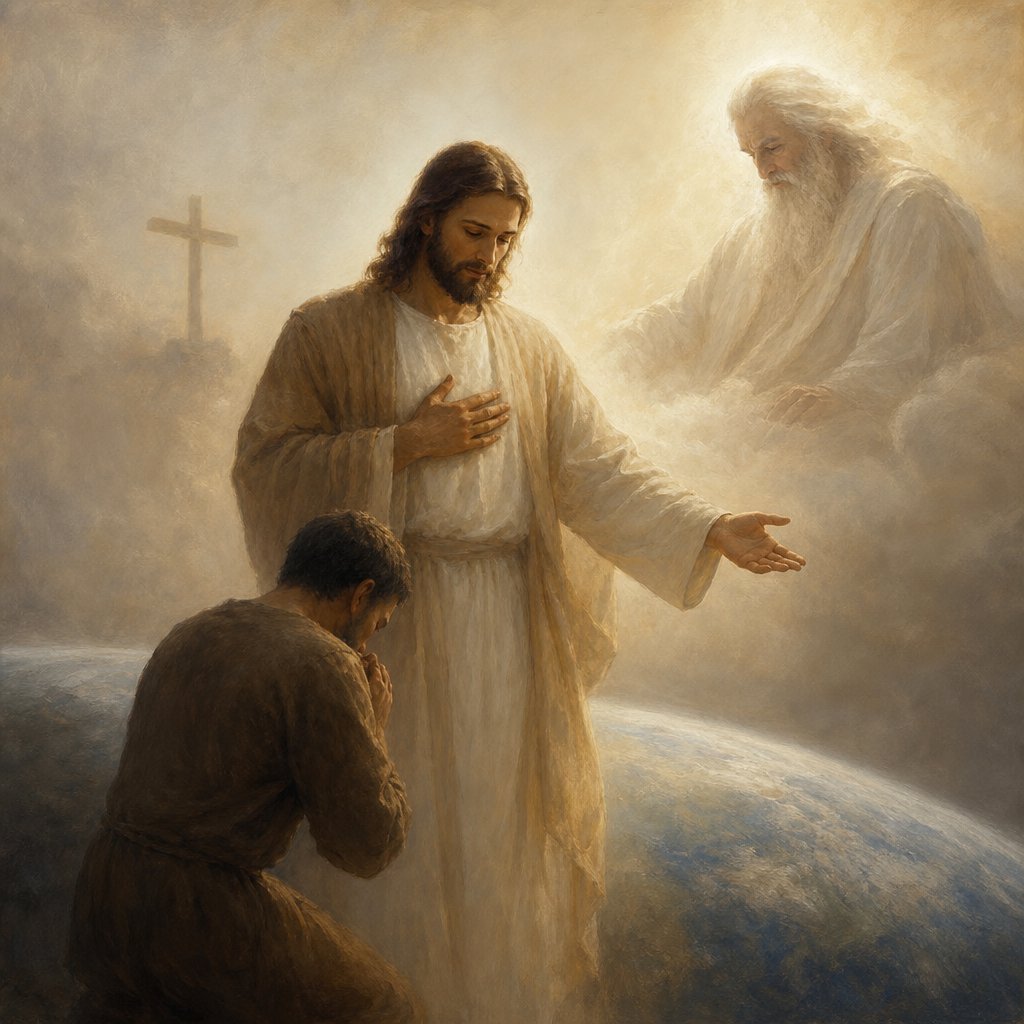
“My little children, these things write I unto you, that ye sin not. And if any man sin, we have an advocate with the Father, Jesus Christ the righteous: And he is the propitiation for our sins: and not for ours only, but also for the sins of the whole world.” (1 John 2:1–2, KJV)
In these words John speaks with a fatherly tenderness—“My little children”—not to diminish believers, but to show pastoral care and to set the tone of family instruction within the household of faith. He has just said that “the blood of Jesus Christ his Son cleanseth us from all sin” and that if we confess our sins “he is faithful and just to forgive us our sins” (1 John 1:7, 9, KJV). Yet he has also warned against the self-deception of claiming sinlessness (1 John 1:8, 10, KJV). Against that backdrop, 1 John 2:1–2 holds together two truths that must not be separated: God’s people are called to holiness—“that ye sin not”—and God has provided a remedy when they fail—“And if any man sin, we have an advocate with the Father.”
The first theme is the moral aim of the gospel. John does not write so that sin may be treated lightly, excused, or normalized. “That ye sin not” is the stated purpose. The grace of God is not presented as permission to continue in sin, but as power and motive to forsake it. John’s counsel is realistic, but never indulgent. He addresses the believer’s life as one that ought to be marked by obedience, a life in which sin is an intruder rather than a master. This is consistent with the larger flow of the epistle, where walking in the light, keeping commandments, and loving the brethren are presented as the fruit that corresponds to knowing God (1 John 1:7; 2:3–11, KJV).
The second theme is the provision of mercy for the believer’s failures. John says, “And if any man sin,” not “when,” as though sin were inevitable in a way that empties the call to holiness, but “if,” as a sober acknowledgment that believers may indeed fall. Yet the moment he mentions the possibility of sin, he immediately points upward: “we have an advocate with the Father.” The language is courtroom language. An advocate is one who speaks for another, who stands alongside, who pleads a cause. The setting is “with the Father,” which is deeply significant. John does not present God as a distant judge unknown to the accused, but as “the Father,” the One who has already received believers into a relationship of adoption and love. The believer’s sin does not erase God’s fatherhood, yet it does require a true and holy answer in God’s presence. The gospel provides that answer in the person of Jesus Christ.
John names the advocate in full: “Jesus Christ the righteous.” The title “Jesus” points to the One who came in the flesh and was known among men; “Christ” points to God’s anointed, the promised Messiah; “the righteous” points to his fitness to represent sinners before a holy God. In a courtroom, the character and standing of the advocate matters. Christ’s righteousness is not merely a moral quality admired from afar; it is the foundation of his right to plead and the assurance that his intercession is effective. John’s emphasis guards the reader from thinking of this advocacy as mere sympathy. It is righteous advocacy, grounded in the purity, obedience, and truth of the Son, whose standing with the Father cannot be questioned.
John then explains why Christ can be this advocate: “And he is the propitiation for our sins.” This word carries the weight of sacrificial imagery. Propitiation speaks of an offering that deals with sin before God, not by denying its seriousness, but by answering its guilt. It is not described as something Christ gives apart from himself; “he is” the propitiation, meaning his own person and work are the decisive sacrifice and satisfaction in view. The symbolism behind such language reaches back into the sacrificial pattern where blood was shed because sin brings death, and where atonement spoke of sin being truly addressed rather than ignored. John’s point is that Jesus is not only one who pleads; he pleads on the basis of what he has done and what he is. His advocacy is not an attempt to talk God into overlooking sin; it rests upon God’s own appointed remedy for sin.
This also clarifies the relationship between God’s holiness and God’s forgiveness. The epistle has already said God is “faithful and just” to forgive (1 John 1:9, KJV). Forgiveness is not portrayed as God setting aside justice, but as God expressing justice through the propitiation that he himself has provided. Thus the believer’s assurance is strengthened: the ground of pardon is not the believer’s fluctuating feelings, vows, or worthiness, but Christ’s righteousness and Christ’s propitiatory work. John is writing so that believers may be kept from sin, and also so that when they fall they are not driven into despair, as though their sin has left them without any standing before God. The gospel gives both a warning and a refuge.
Finally, John expands the horizon: “and not for ours only, but also for the sins of the whole world.” Within the immediate voice of the letter, “ours” naturally includes John and the community of believers to whom he writes—those within the circle of confession and fellowship described in the previous chapter. Yet John refuses any narrowness that would make Christ’s propitiation a private possession of one small group as though God’s remedy were too small for humanity. “The whole world” is the broadest sweep of need and the broadest announcement of provision. It underscores the sufficiency and reach of Christ’s work: it is not limited in value to one nation, one class, or one generation. John’s language also keeps the reader from imagining that the Christian message is merely tribal; it is a proclamation to a world in sin that there is a true propitiation provided by God in his Son.
Taken together, 1 John 2:1–2 is a pastoral bridge between command and comfort. It calls believers away from sin with seriousness—because sin is real and God is light—and it calls believers toward Christ with confidence—because in the very presence of the Father there is One who represents them, and that representation is anchored in a righteous person and a real propitiation. The significance of the passage lies in its balance: it neither excuses sin nor denies mercy; it neither collapses God into indulgence nor portrays him as unwilling to forgive. It presents Jesus Christ as both the righteous advocate and the propitiation, so that believers may walk in the light without presumption and may rise from their falls without hopelessness, trusting that the remedy God has provided is as wide as the world’s need and as solid as the righteousness of his Son.
Get our apps


Artwork for 1 John 2:1-2

1 John 2:1-2 - "My little children, these things write I unto you, that ye sin not. And if any man sin, we have an advocate with the Father, Jesus Christ the righteous: And he is the propitiation for our sins: and not for ours only, but also for the sins of the whole world."
"My little children, these things write I unto you, that ye sin not. And if any man sin, we have an advocate with the Father, Jesus Christ the righteous: And he is the propitiation for our sins: and not for ours only, but also for the sins of the whole world." - 1 John 2:1-2

John 1:1-2

John 1:1-2

John 1:1-2

John 1:1-2

John 1:1-2

1 John 2:27

1 John 2:27

1 John 2:27

1 John 2:27

2 John 1:2 - "For the truth's sake, which dwelleth in us, and shall be with us for ever."

John 1:2 - "The same was in the beginning with God."

1 John 2:14

1 John 2:14

John 14:1-2

1 John 2:2 - "And he is the propitiation for our sins: and not for our's only, but also for the sins of the whole world."

1 John 2:1 - "My little children, these things write I unto you, that ye sin not. And if any man sin, we have an advocate with the Father, Jesus Christ the righteous:"

2 John 1:6 – "And this is love: that we walk in obedience to his commands."

2 John 1:6 – "And this is love: that we walk in obedience to his commands."

John 2:1 - "And the third day there was a marriage in Cana of Galilee; and the mother of Jesus was there:"

"The same was in the beginning with God." - John 1:2

2 John 1:13 - "The children of thy elect sister greet thee. Amen."

1 John 2:25 - "And this is the promise that he hath promised us, even eternal life."

2 John 1:11 - "For he that biddeth him God speed is partaker of his evil deeds."

2 John 1:1 - "The elder unto the elect lady and her children, whom I love in the truth; and not I only, but also all they that have known the truth;"

1 John 1:2 - "(For the life was manifested, and we have seen it, and bear witness, and shew unto you that eternal life, which was with the Father, and was manifested unto us;)"

1 John 2:16 - "For all that is in the world, the lust of the flesh, and the lust of the eyes, and the pride of life, is not of the Father, but is of the world."

1 John 2:10 - "He that loveth his brother abideth in the light, and there is none occasion of stumbling in him."

1 John 2:26 - "These things have I written unto you concerning them that seduce you."