What does 1 Kings 12:32 mean?
"And Jeroboam ordained a feast in the eighth month, on the fifteenth day of the month, like unto the feast that is in Judah, and he offered upon the altar. So did he in Beth-el, sacrificing unto the calves that he had made: and he placed in Beth-el the priests of the high places which he had made." - 1 Kings 12:32
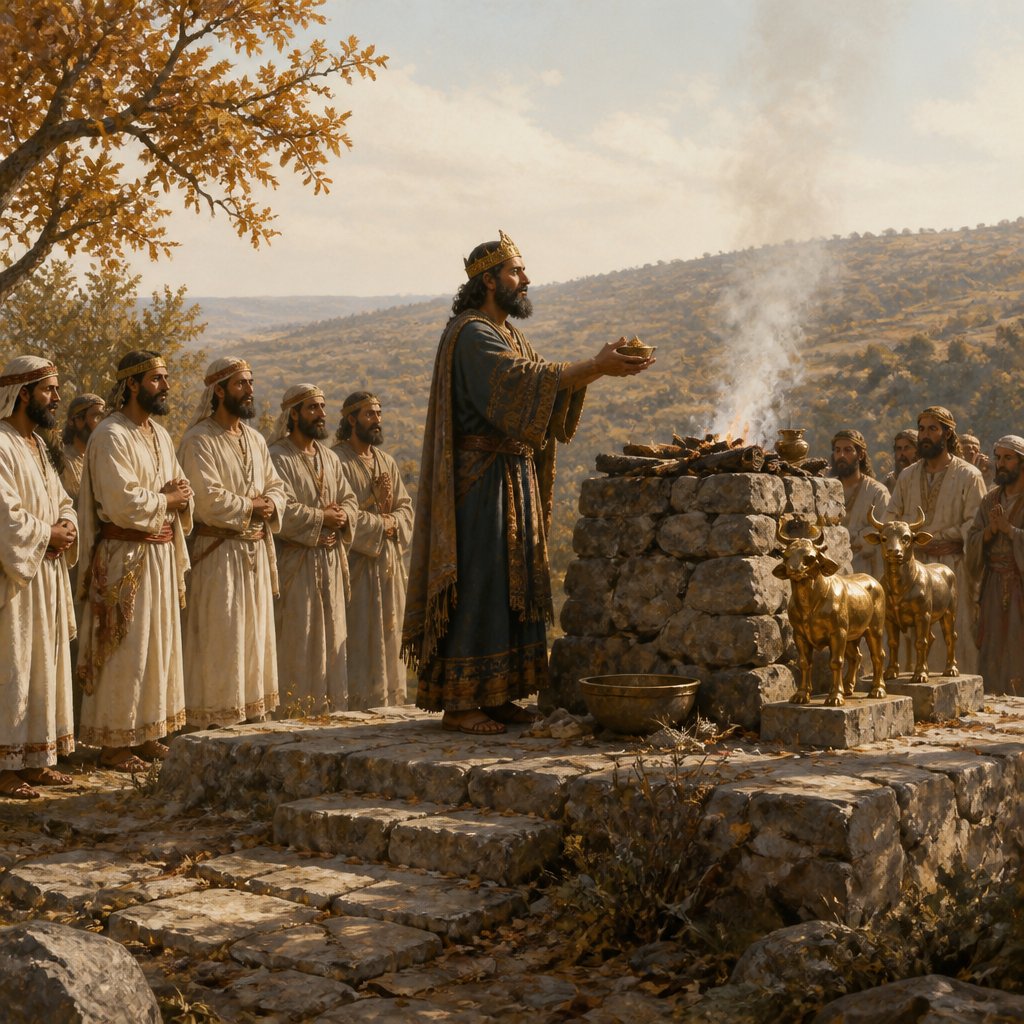
1 Kings 12:32 (KJV) states, "And Jeroboam ordained a feast in the eighth month, on the fifteenth day of the month, like unto the feast that is in Judah, and he offered upon the altar. So did he in Bethel, sacrificing unto the calves that he had made: and he placed in Bethel the priests of the high places which he had made."
This verse takes place in the context of the divided kingdom of Israel. After the reign of King Solomon, his son Rehoboam became king over Judah in the south, while Jeroboam rose to power as the king of the northern tribes, collectively known as Israel. Jeroboam, fearing that his people would return to their allegiance to the house of David in Jerusalem if they continued to worship at the temple there, took action to establish a new religious order for the northern kingdom.
The feast that Jeroboam ordains in the eighth month on the fifteenth day of the month is an example of his attempts to create a parallel religious system to the one in Judah. The eighth month corresponds to the traditional time of the feast of Tabernacles in Judah, but Jeroboam institutes a similar feast in Bethel, a city in the northern kingdom. This act of establishing a new religious festival is a direct challenge to the authority and tradition of the temple in Jerusalem and is meant to solidify the northern kingdom's autonomy from the southern kingdom.
Jeroboam's actions, however, go beyond simply instituting a new feast. The verse also details how Jeroboam offered sacrifices upon the altar and constructed calves for the people to worship. His placement of priests at high places in Bethel to oversee the sacrifices and offerings further demonstrates his deliberate attempt to replace the established religious practices of Judah with his own. These actions symbolize Jeroboam's desire for political and religious control, as well as his willingness to lead his people away from the true worship of Yahweh.
The symbolism in this verse is multifaceted. The establishment of a new feast, sacrificial system, and priesthood in the northern kingdom reflects the spiritual and moral decline of Israel under Jeroboam's leadership. The use of calves as objects of worship mirrors the sin of idolatry that had plagued the people of Israel throughout their history. This deliberate departure from the worship of Yahweh further highlights Jeroboam's rebellion against God's commandments and his disregard for the covenant with the people of Israel.
The broader themes present in this verse include the abuse of power, the dangers of religious syncretism, and the consequences of forsaking true worship. Jeroboam's actions ultimately lead to the idolatry and corruption of the kingdom of Israel, setting the stage for its eventual downfall. By establishing a parallel religious system, Jeroboam sows division among the people of Israel and undermines the unity and integrity of their worship.
In conclusion, 1 Kings 12:32 offers a cautionary tale of the dangers of forsaking true worship and succumbing to the temptations of power and idolatry. Jeroboam's actions stand as a warning against compromising the worship of the one true God and serve as a reminder of the importance of faithfulness to His commandments. This verse also serves as a call to uphold the purity of worship and to resist the allure of false gods and worldly power.
Have questions about 1 Kings 12:32?
Dive deeper into this scripture with Bible Chat — an AI-powered tool for exploring God's Word through conversation. Ask questions, get context, and grow in your understanding of the Bible.
Get Our Apps


1 Kings 12:32 Artwork
1 Kings 12:32 - "And Jeroboam ordained a feast in the eighth month, on the fifteenth day of the month, like unto the feast that is in Judah, and he offered upon the altar. So did he in Beth-el, sacrificing unto the calves that he had made: and he placed in Beth-el the priests of the high places which he had made."
"And Jeroboam ordained a feast in the eighth month, on the fifteenth day of the month, like unto the feast that is in Judah, and he offered upon the altar. So did he in Beth-el, sacrificing unto the calves that he had made: and he placed in Beth-el the priests of the high places which he had made." - 1 Kings 12:32

1 Kings 11:29-32

1 Kings 15:32 - "And there was war between Asa and Baasha king of Israel all their days."

1 Kings 12:11

1 Kings 12:11

1 Kings 12:10

1 Kings 12:10

1 Kings 12:10

1 Kings 12:11

1 Kings 12:10
1 Kings 12:11

1 Kings 12:14

1 Kings 12:14

1 Kings 12:11

1 Kings 1:32 - "¶ And king David said, Call me Zadok the priest, and Nathan the prophet, and Benaiah the son of Jehoiada. And they came before the king."

1 Kings 4:32 - "And he spake three thousand proverbs: and his songs were a thousand and five."

1 Kings 16:32 - "And he reared up an altar for Baal in the house of Baal, which he had built in Samaria."

1 kings 3:12

1 Kings 7:32 - "And under the borders were four wheels; and the axletrees of the wheels were joined to the base: and the height of a wheel was a cubit and half a cubit."

1 Kings 12:1 - "And Rehoboam went to Shechem: for all Israel were come to Shechem to make him king."

1 Kings 18:32 - "And with the stones he built an altar in the name of the LORD: and he made a trench about the altar, as great as would contain two measures of seed."

"And there was war between Asa and Baasha king of Israel all their days." - 1 Kings 15:32

1 Kings 22:32 - "And it came to pass, when the captains of the chariots saw Jehoshaphat, that they said, Surely it is the king of Israel. And they turned aside to fight against him: and Jehoshaphat cried out."

1 Kings 12:19 - "So Israel rebelled against the house of David unto this day."

1 Kings 21:12 - "They proclaimed a fast, and set Naboth on high among the people."

1 Kings 12:12 - "¶ So Jeroboam and all the people came to Rehoboam the third day, as the king had appointed, saying, Come to me again the third day."

1 Kings 11:32 - "(But he shall have one tribe for my servant David's sake, and for Jerusalem's sake, the city which I have chosen out of all the tribes of Israel:)"

1 Kings 12:22 - "But the word of God came unto Shemaiah the man of God, saying,"

1 Kings 12:13 - "And the king answered the people roughly, and forsook the old men's counsel that they gave him;"