What does 1 Kings 14:27 mean?
“And king Rehoboam made in their stead brasen shields, and committed them unto the hands of the chief of the guard, which kept the door of the king’s house.” — 1 Kings 14:27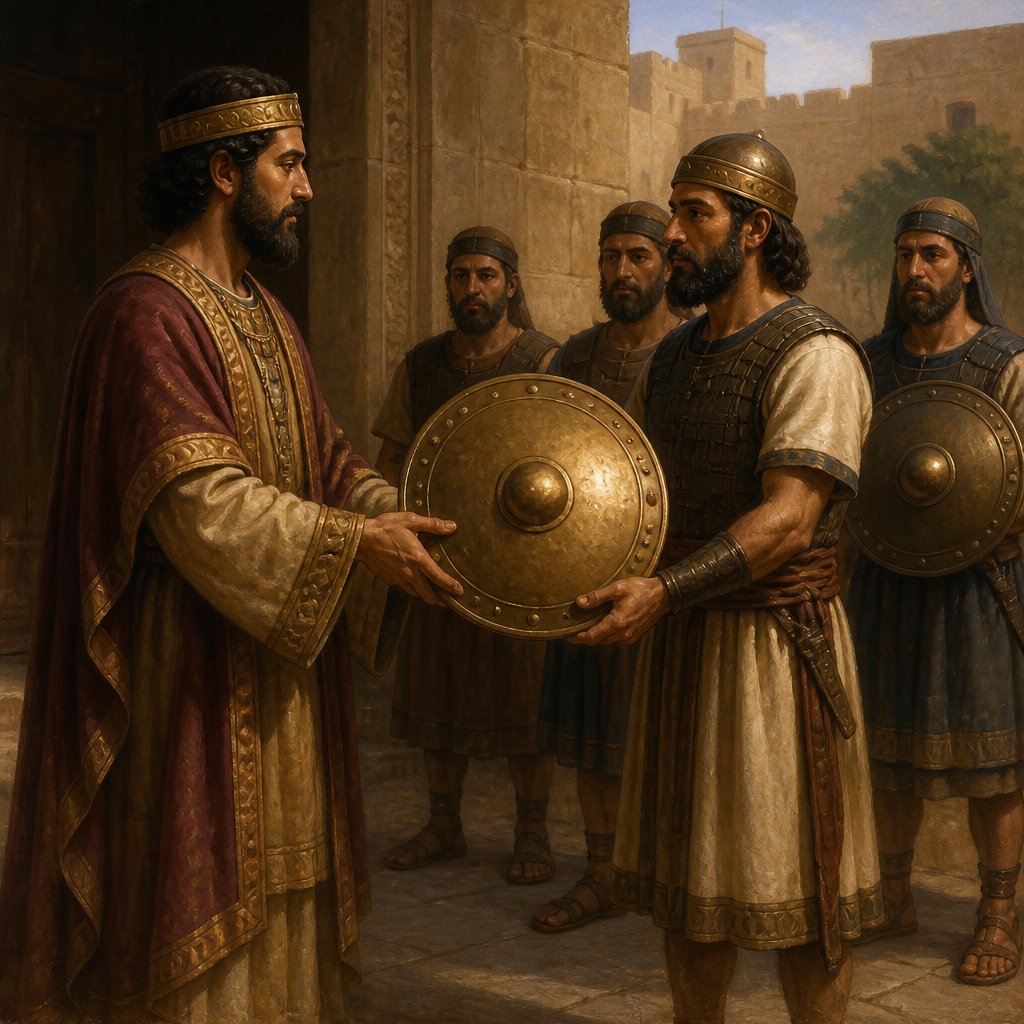
1 Kings 14:27 (KJV) states, "And king Rehoboam made in their stead brasen shields, and committed them unto the hands of the chief of the guard, which kept the door of the king's house."
This verse is part of a larger narrative in the Books of Kings that details the events following the division of the united Israelite kingdom into two separate entities – the northern kingdom of Israel and the southern kingdom of Judah. King Rehoboam reigned over the southern kingdom of Judah following the death of his father, King Solomon.
In order to understand the significance of this verse, it is important to consider its context within the broader narrative of 1 Kings 14. In the earlier verses, we learn that Rehoboam's reign was marked by disobedience and idolatry, both on the part of the king himself and the people of Judah. As a result, the nation faced constant threats and upheavals, including attacks from neighboring nations.
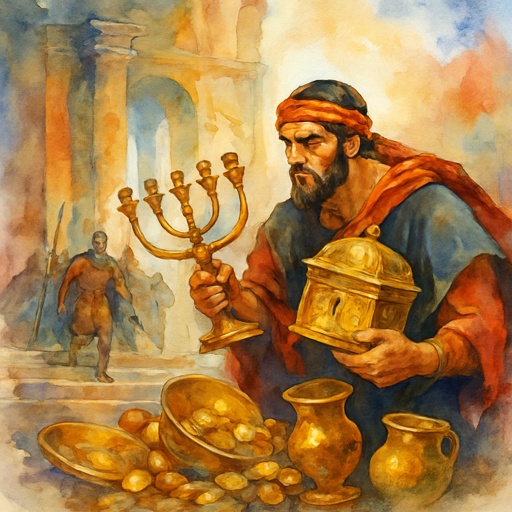
In 1 Kings 14:25-28, we see that King Shishak of Egypt invaded Judah and seized the treasures of the king's house, including the golden shields that King Solomon had made. In response, Rehoboam made replacement shields out of bronze and entrusted them to the chief of the guard to be placed in the king's house.
The significance of this act lies in its symbolic and practical implications. The shields were not just ordinary weapons or defensive tools, but they held deep symbolic meaning. In the ancient world, shields were not only used for protection in battle, but they also served as symbols of strength, security, and victory. The fact that the original shields were made of gold, a precious metal often associated with royalty and divinity, further emphasizes their symbolic importance.
By replacing the stolen golden shields with bronze ones, Rehoboam was not just providing for the practical defense of the kingdom; he was also making a statement about the spiritual and moral state of his reign and the nation as a whole. Bronze, while still a durable and strong metal, was not as valuable or prestigious as gold. This substitution of precious metal with a lower-quality material represents a decline in the spiritual and moral standing of the kingdom under Rehoboam's rule.
Furthermore, the act of entrusting the replacement shields to the chief of the guard, who was responsible for safeguarding the king's house, underscores the sense of vulnerability and insecurity that plagued Judah during this period. It suggests a lack of trust in divine protection and a reliance on human strength and earthly resources to secure the nation's well-being.
The significance of this verse extends beyond its immediate context and holds timeless lessons for readers. It serves as a cautionary tale about the dangers of spiritual decline, idolatry, and misplaced trust. It also highlights the consequences of straying from God's commands and the resulting vulnerability to external threats and calamities.
In a broader theological sense, this verse can be viewed as a sobering reminder of the consequences of spiritual compromise and the need for unwavering faith and obedience to God. It underscores the importance of seeking divine protection and guidance rather than relying on worldly substitutes and human strength.
In conclusion, 1 Kings 14:27 carries deep symbolism and profound implications within its historical and theological context. It serves as a powerful reminder of the consequences of spiritual decline and the need for unwavering faith and obedience to God. It challenges readers to examine their own lives and the ways in which they place their trust and reliance, urging them to seek divine protection and guidance above all else.
Get our apps


Artwork for 1 Kings 14:27

1 Kings 14:27 - "And king Rehoboam made in their stead brasen shields, and committed them unto the hands of the chief of the guard, which kept the door of the king's house."
"And king Rehoboam made in their stead brasen shields, and committed them unto the hands of the chief of the guard, which kept the door of the king's house." - 1 Kings 14:27

1 Kings 7:27-38

1 Samuel 14:27

1 Kings 7:27-38

Psalm 27:13-14

1 Kings 14:1-20

1 Kings 14:26
1 Kings 14:26

2 Kings 14:27 - "And the LORD said not that he would blot out the name of Israel from under heaven: but he saved them by the hand of Jeroboam the son of Joash."

1 Kings 12:14

1 Kings 12:14

1 Kings 16:27 - "Now the rest of the acts of Omri which he did, and his might that he shewed, are they not written in the book of the chronicles of the kings of Israel?"

1 Kings 14:1 - "At that time Abijah the son of Jeroboam fell sick."

1 Kings 13:27 - "And he spake to his sons, saying, Saddle me the ass. And they saddled him."

1 Kings 10:27 - "And the king made silver to be in Jerusalem as stones, and cedars made he to be as the sycomore trees that are in the vale, for abundance."

1 Kings 9:14 - "And Hiram sent to the king sixscore talents of gold."

1 Kings 3:27 - "Then the king answered and said, Give her the living child, and in no wise slay it: she is the mother thereof."

1 Kings 9:27 - "And Hiram sent in the navy his servants, shipmen that had knowledge of the sea, with the servants of Solomon."

1 Kings 14:29 - "¶ Now the rest of the acts of Rehoboam, and all that he did, are they not written in the book of the chronicles of the kings of Judah?"

1 Kings 16:14 - "Now the rest of the acts of Elah, and all that he did, are they not written in the book of the chronicles of the kings of Israel?"

1 Kings 6:14 - "So Solomon built the house, and finished it."

1 Kings 4:14 - "Ahinadab the son of Iddo had Mahanaim:"

1 Kings 1:27 - "Is this thing done by my lord the king, and thou hast not shewed it unto thy servant, who should sit on the throne of my lord the king after him?"

1 Kings 21:14 - "Then they sent to Jezebel, saying, Naboth is stoned, and is dead."

1 Kings 14:30 - "And there was war between Rehoboam and Jeroboam all their days."

1 Kings 14:19 - "And the rest of the acts of Jeroboam, how he warred, and how he reigned, behold, they are written in the book of the chronicles of the kings of Israel."

1 Samuel 27:6 - "Then Achish gave him Ziklag that day: wherefore Ziklag pertaineth unto the kings of Judah unto this day."

1 Kings 1:14 - "Behold, while thou yet talkest there with the king, I also will come in after thee, and confirm thy words."

1 Corinthians 14:27 - "If any man speak in an unknown tongue, let it be by two, or at the most by three, and that by course; and let one interpret."