What does 1 Kings 15:4 mean?
“Nevertheless for David’s sake did the LORD his God give him a lamp in Jerusalem, to set up his son after him, and to establish Jerusalem:” — 1 Kings 15:4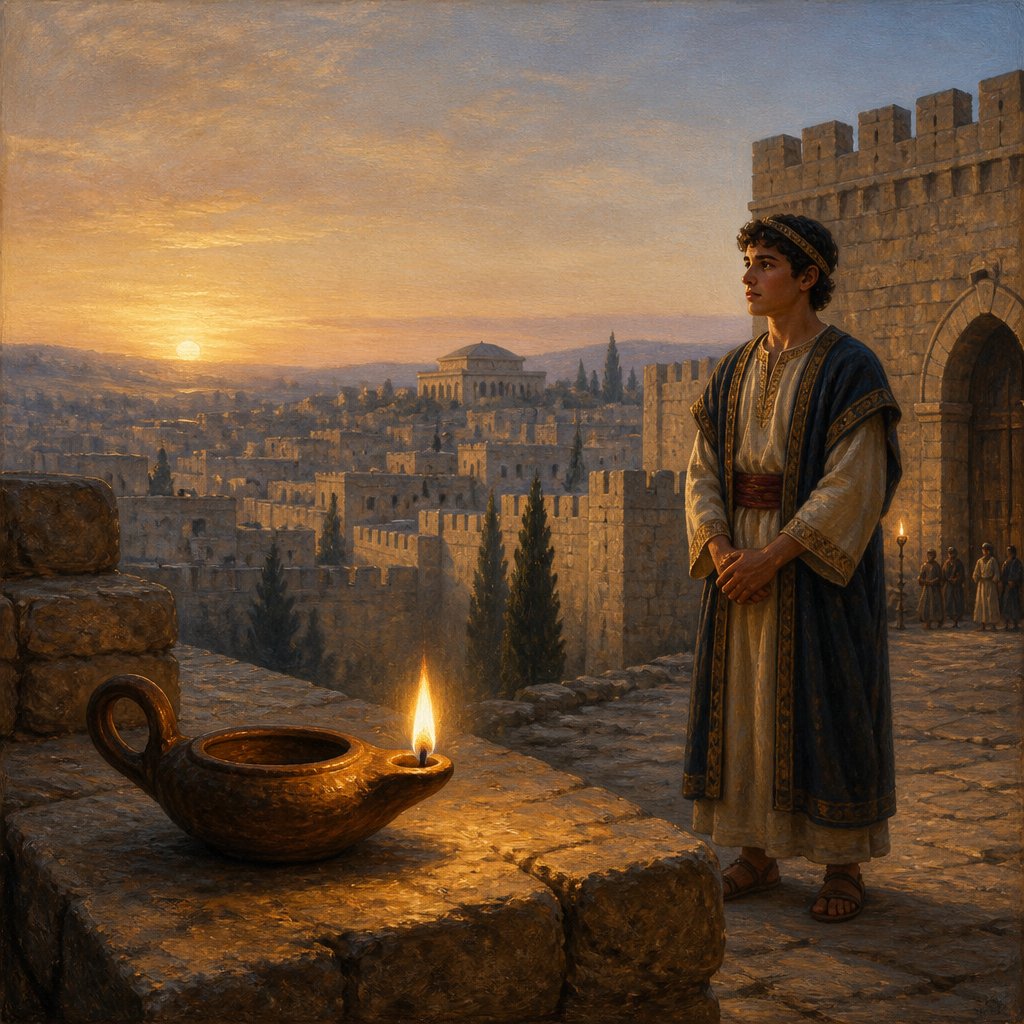
The verse 1 Kings 15:4 in the King James Version (KJV) reads, "Nevertheless for David's sake did the Lord his God give him a lamp in Jerusalem, to set up his son after him, and to establish Jerusalem." This verse is part of a larger passage that describes the reign of Abijam, the son of Rehoboam, the grandson of Solomon, who was the king of Judah.
In this verse, we find a reference to the special relationship that God had with King David. It mentions that God gave David a lamp in Jerusalem, symbolizing the enduring legacy of David's royal line. The metaphor of a lamp represents the perpetuation of David's lineage and the divine protection and guidance that God had promised to provide for the Davidic dynasty. This promise was rooted in the covenant that God made with David, as recorded in 2 Samuel 7:12-16, where God promised to establish David's kingdom and his royal line forever.
The mention of a lamp also has symbolic significance in the broader biblical context. In the Bible, light and lamps are often associated with God's presence, guidance, and salvation. Psalm 119:105 declares, "Thy word is a lamp unto my feet, and a light unto my path," underscoring the idea that God's word provides illumination and direction to those who follow it. Additionally, Jesus is described as the "light of the world" in the New Testament (John 8:12), further reinforcing the spiritual significance of light and lamps in the biblical narrative.
The verse also alludes to the establishment of Jerusalem, emphasizing its central role in God's plan for the Davidic dynasty. Jerusalem held religious, political, and cultural significance as the capital of the united monarchy under David and Solomon. The promise to establish Jerusalem reflects God's commitment to uphold the city as the center of His redemptive purpose for Israel and the world. This connection between the Davidic dynasty and Jerusalem underscores their intertwined destiny in God's unfolding plan of salvation.
The historical context of this verse is crucial for understanding the broader themes it encompasses. The divided monarchy of Israel and Judah, following the reign of Solomon, was marked by political instability, idolatry, and a departure from God's commandments. The reign of Abijam, to whom this verse refers, was characterized by continued disobedience and a failure to fully follow God. Despite this, the verse highlights God's faithfulness to His promises, particularly His covenant with David, and His commitment to preserving the Davidic dynasty for the fulfillment of His redemptive purposes.
In essence, 1 Kings 15:4 encapsulates several profound themes that resonate throughout the biblical narrative. It speaks to the faithfulness of God in upholding His promises, the enduring legacy of the Davidic dynasty, the significance of Jerusalem in God's plan, and the spiritual symbolism of light and guidance. These themes collectively underscore God's sovereign and redemptive work in human history, pointing towards the ultimate fulfillment of His promises through the person of Jesus Christ, who is the true light and the fulfillment of the Davidic covenant. Thus, this verse serves as a reminder of God's unwavering faithfulness and His overarching plan of redemption for humanity.
Get our apps


Artwork for 1 Kings 15:4

1 Kings 15:4 - "Nevertheless for David's sake did the LORD his God give him a lamp in Jerusalem, to set up his son after him, and to establish Jerusalem:"
"Nevertheless for David's sake did the LORD his God give him a lamp in Jerusalem, to set up his son after him, and to establish Jerusalem:" - 1 Kings 15:4

1 Kings 4:15 - "Ahimaaz was in Naphtali; he also took Basmath the daughter of Solomon to wife:"

"Ahimaaz was in Naphtali; he also took Basmath the daughter of Solomon to wife:" - 1 Kings 4:15

1 kings 3:15

1 kings 3:15

2 Kings 15:4 - "Save that the high places were not removed: the people sacrificed and burnt incense still on the high places."

2 Kings 4:15 - "And he said, Call her. And when he had called her, she stood in the door."

1 Kings 15:31 - "¶ Now the rest of the acts of Nadab, and all that he did, are they not written in the book of the chronicles of the kings of Israel?"

1 Kings 10:15 - "Beside that he had of the merchantmen, and of the traffick of the spice merchants, and of all the kings of Arabia, and of the governors of the country."

1 Kings 4:1 - "So king Solomon was king over all Israel."

1 Kings 15:1 - "Now in the eighteenth year of king Jeroboam the son of Nebat reigned Abijam over Judah."

Revelation 15:1-4

1 Timothy 4:15

1 Kings 11:1-5

1 Timothy 6:15-16 – "God, the blessed and only Ruler, the King of kings and Lord of lords."

1 Kings 15:32 - "And there was war between Asa and Baasha king of Israel all their days."

1 Kings 15:16 - "¶ And there was war between Asa and Baasha king of Israel all their days."

1 Timothy 6:15-16 – "God, the blessed and only Ruler, the King of kings and Lord of lords."

1 Timothy 6:15-16 – "God, the blessed and only Ruler, the King of kings and Lord of lords."
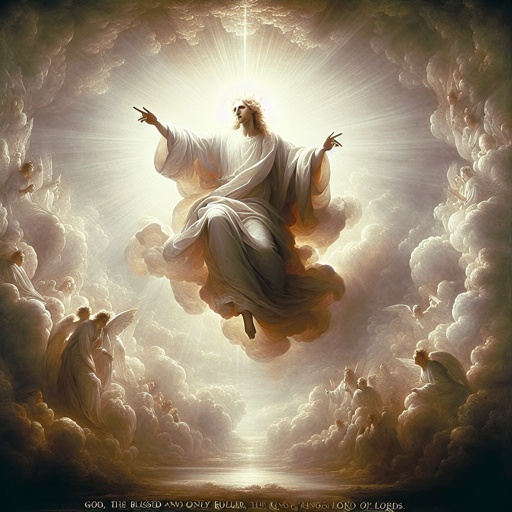
1 Timothy 6:15-16 – "God, the blessed and only Ruler, the King of kings and Lord of lords."

1 Kings 1:15 - "¶ And Bath-sheba went in unto the king into the chamber: and the king was very old; and Abishag the Shunammite ministered unto the king."

1 Kings 15:9 - "¶ And in the twentieth year of Jeroboam king of Israel reigned Asa over Judah."

1 Timothy 6:15-16 – "God, the blessed and only Ruler, the King of kings and Lord of lords."

Luke 15: 4-7

1 Kings 4:4 - "And Benaiah the son of Jehoiada was over the host: and Zadok and Abiathar were the priests:"

1 Kings 1:4 - "And the damsel was very fair, and cherished the king, and ministered to him: but the king knew her not."

1 Kings 15:7 - "Now the rest of the acts of Abijam, and all that he did, are they not written in the book of the chronicles of the kings of Judah? And there was war between Abijam and Jeroboam."

1 Kings 4:18 - "Shimei the son of Elah, in Benjamin:"

1 Kings 15:6 - "And there was war between Rehoboam and Jeroboam all the days of his life."