What does 1 Kings 17:11 mean?
“And as she was going to fetch it, he called to her, and said, Bring me, I pray thee, a morsel of bread in thine hand.” — 1 Kings 17:11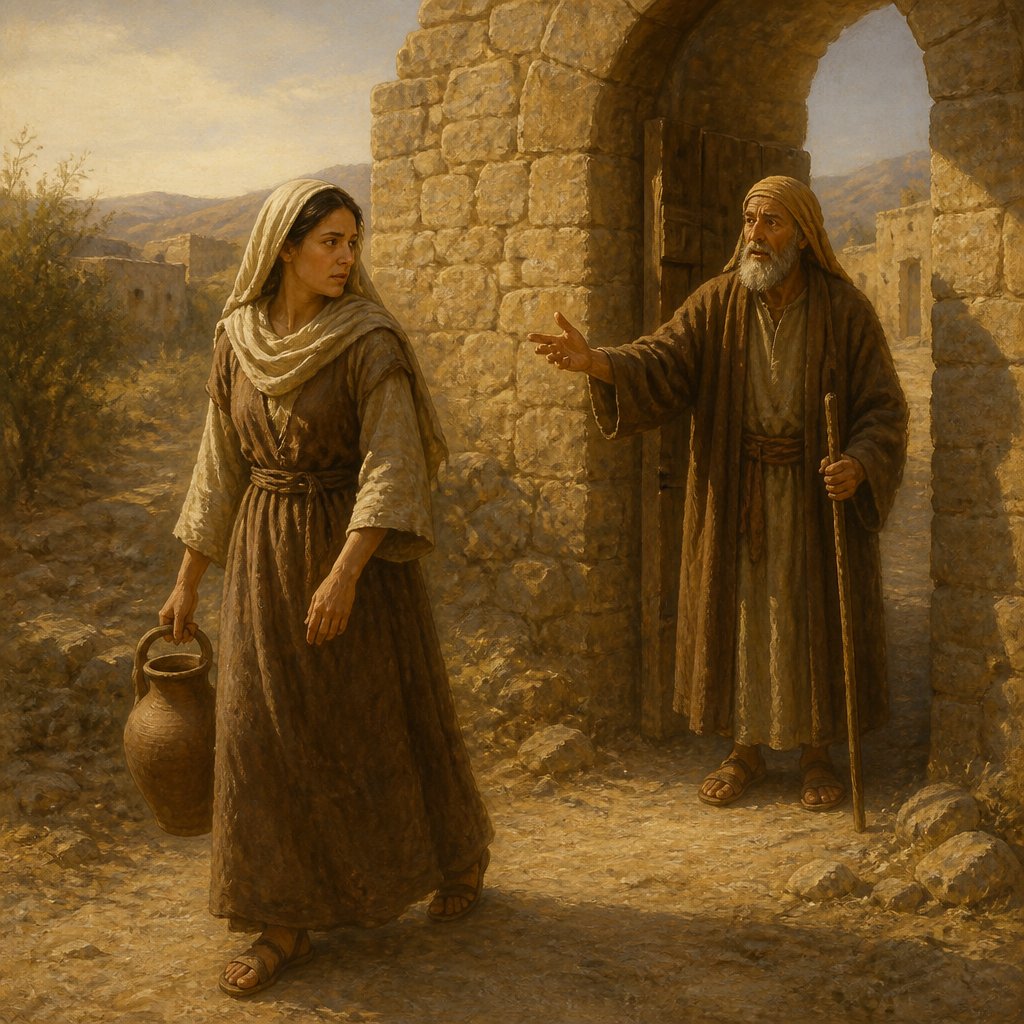
1 Kings 17:11 in the King James Version reads: "And as she was going to fetch it, he called to her, and said, Bring me, I pray thee, a morsel of bread in thine hand."
This verse is part of the narrative of the prophet Elijah during a time of great famine in the land of Israel. Elijah had been commanded by God to go to the region of Zarephath, where a widow would provide for him. When he arrived at the gate of the city, he saw a widow gathering sticks and asked her for a drink of water. As she went to get it, Elijah then asked her for a piece of bread as well.
This seemingly simple and straightforward request carries deep symbolic and contextual significance. The context of this verse is essential for understanding its meaning. The kingdom of Israel at this time was in the midst of a severe famine, caused by the disobedience of the people and their leaders to God's commandments. The land was barren, and the people were suffering from hunger and want. Elijah's request for bread from the widow is thus a symbolic representation of the desperation and need that was prevalent in the land at that time.
The symbolism of bread is crucial in the Bible and holds significant meaning. Bread is often used as a symbol of sustenance, provision, and even spiritual nourishment. In this context, Elijah's request for bread can be seen as a test of faith and obedience for the widow. It was a test to see if she would trust in God's provision, despite her own lack and scarcity. The widow herself acknowledges this when she tells Elijah that she only has a handful of flour and a little oil left, and she is gathering sticks to make a final meal for herself and her son before they die of starvation (1 Kings 17:12).
The widow's response to Elijah's request also provides a powerful commentary on selflessness and generosity. Despite her own desperate situation, she agrees to give Elijah the small amount of bread she has left. This act of giving, even in the midst of scarcity, mirrors the sacrificial nature of Christ's own ministry and the Gospel message of selflessness and compassion.
Furthermore, this verse speaks to the theme of God's provision and faithfulness, even in times of scarcity and lack. Just as God provided for Elijah and the widow in their time of need, so too does he promise to provide for his people in every circumstance. This serves as a reminder of the importance of trusting in God's provision and having faith in his ability to meet our needs, even when the situation seems dire and hopeless.
Overall, 1 Kings 17:11 serves as a powerful reminder of the themes of faith, obedience, generosity, and God's provision. It challenges us to trust in God's faithfulness and to be willing to give sacrificially, even in times of scarcity. It also points to the symbolic significance of bread as a representation of sustenance and God's abundant provision. Through this verse, we are encouraged to have faith in God's ability to meet our needs and to act with generosity towards others, even in the midst of our own lack.
Get our apps


Artwork for 1 Kings 17:11

1 Kings 17:11 - "And as she was going to fetch it, he called to her, and said, Bring me, I pray thee, a morsel of bread in thine hand."
"And as she was going to fetch it, he called to her, and said, Bring me, I pray thee, a morsel of bread in thine hand." - 1 Kings 17:11

1 Kings 11:17 - "That Hadad fled, he and certain Edomites of his father's servants with him, to go into Egypt; Hadad being yet a little child."

1 Kings 11:11

1 Kings 11:11

1 Kings 11:11

1 Kings 11:11

1 Kings 11:11

1 kings 11:11-13

1 Kings 11:11-13

1 Kings 11:11-13

2 Kings 11:17 - "¶ And Jehoiada made a covenant between the LORD and the king and the people, that they should be the LORD'S people; between the king also and the people."

Exodus 17:11

1 Kings 11:1-5

1 Kings 4:17 - "Jehoshaphat the son of Paruah, in Issachar:"

1 Kings 12:11

1 Kings 11:13

1 Kings 12:11

1 Kings 11:5

1 Kings 11:13

1 Kings 12:11

1 Kings 12:11

1 Kings 12:11

1 Kings 21:17 - "¶ And the word of the LORD came to Elijah the Tishbite, saying,"

1 Kings 17:8 - "¶ And the word of the LORD came unto him, saying,"

1 Kings 6:17 - "And the house, that is, the temple before it, was forty cubits long."

1 Kings 17:2 - "And the word of the LORD came unto him, saying,"

1 Kings 9:17 - "And Solomon built Gezer, and Beth-horon the nether,"

1 Kings 6:11-13

1 Kings 11:29-32