What does 1 Kings 1:16 mean?
"And Bath-sheba bowed, and did obeisance unto the king. And the king said, What wouldest thou?" - 1 Kings 1:16
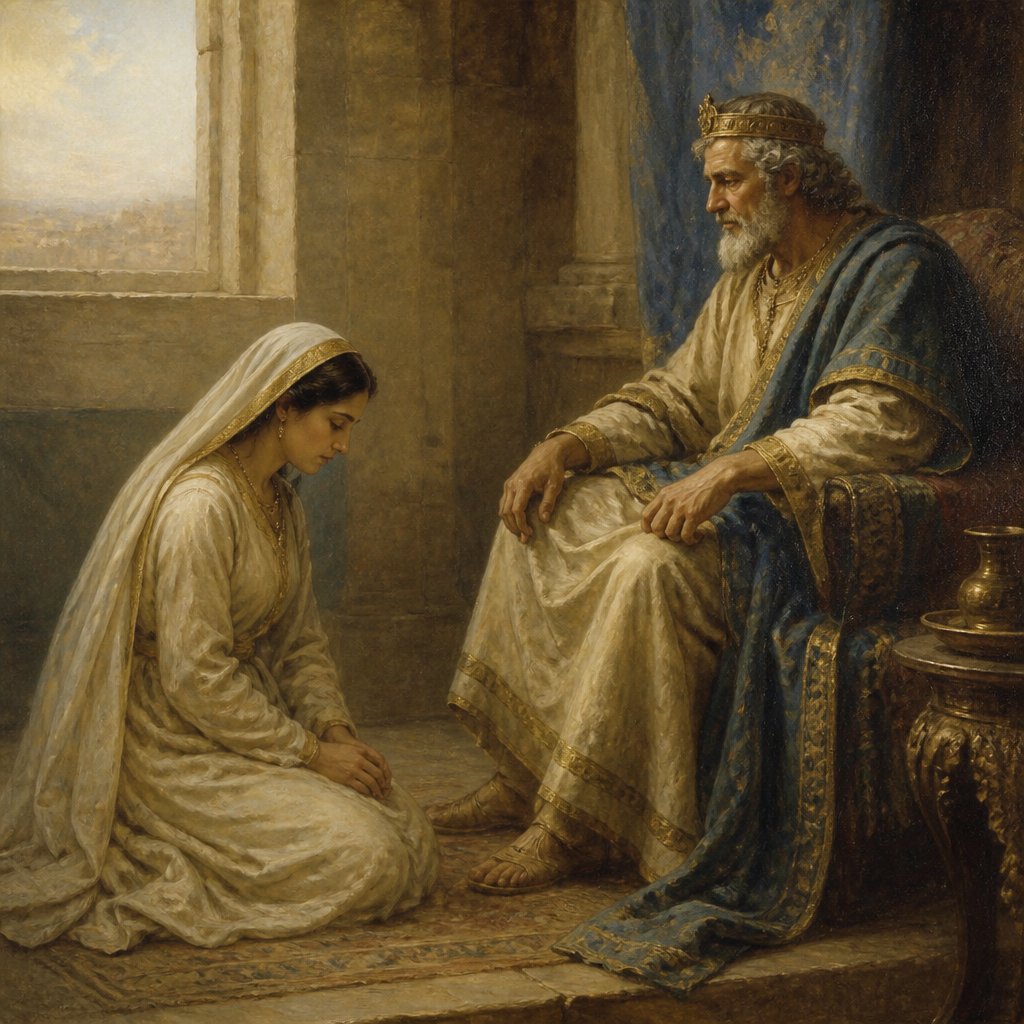
The verse 1 Kings 1:16 from the King James Version of the Bible states: "And Bathsheba bowed, and did obeisance unto the king. And the king said, What wouldest thou?"
This verse comes from the Old Testament and is part of the story of King David, specifically the events leading up to the transfer of power from King David to his son Solomon. To fully understand the meaning and commentary of this verse, it is important to place it within its broader context.
The verse takes place during a critical moment in David’s reign, as he grows old and weak, and his sons begin to vie for the throne. In this particular verse, Bathsheba, David’s wife and Solomon's mother, approaches him to discuss the matter of the succession. As a sign of respect and deference, she bows and does obeisance to the king before addressing him.
The themes present in this verse are respect, honor, and succession. Bathsheba’s action of bowing and doing obeisance to King David highlights the respect and honor she holds for him as the reigning king. This act also underscores the formal and hierarchical nature of the royal court in ancient Israel. Additionally, the theme of succession is prominent as the conversation between Bathsheba and King David revolves around who will succeed him as the ruler of Israel.
Symbolism is present in the verse through Bathsheba’s act of bowing and doing obeisance. In ancient Near Eastern cultures, bowing and doing obeisance were common gestures of respect and submission shown to a ruler or a person of authority. It symbolizes Bathsheba’s acknowledgment of King David’s authority and her willingness to submit to his judgment and decisions.
The broader context of this verse further amplifies its significance. King David’s reign was marked by moments of triumph, such as his victory over Goliath and the establishment of Jerusalem as the capital city of Israel, as well as moments of moral failure, particularly his affair with Bathsheba and the subsequent murder of her husband, Uriah. Despite his great accomplishments, David’s personal transgressions had lasting consequences for his family and the nation. This context adds depth to Bathsheba’s approach to King David, as it showcases the complex dynamics within the royal family and the delicate process of succession.
In terms of historical and cultural context, this verse reflects the customs and etiquette of ancient Israelite society. The act of bowing and doing obeisance was a customary display of respect and submission. Additionally, the matter of succession was of utmost importance in ancient monarchies, as it determined the future stability and leadership of the nation.
The verse also sets the stage for the eventual succession of Solomon as the next king of Israel. Bathsheba’s approach to King David and her discussion about the succession directly paves the way for Solomon to ascend to the throne. This transition of power, while marked by political intrigue and familial conflict, ultimately leads to a period of great prosperity and expansion for the Israelite kingdom during Solomon’s reign.
In conclusion, 1 Kings 1:16 from the King James Version of the Bible captures a pivotal moment in the history of Israel, as the aging King David confronts the question of his successor. The themes of respect, honor, and succession, as well as the symbolism of Bathsheba’s act of obeisance, contribute to the rich and layered meaning of this verse. Its historical, cultural, and contextual significance sheds light on the intricate dynamics of ancient Israelite monarchy and the transition of power from one generation to the next.
Have questions about 1 Kings 1:16?
Dive deeper into this scripture with Bible Chat — an AI-powered tool for exploring God's Word through conversation. Ask questions, get context, and grow in your understanding of the Bible.
Get Our Apps


1 Kings 1:16 Artwork

1 Kings 1:16 - "And Bath-sheba bowed, and did obeisance unto the king. And the king said, What wouldest thou?"
"And Bath-sheba bowed, and did obeisance unto the king. And the king said, What wouldest thou?" - 1 Kings 1:16

1 Kings 16:1 - "Then the word of the LORD came to Jehu the son of Hanani against Baasha, saying,"

1 Kings 4:16 - "Baanah the son of Hushai was in Asher and in Aloth:"

1 Kings 16:14 - "Now the rest of the acts of Elah, and all that he did, are they not written in the book of the chronicles of the kings of Israel?"

1 Timothy 6:15-16 – "God, the blessed and only Ruler, the King of kings and Lord of lords."

1 Timothy 6:15-16 – "God, the blessed and only Ruler, the King of kings and Lord of lords."
1 Timothy 6:15-16 – "God, the blessed and only Ruler, the King of kings and Lord of lords."

1 Kings 1:6 - "And his father had not displeased him at any time in saying, Why hast thou done so? and he also was a very goodly man; and his mother bare him after Absalom."

1 Kings 20:16 - "And they went out at noon. But Ben-hadad was drinking himself drunk in the pavilions, he and the kings, the thirty and two kings that helped him."

1 Timothy 6:15-16 – "God, the blessed and only Ruler, the King of kings and Lord of lords."

1 Kings 15:16 - "¶ And there was war between Asa and Baasha king of Israel all their days."

1 Kings 16:20 - "Now the rest of the acts of Zimri, and his treason that he wrought, are they not written in the book of the chronicles of the kings of Israel?"

1 Kings 16:5 - "Now the rest of the acts of Baasha, and what he did, and his might, are they not written in the book of the chronicles of the kings of Israel?"

1 Timothy 6:15-16 – "God, the blessed and only Ruler, the King of kings and Lord of lords."

1 Kings 3:16 - "¶ Then came there two women, that were harlots, unto the king, and stood before him."

1 Kings 16:27 - "Now the rest of the acts of Omri which he did, and his might that he shewed, are they not written in the book of the chronicles of the kings of Israel?"

2 Kings 16:1 - "In the seventeenth year of Pekah the son of Remaliah Ahaz the son of Jotham king of Judah began to reign."

1 Kings 16:33 - "And Ahab made a grove; and Ahab did more to provoke the LORD God of Israel to anger than all the kings of Israel that were before him."

1 Kings 16:17 - "And Omri went up from Gibbethon, and all Israel with him, and they besieged Tirzah."

1 Chronicles 16:21 - "He suffered no man to do them wrong: yea, he reproved kings for their sakes,"

1 Kings 18:16 - "So Obadiah went to meet Ahab, and told him: and Ahab went to meet Elijah."

Soothing the Soul: The Gospel of Gentle Care 1 Kings 19:3-8; 1 Samuel 16:14-23

1 Kings 16:30 - "And Ahab the son of Omri did evil in the sight of the LORD above all that were before him."

1 Kings 16:25 - "¶ But Omri wrought evil in the eyes of the LORD, and did worse than all that were before him."

1 Kings 16:32 - "And he reared up an altar for Baal in the house of Baal, which he had built in Samaria."

Soothing the Soul: The Gospel of Gentle Care 1 Kings 19:3-8; 1 Samuel 16:14-23

"Baanah the son of Hushai was in Asher and in Aloth:" - 1 Kings 4:16

"Then the word of the LORD came to Jehu the son of Hanani against Baasha, saying," - 1 Kings 16:1

1 Kings 10:16 - "¶ And king Solomon made two hundred targets of beaten gold: six hundred shekels of gold went to one target."