What does 1 Kings 2:13 mean?
“And Adonijah the son of Haggith came to Bath-sheba the mother of Solomon. And she said, Comest thou peaceably? And he said, Peaceably.” — 1 Kings 2:13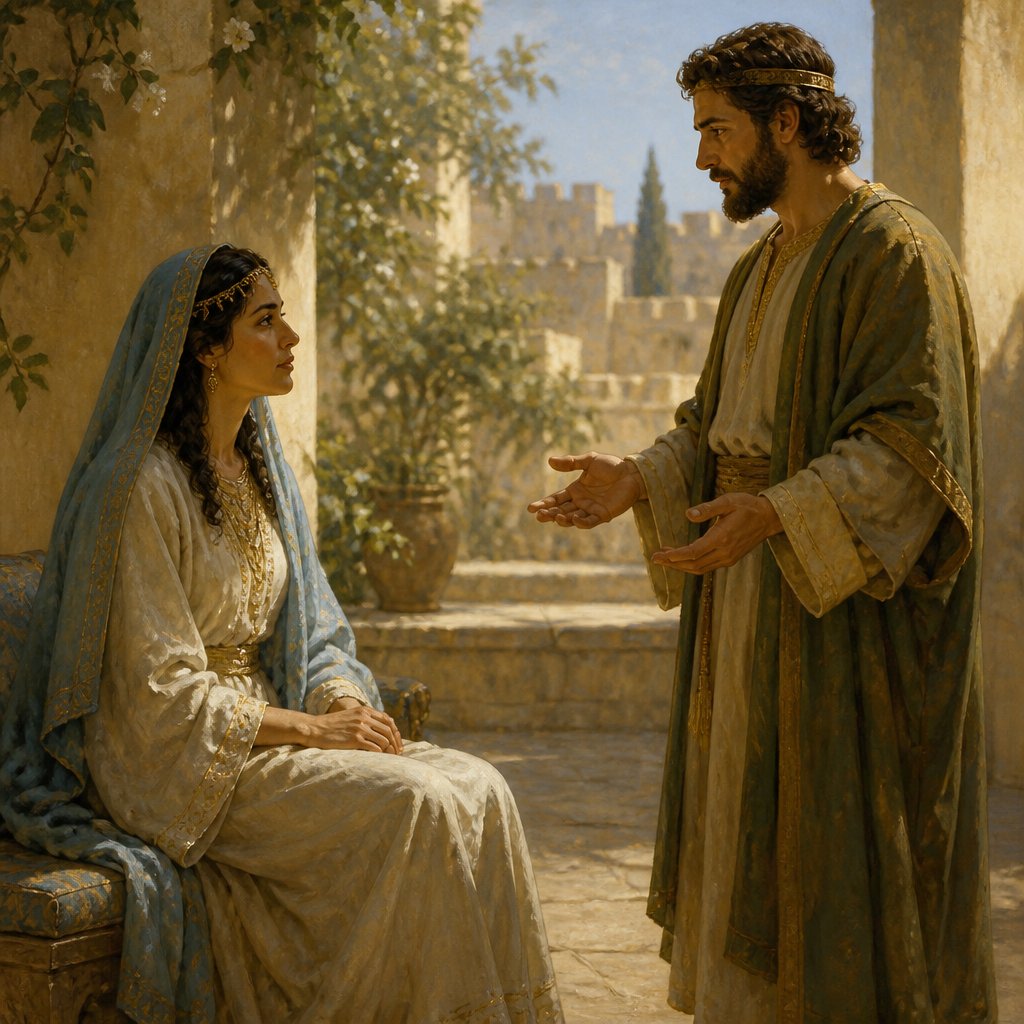
In 1 Kings 2:13 in the King James Version of the Bible, the verse reads: "And Adonijah the son of Haggith came to Bathsheba the mother of Solomon. And she said, Comest thou peaceably? And he said, Peaceably." This verse marks the beginning of a significant event in the history of Israel, as it sets the stage for the succession of King Solomon to the throne.
To fully understand the meaning and significance of this verse, it is important to consider the historical and political context in which it takes place. Adonijah was the fourth son of King David and had attempted to usurp the throne from his younger brother Solomon, the rightful heir. As a result, he was eventually put to death by Solomon for his attempt to seize power.
The meeting between Adonijah and Bathsheba, the mother of Solomon, is a crucial moment in the narrative as it reveals Adonijah's intentions and sets the scene for the events that follow. Bathsheba's question "Comest thou peaceably?" is significant as it shows her awareness of the potential for conflict and her desire to ensure that Adonijah's intentions are peaceful. Adonijah's response, "Peaceably," may be seen as an attempt to reassure Bathsheba and avoid any immediate confrontation.
One of the key themes in this verse is the struggle for power and succession. The tension between Adonijah and Solomon reflects the ongoing struggle for leadership and authority within the royal family. This theme is a recurring motif throughout the Bible, as various characters and dynasties vie for power and attempt to establish their legitimacy as rulers.
Another important theme in this verse is the importance of legitimate succession and the divine right to rule. In the biblical narrative, the line of succession is often seen as a matter of divine providence, as God's chosen leader is expected to rule in accordance with His will. Solomon's rightful claim to the throne, as the son of David and Bathsheba, is a crucial factor in the resolution of the conflict with Adonijah.
The symbolism in this verse is also significant, particularly in the characters of Adonijah and Solomon. Adonijah represents ambition and self-interest, as he seeks to assert his claim to the throne despite knowing that it goes against God's will. In contrast, Solomon embodies wisdom and divine favor, as he ultimately fulfills his destiny as the chosen ruler of Israel.
Overall, 1 Kings 2:13 marks a pivotal moment in the history of Israel, as it foreshadows the eventual resolution of the struggle for power and the establishment of Solomon as the legitimate king. The themes of succession, divine providence, and the struggle for power are central to the narrative, and the symbolism of the characters adds depth and complexity to the story. This verse serves as a reminder of the importance of staying true to God's will and the consequences of succumbing to ambition and self-interest.
Get our apps


Artwork for 1 Kings 2:13

1 Kings 2:13 - "¶ And Adonijah the son of Haggith came to Bath-sheba the mother of Solomon. And she said, Comest thou peaceably? And he said, Peaceably."
"¶ And Adonijah the son of Haggith came to Bath-sheba the mother of Solomon. And she said, Comest thou peaceably? And he said, Peaceably." - 1 Kings 2:13

2 Kings 13:13 - "And Joash slept with his fathers; and Jeroboam sat upon his throne: and Joash was buried in Samaria with the kings of Israel."

2 Kings 13:1 - "In the three and twentieth year of Joash the son of Ahaziah king of Judah Jehoahaz the son of Jehu began to reign over Israel in Samaria, and reigned seventeen years."

1 Kings 11:13

1 Kings 11:13

1 Kings 6:11-13

1 kings 11:11-13

1 Kings 11:11-13

2 Kings 13:22 - "¶ But Hazael king of Syria oppressed Israel all the days of Jehoahaz."

2 Kings 2:13 - "He took up also the mantle of Elijah that fell from him, and went back, and stood by the bank of Jordan;"

2 Kings 13:8 - "¶ Now the rest of the acts of Jehoahaz, and all that he did, and his might, are they not written in the book of the chronicles of the kings of Israel?"

1 Kings 6:11-13

1 Kings 6:11-13

1 Kings 6:11-13

1 Kings 6:11-13

1 Kings 11:11-13

1 Kings 7:13 - "¶ And king Solomon sent and fetched Hiram out of Tyre."

2 Kings 19:13 - "Where is the king of Hamath, and the king of Arpad, and the king of the city of Sepharvaim, of Hena, and Ivah?"

2 Kings 13:12 - "And the rest of the acts of Joash, and all that he did, and his might wherewith he fought against Amaziah king of Judah, are they not written in the book of the chronicles of the kings of Israel?"

1 Kings 13:13 - "And he said unto his sons, Saddle me the ass. So they saddled him the ass: and he rode thereon,"

2 Kings 19:2

2 Kings 19:2

2 Kings 19:2

1 Kings 12:13 - "And the king answered the people roughly, and forsook the old men's counsel that they gave him;"

2 Kings 13:20 - "¶ And Elisha died, and they buried him. And the bands of the Moabites invaded the land at the coming in of the year."

"And Joash slept with his fathers; and Jeroboam sat upon his throne: and Joash was buried in Samaria with the kings of Israel." - 2 Kings 13:13

2 Kings 13:24 - "So Hazael king of Syria died; and Ben-hadad his son reigned in his stead."

1 Kings 6:13 - "And I will dwell among the children of Israel, and will not forsake my people Israel."

1 Kings 5:13 - "¶ And king Solomon raised a levy out of all Israel; and the levy was thirty thousand men."