What does 1 Samuel 14:2 mean?
“And Saul tarried in the uttermost part of Gibeah under a pomegranate tree which is in Migron: and the people that were with him were about six hundred men;” — 1 Samuel 14:2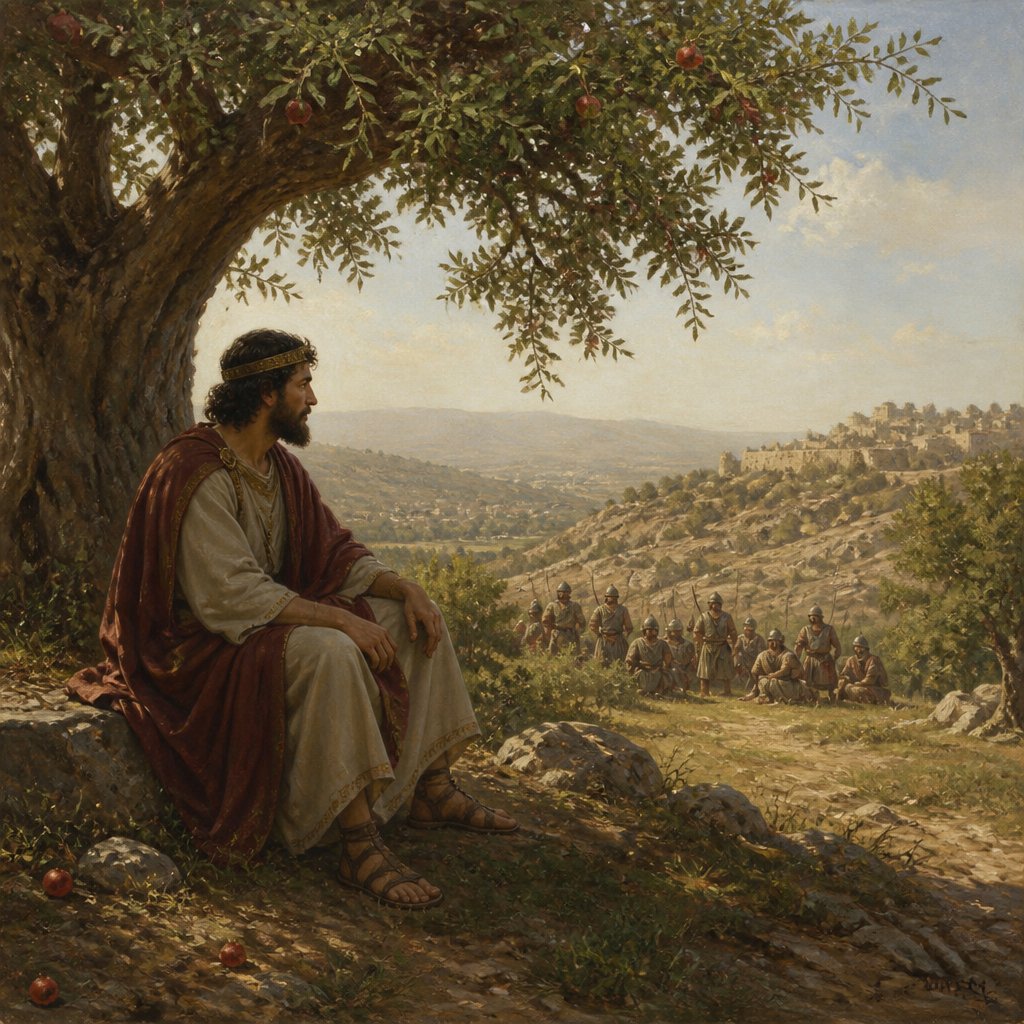
The verse 1 Samuel 14:2 in the King James Version of the Bible reads, "And Saul tarried in the uttermost part of Gibeah under a pomegranate tree which is in Migron: and the people that were with him were about six hundred men."
To fully understand the meaning and significance of this verse, it is important to consider the context in which it appears. The book of 1 Samuel is a historical account of the transition of leadership in Israel from judges to kings. Saul, who was the first king of Israel, is mentioned in this verse. At this point in the story, Saul is depicted as being in a position of leadership and power, with a large group of men at his disposal.
The verse describes Saul "tarried in the uttermost part of Gibeah under a pomegranate tree which is in Migron." This imagery serves to depict Saul as being in a place of comfort and rest. The pomegranate tree is traditionally seen in the Bible as a symbol of prosperity and abundance, which could suggest that Saul was enjoying the fruits of his leadership and the success he had achieved. However, it is noteworthy that Saul is described as "tarrying," which could imply a sense of delay or hesitation in his actions. This could be seen as a foreshadowing of the struggles and shortcomings that will befall Saul in the future.
The verse also mentions that Saul was accompanied by about six hundred men. This large number of followers indicates the extent of his authority and the strength of his army. However, it is also significant that Saul is depicted as being separated from these men, as he is under the pomegranate tree in Migron, while the rest of his people are not mentioned to be with him. This could hint at a potential disconnect between Saul and his followers, or a sense of isolation in his leadership.
Symbolically, the pomegranate tree can also be interpreted as a representation of fertility, abundance, and the divine presence. In Jewish tradition, the pomegranate is often associated with righteousness and the commandments of God. Therefore, Saul's proximity to the pomegranate tree could signify his divine appointment as king and his responsibility to uphold the laws and principles of God.
In a broader sense, this verse can be seen as a reflection of the complexities of leadership and the challenges that come with it. Saul's position under the pomegranate tree could be seen as a moment of contemplation and introspection, as he grapples with the responsibilities and burdens of leadership. The image of Saul resting under the tree could also be viewed as a symbol of his reliance on his own strength and power, rather than seeking guidance and wisdom from God.
The number six hundred, which is the size of Saul's army, is also symbolically significant. In biblical numerology, the number six often represents imperfection and incompleteness. This could suggest that despite Saul's sizable army, there are shortcomings and vulnerabilities in his leadership that will ultimately lead to his downfall.
In conclusion, 1 Samuel 14:2 offers a rich and multi-layered depiction of Saul's leadership and the challenges he faces. It serves as a reminder of the complexities of power and the importance of seeking divine guidance and wisdom in leadership. The symbolism of the pomegranate tree and the six hundred men adds depth and meaning to the verse, inviting readers to contemplate the themes of authority, responsibility, and the human condition.
Get our apps


Artwork for 1 Samuel 14:2

1 Samuel 14:2 - "And Saul tarried in the uttermost part of Gibeah under a pomegranate tree which is in Migron: and the people that were with him were about six hundred men;"
"And Saul tarried in the uttermost part of Gibeah under a pomegranate tree which is in Migron: and the people that were with him were about six hundred men;" - 1 Samuel 14:2

2 Samuel 6:14

2 Samuel 14:1 - "Now Joab the son of Zeruiah perceived that the king's heart was toward Absalom."

2 Samuel 1:14 - "And David said unto him, How wast thou not afraid to stretch forth thine hand to destroy the LORD'S anointed?"

1 Samuel 14:6

1 Samuel 14:7

1 Samuel 14:27
1 Samuel 13:14

1 Samuel 11:14 - "Then said Samuel to the people, Come, and let us go to Gilgal, and renew the kingdom there."

2 Samuel 6:14–22

1 Samuel 2:14 - "And he struck it into the pan, or kettle, or caldron, or pot; all that the fleshhook brought up the priest took for himself. So they did in Shiloh unto all the Israelites that came thither."

2 Samuel 23:14 - "And David was then in an hold, and the garrison of the Philistines was then in Beth-lehem."
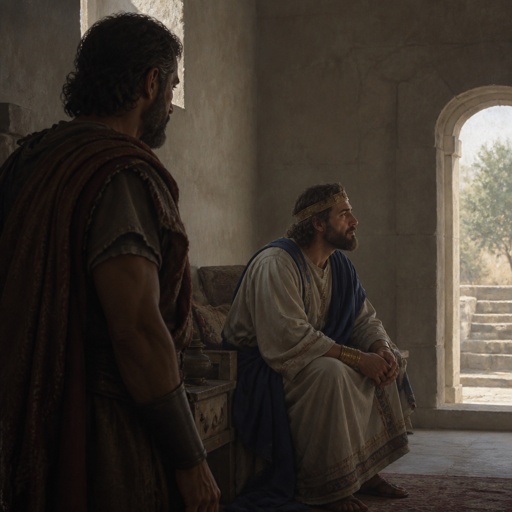
"Now Joab the son of Zeruiah perceived that the king's heart was toward Absalom." - 2 Samuel 14:1
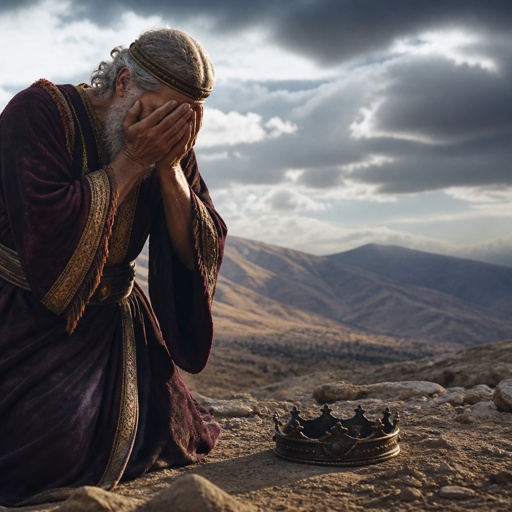
1 Samuel 13:13-14

1 Samuel 17:14 - "And David was the youngest: and the three eldest followed Saul."
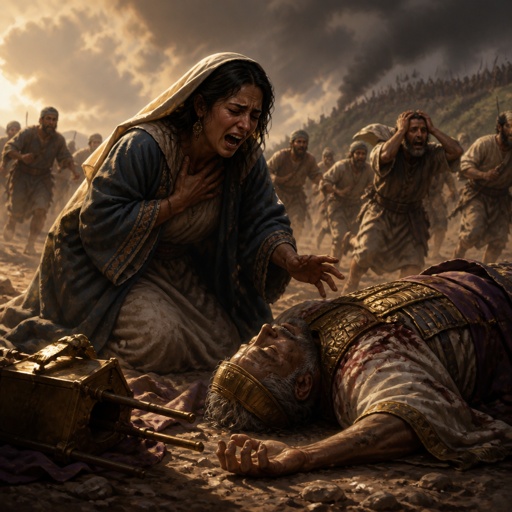
1 Samuel 4:14-16

1 Samuel 15:14 - "And Samuel said, What meaneth then this bleating of the sheep in mine ears, and the lowing of the oxen which I hear?"

2 Samuel 14:23 - "So Joab arose and went to Geshur, and brought Absalom to Jerusalem."

1 Samuel 14:51 - "And Kish was the father of Saul; and Ner the father of Abner was the son of Abiel."

1 Samuel 14:25 - "And all they of the land came to a wood; and there was honey upon the ground."

2 Samuel 22:14 - "The LORD thundered from heaven, and the most High uttered his voice."

2 Samuel 16:14 - "And the king, and all the people that were with him, came weary, and refreshed themselves there."

1 Samuel 9:14 - "And they went up into the city: and when they were come into the city, behold, Samuel came out against them, for to go up to the high place."

2 Samuel 14:28 - "¶ So Absalom dwelt two full years in Jerusalem, and saw not the king's face."

2 Samuel 11:14 - "¶ And it came to pass in the morning, that David wrote a letter to Joab, and sent it by the hand of Uriah."

1 Samuel 19:14 - "And when Saul sent messengers to take David, she said, He is sick."

1 Samuel 14:46 - "Then Saul went up from following the Philistines: and the Philistines went to their own place."

2 Samuel 2:14 - "And Abner said to Joab, Let the young men now arise, and play before us. And Joab said, Let them arise."

1 Samuel 14:35 - "And Saul built an altar unto the LORD: the same was the first altar that he built unto the LORD."