What does 1 Samuel 17:51 mean?
"Therefore David ran, and stood upon the Philistine, and took his sword, and drew it out of the sheath thereof, and slew him, and cut off his head therewith. And when the Philistines saw their champion was dead, they fled." - 1 Samuel 17:51
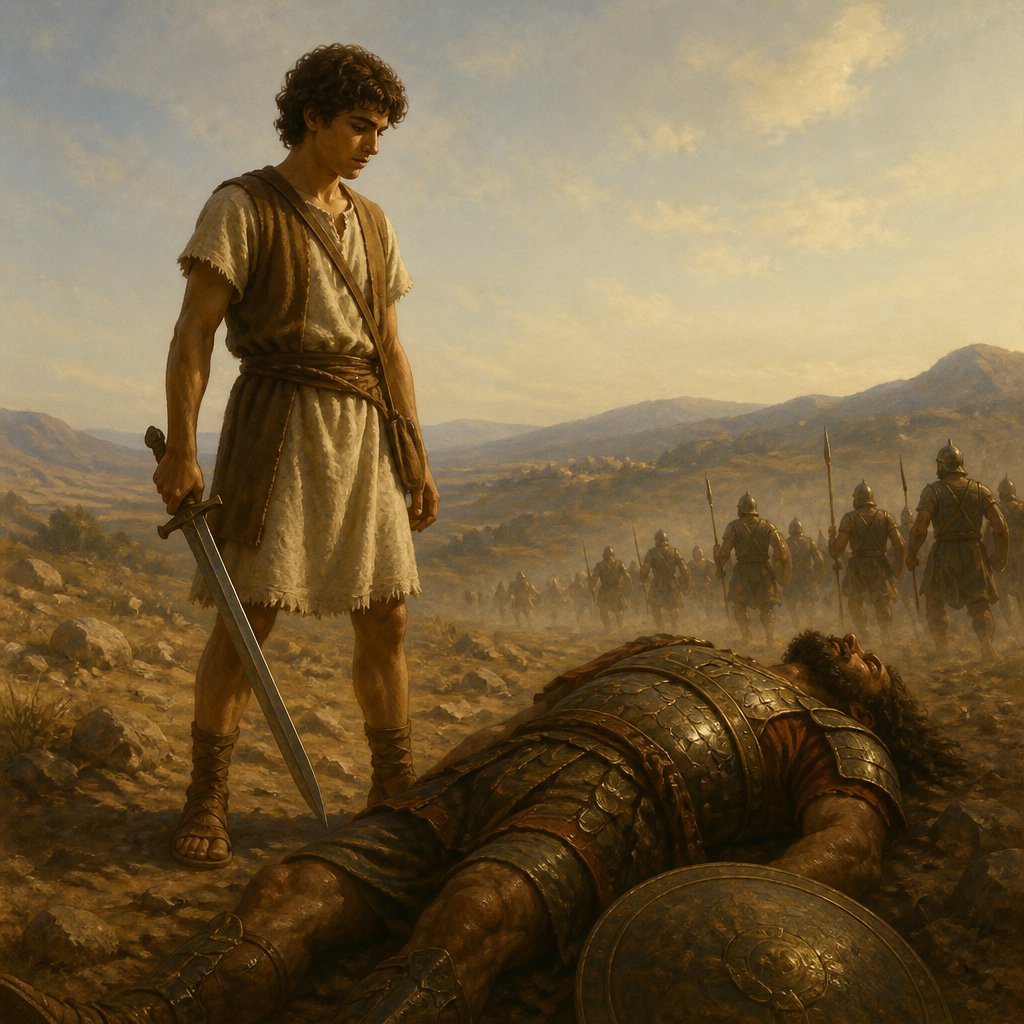
The Bible verse 1 Samuel 17:51 in the King James Version (KJV) reads, "Therefore David ran, and stood upon the Philistine, and took his sword, and drew it out of the sheath thereof, and slew him, and cut off his head therewith. And when the Philistines saw their champion was dead, they fled." This verse is part of the well-known story of David and Goliath, which is one of the most famous and beloved stories in the Bible. It is a story of triumph against all odds and illustrates the power of faith in God to overcome seemingly insurmountable obstacles.
The context of this verse is set in the midst of a great conflict between the Israelites and the Philistines. The Philistines had a champion named Goliath who was a giant of a man, standing over nine feet tall. Goliath challenged the Israelites to send out a champion to fight him in single combat, with the winner determining the outcome of the entire battle. The Israelites were terrified and none of their soldiers were willing to face Goliath, until David, a young shepherd boy, stepped forward and accepted the challenge.
The story of David and Goliath is rich with themes and symbolism that hold deep meaning for readers. One of the main themes of the story is the triumph of the underdog. On the surface, David seems to be no match for the powerful Goliath, but through his faith in God and his courage, he is able to defeat the giant. This serves as a powerful reminder that with God on our side, we can overcome any obstacle or enemy that stands in our way.
Another important theme in this story is the power of faith. David's faith in God is unwavering, and he demonstrates complete trust that God will deliver him from the hands of his enemies. This faith is what gives him the strength and courage to face Goliath head on, and it ultimately leads to his victory. This serves as a powerful example for believers to put their trust in God in the face of adversity and to have confidence in His ability to deliver them.
The symbolism in this verse is also significant. The act of David running and standing upon Goliath before taking his sword and slaying him is symbolic of the defeat of evil and the victory of righteousness over wickedness. Goliath represents the forces of evil and oppression, while David, with God's help, represents righteousness and justice. David's act of cutting off Goliath's head symbolizes the complete and final defeat of the enemy, and it serves as a powerful image of triumph and deliverance.
Furthermore, the reaction of the Philistines to the death of their champion is significant. Their fleeing in fear symbolizes the power of God to scatter the enemies of His people. It shows that when God's chosen ones stand up against their adversaries with faith and courage, the enemy will ultimately be defeated and driven away.
In conclusion, 1 Samuel 17:51 is a powerful and inspiring verse that holds deep meaning for believers. It is a story of triumph, faith, and courage, and it serves as a reminder of the power of God to deliver His people from any obstacle or enemy they may face. The themes and symbolism in this verse provide valuable lessons for believers to trust in God, stand firm in the face of adversity, and rely on His strength to overcome their enemies.
Have questions about 1 Samuel 17:51?
Dive deeper into this scripture with Bible Chat — an AI-powered tool for exploring God's Word through conversation. Ask questions, get context, and grow in your understanding of the Bible.
Get Our Apps


1 Samuel 17:51 Artwork
"Therefore David ran, and stood upon the Philistine, and took his sword, and drew it out of the sheath thereof, and slew him, and cut off his head therewith. And when the Philistines saw their champion was dead, they fled." - 1 Samuel 17:51

1 Samuel 14:51 - "And Kish was the father of Saul; and Ner the father of Abner was the son of Abiel."

Psalm 51:17

"And Kish was the father of Saul; and Ner the father of Abner was the son of Abiel." - 1 Samuel 14:51

1 Samuel 10:17 - "¶ And Samuel called the people together unto the LORD to Mizpeh;"

1 Samuel 17:33

1 Samuel 1:15-17

1 Samuel 17:34-35

1 Samuel 17:49

1 Samuel 17:45

1 Samuel 17:49

1 Samuel 17:45

1 samuel 17:3

1 Samuel 17:49

1 Samuel 17:45
1 Samuel 17:49

2 Samuel 1. 17-27

1 Samuel 17:38-40

1 Samuel 17:14 - "And David was the youngest: and the three eldest followed Saul."

1 Samuel 17:45-49

1 Samuel 17:56 - "And the king said, Enquire thou whose son the stripling is."

1 Samuel 9:17 - "And when Samuel saw Saul, the LORD said unto him, Behold the man whom I spake to thee of! this same shall reign over my people."

2 Samuel 1:17 - "¶ And David lamented with this lamentation over Saul and over Jonathan his son:"

Psalms 51:17 - "The sacrifices of God are a broken spirit: a broken and a contrite heart, O God, thou wilt not despise."

1 Samuel 17:19 - "Now Saul, and they, and all the men of Israel, were in the valley of Elah, fighting with the Philistines."

1 Samuel 17:29 - "And David said, What have I now done? Is there not a cause?"

"¶ And Samuel called the people together unto the LORD to Mizpeh;" - 1 Samuel 10:17

1 Samuel 17:21 - "For Israel and the Philistines had put the battle in array, army against army."

1 Samuel 17:53 - "And the children of Israel returned from chasing after the Philistines, and they spoiled their tents."

1 Samuel 8:17 - "He will take the tenth of your sheep: and ye shall be his servants."