What does 1 Samuel 30:14 mean?
“We made an invasion upon the south of the Cherethites, and upon the coast which belongeth to Judah, and upon the south of Caleb; and we burned Ziklag with fire.” — 1 Samuel 30:14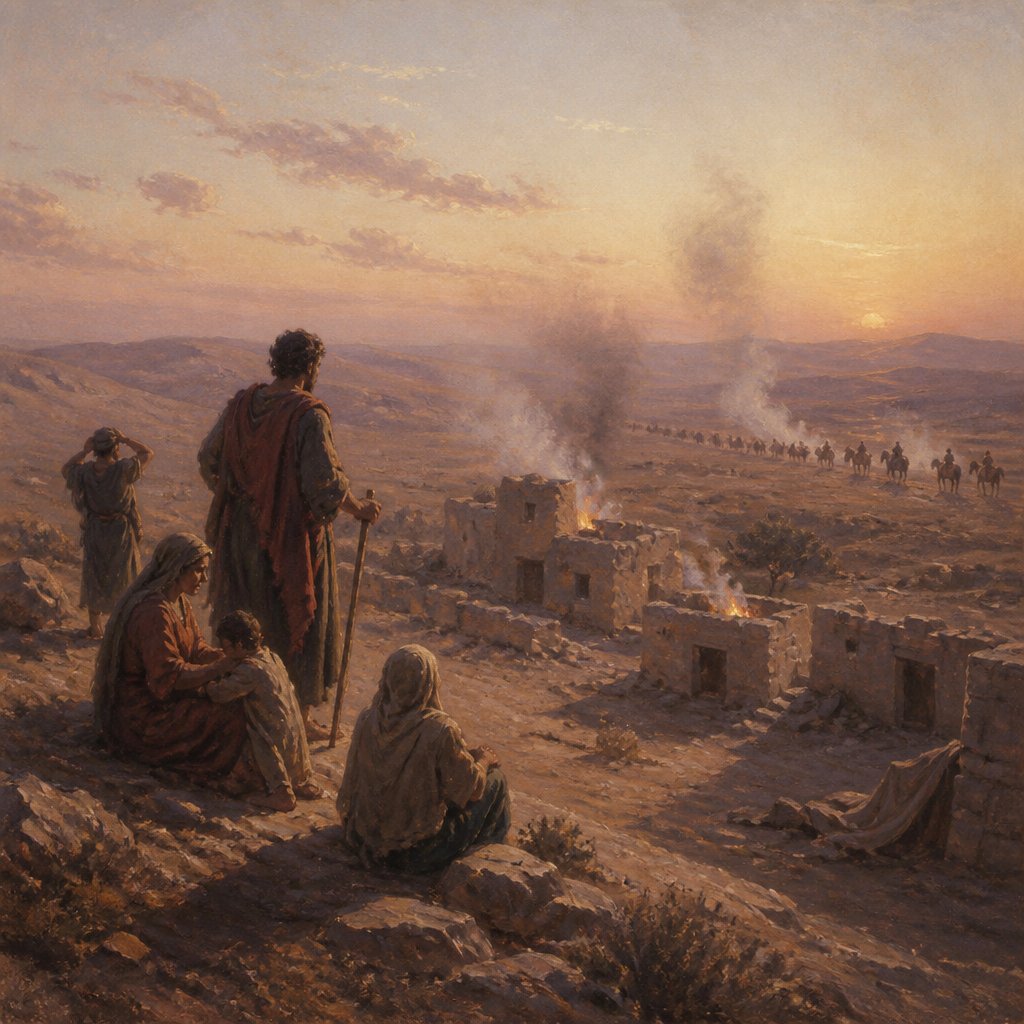
The verse 1 Samuel 30:14 from the King James Version (KJV) reads, "We made an invasion upon the south of the Cherethites, and upon the coast which belongeth to Judah, and upon the south of Caleb; and we burned Ziklag with fire." This verse is part of the larger story of David and his men's return to Ziklag, their home, only to find it burned and their families taken captive. This verse is spoken by an Amalekite who joins David upon his return.
The context of this verse is crucial to understanding its significance. David had been living in Philistine territory, at the town of Ziklag, and had gained the favor of King Achish. However, when the Philistine rulers rejected David's involvement in their upcoming battle against Israel, David and his men were forced to return to Ziklag. Upon their return, they found the town burned and their families taken captive by the Amalekites. The verse in question is part of an account given by an Amalekite who claimed to have deserted his people and joined David's forces. This particular statement is his claim of involvement in the destruction of Ziklag, showing the devastation caused by the Amalekites.
The verse holds several important themes, the primary one being the consequences of the choices made by individuals and nations. The Amalekites' attack on Ziklag and the subsequent misery inflicted on its inhabitants is a direct result of the Amalekites' choice to engage in raiding and plunder. This reinforces the idea of reaping what one sows and the inevitable effects of violence and destruction.
Another significant theme is the concept of betrayal and deceit. The Amalekite's claim of joining David's forces and his involvement in the destruction of Ziklag is portrayed as an act of betrayal against his own people. This highlights the moral complexities of the characters in the story and raises questions about loyalty and honor.
The verse also symbolizes the fragility of human security and the transient nature of possessions. The sudden and unexpected destruction of Ziklag serves as a reminder of the impermanence of material possessions and the dangers of placing too much trust in earthly belongings. It also emphasizes the vulnerability of human life and the importance of reliance on God rather than worldly goods.
Furthermore, the verse sheds light on the recurring biblical theme of the conflict between good and evil. The Amalekites, in their violent raid on Ziklag, represent the forces of evil and chaos, while David and his men, in their quest to rescue their families, represent the forces of righteousness and justice. This dichotomy reflects the ongoing struggle between good and evil in the biblical narrative and emphasizes the need for courage and faith in the face of adversity.
In conclusion, 1 Samuel 30:14 from the King James Version holds profound significance within the larger context of the story of David and his men. It addresses themes of choice and consequence, betrayal and deceit, the fragility of human security, and the conflict between good and evil. Through its rich symbolism and powerful imagery, this verse offers valuable insights into the complexities of human nature and the eternal struggle for righteousness.
Get our apps


Artwork for 1 Samuel 30:14

1 Samuel 30:14 - "We made an invasion upon the south of the Cherethites, and upon the coast which belongeth to Judah, and upon the south of Caleb; and we burned Ziklag with fire."
"We made an invasion upon the south of the Cherethites, and upon the coast which belongeth to Judah, and upon the south of Caleb; and we burned Ziklag with fire." - 1 Samuel 30:14
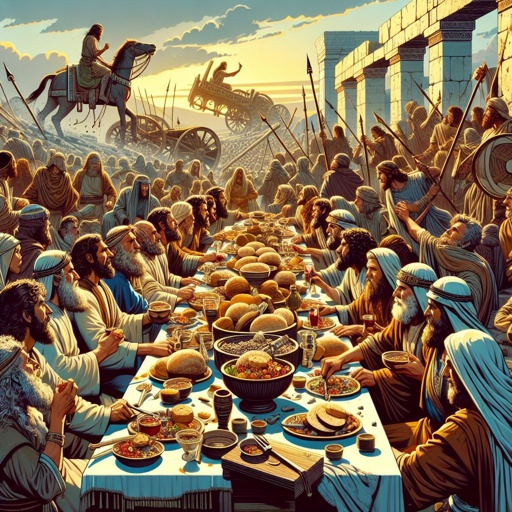
1 Samuel 14:30 - "How much more, if haply the people had eaten freely to day of the spoil of their enemies which they found? for had there not been now a much greater slaughter among the Philistines?"

1.samuel 15:30

1 Samuel 30:18

1.samuel 15:30

1 Samuel 30:30 - "And to them which were in Hormah, and to them which were in Chorashan, and to them which were in Athach,"
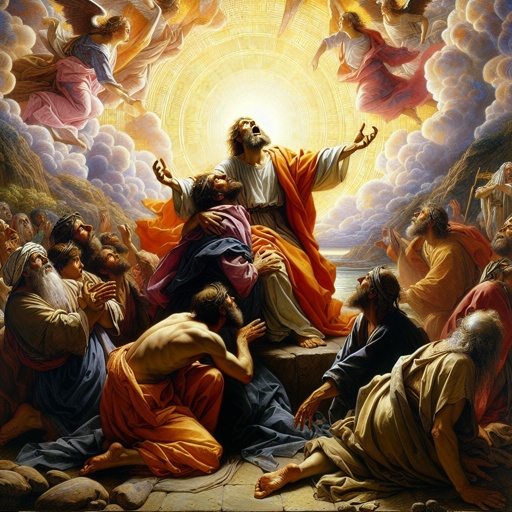
1 Samuel 20:27-30

1 Samuel 14:6

1 Kings 14:30 - "And there was war between Rehoboam and Jeroboam all their days."

1 Samuel 14:27
1 Samuel 13:14

2 Samuel 6:14

1 Samuel 14:7

1 Samuel 11:14 - "Then said Samuel to the people, Come, and let us go to Gilgal, and renew the kingdom there."

1 Samuel 30:25 - "And it was so from that day forward, that he made it a statute and an ordinance for Israel unto this day."

2 Samuel 14:30 - "Therefore he said unto his servants, See, Joab's field is near mine, and he hath barley there; go and set it on fire. And Absalom's servants set the field on fire."

1 Samuel 30:28 - "And to them which were in Aroer, and to them which were in Siphmoth, and to them which were in Eshtemoa,"

1 Samuel 30:18 - "And David recovered all that the Amalekites had carried away: and David rescued his two wives."

1 Samuel 30:5 - "And David's two wives were taken captives, Ahinoam the Jezreelitess, and Abigail the wife of Nabal the Carmelite."
1 Samuel 13:13-14

1 Samuel 17:14 - "And David was the youngest: and the three eldest followed Saul."
1 Samuel 4:14-16

1 Samuel 30:4 - "Then David and the people that were with him lifted up their voice and wept, until they had no more power to weep."

1 Corinthians 14:30 - "If any thing be revealed to another that sitteth by, let the first hold his peace."

1 Samuel 15:14 - "And Samuel said, What meaneth then this bleating of the sheep in mine ears, and the lowing of the oxen which I hear?"

1 Samuel 30:29 - "And to them which were in Rachal, and to them which were in the cities of the Jerahmeelites, and to them which were in the cities of the Kenites,"

1 Samuel 30:31 - "And to them which were in Hebron, and to all the places where David himself and his men were wont to haunt."

1 Samuel 30:27 - "To them which were in Beth-el, and to them which were in south Ramoth, and to them which were in Jattir,"

1 Samuel 30:20 - "And David took all the flocks and the herds, which they drave before those other cattle, and said, This is David's spoil."