What does 1 Samuel 30:6 mean?
"And David was greatly distressed; for the people spake of stoning him, because the soul of all the people was grieved, every man for his sons and for his daughters: but David encouraged himself in the LORD his God." - 1 Samuel 30:6
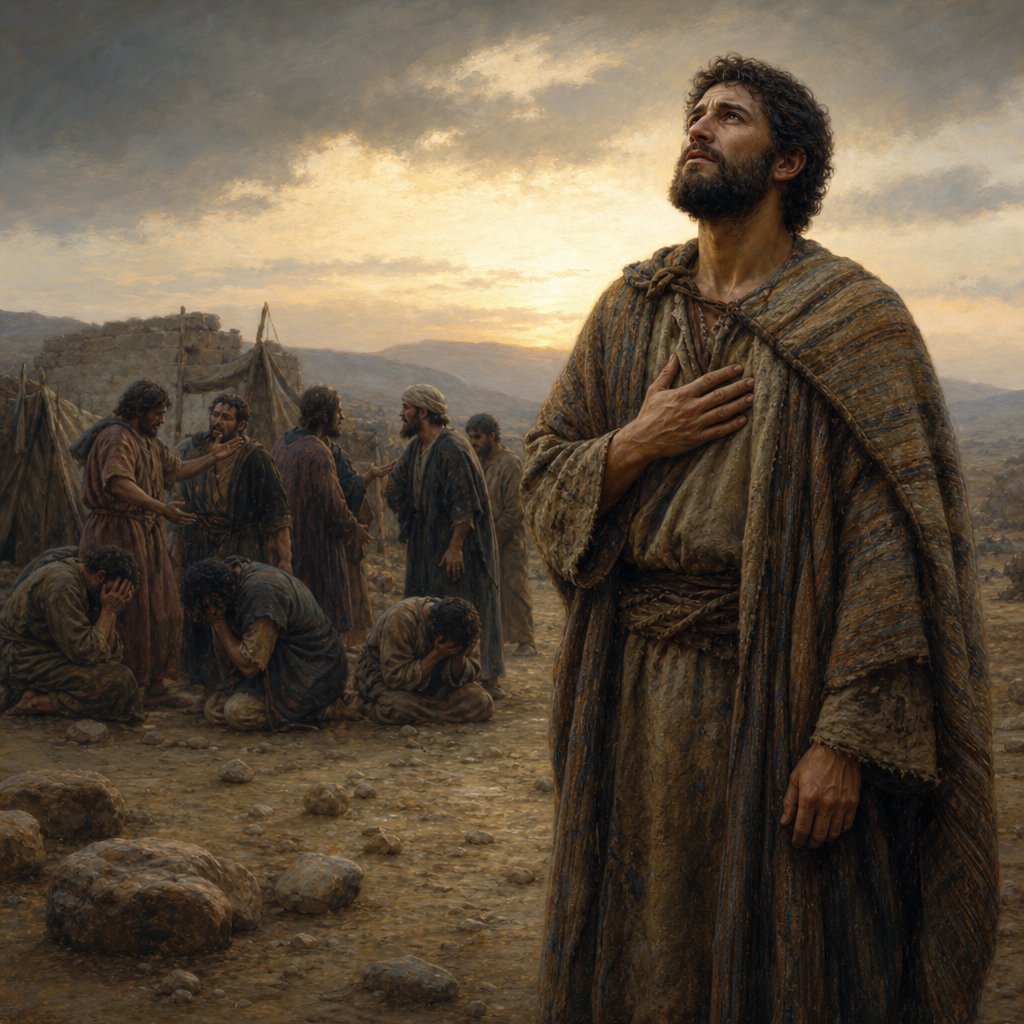
“**And David was greatly distressed; for the people spake of stoning him, because the soul of all the people was grieved, every man for his sons and for his daughters: but David encouraged himself in the LORD his God.**” (1 Samuel 30:6, KJV)
The verse stands at a moment when David’s life is pressed to its breaking point, and its meaning is best felt when read inside the crisis that produces it. David and his men return to Ziklag and find devastation: the city burned and their wives and children taken captive. Nothing is left in place except ashes and absence. The men who have followed David through danger now find that the cost of following him has reached their own homes. This verse captures the turning of their grief into anger, and then the turning of David’s despair into faith.
The first phrase, “David was greatly distressed,” is not merely emotional discomfort but the tightening of circumstances around him from every side. David is already living as a fugitive from Saul and has been moving among the Philistines; now he returns to find that what remained of stability has been ripped away. The distress is intensified because David is not only suffering the same loss as his men; he is also held responsible for it. In the narrative, David carries a double burden: private pain and public blame.
That blame becomes explicit in “the people spake of stoning him.” In Israel, stoning is a community act of judgment, a punishment associated with removing evil from among the people. Here, however, the impulse is not careful justice but raw retaliation. The men’s talk of stoning reveals a grim human reflex: grief searches for a target. When the heart is overwhelmed, it often demands a visible culprit, and leadership becomes the nearest object. The verse shows how quickly a crowd can pivot from loyalty to violence when “the soul of all the people was grieved.” The word “soul” in this setting points to their whole inner life, their breath and being, weighed down by loss. Their grief is personal and piercing: “every man for his sons and for his daughters.” The text forces the reader to understand that this is not abstract suffering. It is the ache of parents, the terror of what might be done to their children, the helplessness of not knowing if they will ever see them again. Their threatened violence against David rises out of that unbearable dread.
The verse then places a sharp “but” in the middle of the calamity: “but David encouraged himself in the LORD his God.” This is the spiritual center of the passage. David’s circumstances do not improve at this moment; his danger actually increases, because the men closest to him are ready to kill him. The significance is that the encouragement David finds is not sourced from the crowd, not from a favorable report, and not from his own strength as a warrior. The KJV’s phrasing is striking: he “encouraged himself.” No one is said to comfort him; the community has turned against him; the future is uncertain. Yet David takes active steps within his own heart to lay hold of God. The action is inward but not self-reliant, because the object of his encouragement is “the LORD.”
Calling God “the LORD” anchors the moment in covenant faithfulness. “The LORD” in the KJV represents the covenant name by which God is known in Israel, the One who promised, delivered, judged, and kept mercy. David does not merely reach for a vague hope that things might get better; he reaches for the character of God as He has revealed Himself. And the verse adds “his God,” which does not mean God belongs to David as property, but that David belongs to God in personal relationship. In the very hour when the people are ready to sever their relationship with David by violence, David reaffirms the relationship that cannot be taken from him: he is the LORD’s.
A key theme is the loneliness of godly leadership under pressure. David is not presented as fearless; he is “greatly distressed.” The Bible does not sanitize the emotional reality of the righteous. Yet it shows that distress need not end in collapse. When every external support is removed, the verse presents an inward turning to God as the decisive act. David’s encouragement in the LORD becomes the hinge between catastrophe and recovery. In the surrounding story, it precedes David’s seeking God’s direction and then pursuing the captors. The order matters: encouragement in the LORD comes before strategy, before pursuit, before victory. The verse teaches that spiritual resilience is not denial of pain but re-centering of the soul upon God in the midst of pain.
There is also a symbolic weight in the scene. Ziklag burned with fire and emptied of families becomes an image of what life looks like when human security is stripped away. The men’s impulse to stone David mirrors the human tendency to turn anguish into accusation, as though a sacrifice could quiet the chaos. Against that, David’s response symbolizes a different sacrifice: not the taking of a life to soothe grief, but the offering of a troubled heart to the LORD for steadiness. The crowd looks downward for a victim; David looks upward for help. The contrast reveals what faith is in a biblical sense: not optimism, but God-centered strengthening when every human angle is dark.
Finally, the verse underscores the moral and spiritual turning point in David himself. He will become king, but kingship in the biblical story is not founded merely on charisma or military success. It is founded on dependence on God. In 1 Samuel 30:6, David is shown not as a man who never breaks, but as a man who, when pressed, returns to the LORD as the source of courage. The significance of the verse is that it captures the secret of David’s endurance: when he has no applause, no safety, and no certainty, he still finds a way to “encourage” his heart in God. That inward act becomes the beginning of outward deliverance, and it shows how, in Scripture, the decisive battles are often fought first within the soul.
Have questions about 1 Samuel 30:6?
Dive deeper into this scripture with Bible Chat — an AI-powered tool for exploring God's Word through conversation. Ask questions, get context, and grow in your understanding of the Bible.
Get Our Apps


1 Samuel 30:6 Artwork

1 Samuel 30:6 - "And David was greatly distressed; for the people spake of stoning him, because the soul of all the people was grieved, every man for his sons and for his daughters: but David encouraged himself in the LORD his God."
"And David was greatly distressed; for the people spake of stoning him, because the soul of all the people was grieved, every man for his sons and for his daughters: but David encouraged himself in the LORD his God." - 1 Samuel 30:6

1.samuel 15:30

1 Samuel 30:18

1.samuel 15:30

1 Samuel 30:30 - "And to them which were in Hormah, and to them which were in Chorashan, and to them which were in Athach,"
1 Samuel 20:27-30

Matthew 6:30

1 Samuel 14:6

1 Samuel 30:25 - "And it was so from that day forward, that he made it a statute and an ordinance for Israel unto this day."

1 Samuel 30:28 - "And to them which were in Aroer, and to them which were in Siphmoth, and to them which were in Eshtemoa,"

1 Samuel 30:18 - "And David recovered all that the Amalekites had carried away: and David rescued his two wives."

1 Samuel 30:5 - "And David's two wives were taken captives, Ahinoam the Jezreelitess, and Abigail the wife of Nabal the Carmelite."

1 Samuel 8:6 - "¶ But the thing displeased Samuel, when they said, Give us a king to judge us. And Samuel prayed unto the LORD."

1 Kings 6:30 - "And the floor of the house he overlaid with gold, within and without."

1 Samuel 6:1 - "And the ark of the LORD was in the country of the Philistines seven months."

2 Samuel 6:14

1 Samuel 30:4 - "Then David and the people that were with him lifted up their voice and wept, until they had no more power to weep."

1 Samuel 30:29 - "And to them which were in Rachal, and to them which were in the cities of the Jerahmeelites, and to them which were in the cities of the Kenites,"

1 Samuel 30:31 - "And to them which were in Hebron, and to all the places where David himself and his men were wont to haunt."

1 Samuel 30:27 - "To them which were in Beth-el, and to them which were in south Ramoth, and to them which were in Jattir,"

1 Samuel 30:20 - "And David took all the flocks and the herds, which they drave before those other cattle, and said, This is David's spoil."

1 Samuel 30:1 - "And it came to pass, when David and his men were come to Ziklag on the third day, that the Amalekites had invaded the south, and Ziklag, and smitten Ziklag, and burned it with fire;"

1 Chronicles 6:30 - "Shimea his son, Haggiah his son, Asaiah his son."

1 Samuel 30:3 - "¶ So David and his men came to the city, and, behold, it was burned with fire; and their wives, and their sons, and their daughters, were taken captives."

1 Chronicles 6:28 - "And the sons of Samuel; the firstborn Vashni, and Abiah."

1 Samuel 17:30 - "¶ And he turned from him toward another, and spake after the same manner: and the people answered him again after the former manner."

"And to them which were in Hormah, and to them which were in Chorashan, and to them which were in Athach," - 1 Samuel 30:30

1 Samuel 30:2 - "And had taken the women captives, that were therein: they slew not any, either great or small, but carried them away, and went on their way."

1 Samuel 30:11 - "¶ And they found an Egyptian in the field, and brought him to David, and gave him bread, and he did eat; and they made him drink water;"