What does 2 Chronicles 16:1 mean?
“In the six and thirtieth year of the reign of Asa Baasha king of Israel came up against Judah, and built Ramah, to the intent that he might let none go out or come in to Asa king of Judah.” — 2 Chronicles 16:1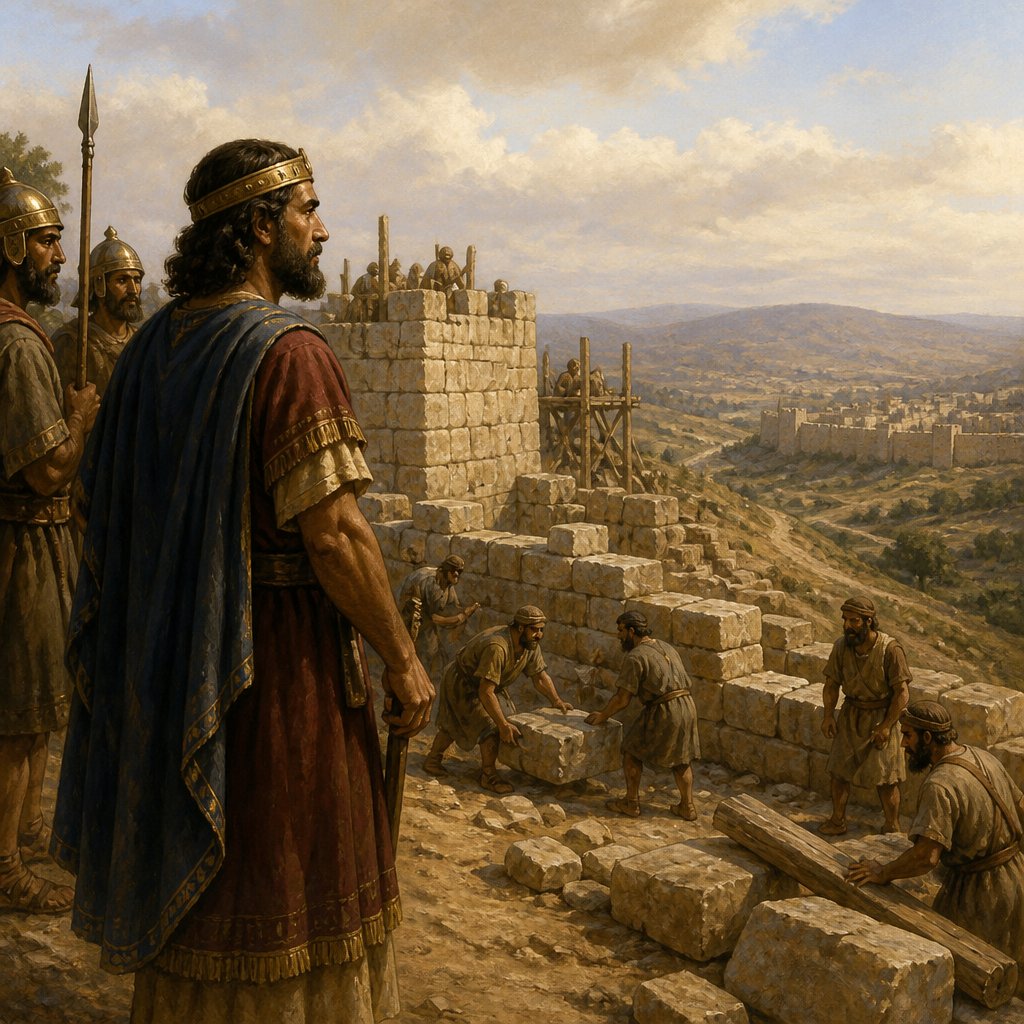
The verse 2 Chronicles 16:1 in the King James Version of the Bible reads, "In the six and thirtieth year of the reign of Asa Baasha king of Israel came up against Judah, and built Ramah, to the intent that he might let none go out or come in to Asa king of Judah."
This verse is part of the historical account of the reign of King Asa of Judah, who reigned for a total of 41 years. The verse is situated in the context of a period of conflict between Israel and Judah, and it details a specific event in the ongoing struggle for power and territory in the region.
In order to understand the full meaning and implications of this verse, it is important to consider the broader historical and political context in which these events took place. The split between the kingdoms of Israel and Judah occurred after the death of King Solomon, with Jeroboam becoming the first king of the northern kingdom of Israel and Rehoboam ruling over the southern kingdom of Judah. This division led to centuries of conflict and occasional alliances between the two kingdoms, as well as with neighboring powers such as Assyria and Egypt.
The specific incident described in 2 Chronicles 16:1 involves King Asa of Judah and King Baasha of Israel. Baasha had come to power through a coup, overthrowing the previous king of Israel, Nadab. Baasha's reign was marked by ongoing conflict with the kingdom of Judah, and he initiated hostilities by building the fortress of Ramah, a strategic location near the border between the two kingdoms. This fortress was intended to control the movement of people and goods in and out of Judah, effectively blockading the kingdom and restricting its ability to trade and communicate with external allies.
The significance of this verse lies in its portrayal of the political and military strategies employed by the rulers of Israel and Judah. It highlights the constant tension and competition between the two kingdoms, as well as their efforts to assert dominance and control over each other. The construction of the fortress at Ramah by Baasha represents a deliberate act of aggression and provocation, aimed at weakening the position of King Asa and undermining the stability and prosperity of Judah.
Additionally, this verse also sheds light on the character and leadership of King Asa. His response to the threat posed by Baasha's actions is a crucial aspect of the narrative. Asa's reign was characterized by a mixture of faithfulness and shortcomings, and this particular episode serves as a test of his faith in God and his ability to navigate the complex challenges of ruling a kingdom in a volatile geopolitical environment. The subsequent actions of Asa, including seeking assistance from a foreign power and making a treaty with them, reflect his reliance on human alliances rather than complete trust in the Lord. This decision is later rebuked by the prophet Hanani, who reminds Asa that reliance on God alone is the key to victory and security.
Symbolically, the construction of the fortress at Ramah and the ensuing conflict between Baasha and Asa can be interpreted as a metaphor for the broader struggles and conflicts that characterize human history and the constant quest for power and control. The themes of trust, faith, and reliance on God in the face of adversity are prominent in this verse, as is the reminder that earthly alliances and military might are ultimately insufficient without the guidance and blessing of the Lord.
In conclusion, 2 Chronicles 16:1 captures a key moment in the tumultuous relationship between the kingdoms of Israel and Judah, and offers valuable insights into the political, military, and spiritual dimensions of ancient Near Eastern history. The verse serves as a reminder of the enduring relevance of themes such as power, faith, and divine providence, and it provides a rich and multifaceted narrative that continues to resonate with readers today.
Get our apps


Artwork for 2 Chronicles 16:1

2 Chronicles 16:1 - "In the six and thirtieth year of the reign of Asa Baasha king of Israel came up against Judah, and built Ramah, to the intent that he might let none go out or come in to Asa king of Judah."
"In the six and thirtieth year of the reign of Asa Baasha king of Israel came up against Judah, and built Ramah, to the intent that he might let none go out or come in to Asa king of Judah." - 2 Chronicles 16:1

1 Chronicles 2:16 - "Whose sisters were Zeruiah, and Abigail. And the sons of Zeruiah; Abishai, and Joab, and Asahel, three."

2 Chronicles 1:16 - "And Solomon had horses brought out of Egypt, and linen yarn: the king's merchants received the linen yarn at a price."

1 Chronicles 16:2 - "And when David had made an end of offering the burnt offerings and the peace offerings, he blessed the people in the name of the LORD."

1 Chronicles 1:16 - "And the Arvadite, and the Zemarite, and the Hamathite."

1 Chronicles 16:16 - "Even of the covenant which he made with Abraham, and of his oath unto Isaac;"

1 Chronicles 24:16 - "The nineteenth to Pethahiah, the twentieth to Jehezekel,"

1 Chronicles 23:16 - "Of the sons of Gershom, Shebuel was the chief."

1 Chronicles 6:16 - "¶ The sons of Levi; Gershom, Kohath, and Merari."

1 Chronicles 8:16 - "And Michael, and Ispah, and Joha, the sons of Beriah;"

"And the Arvadite, and the Zemarite, and the Hamathite." - 1 Chronicles 1:16

1 Chronicles 11:16 - "And David was then in the hold, and the Philistines' garrison was then at Beth-lehem."

1 Chronicles 4:16 - "And the sons of Jehaleleel; Ziph, and Ziphah, Tiria, and Asareel."

1 Chronicles 16:19 - "When ye were but few, even a few, and strangers in it."

2 Chronicles 13:16 - "And the children of Israel fled before Judah: and God delivered them into their hand."

1 Chronicles 12:16 - "And there came of the children of Benjamin and Judah to the hold unto David."

1 Chronicles 16:26 - "For all the gods of the people are idols: but the LORD made the heavens."

2 Chronicles 28:16 - "¶ At that time did king Ahaz send unto the kings of Assyria to help him."

1 Chronicles 16:27 - "Glory and honour are in his presence; strength and gladness are in his place."

1 Chronicles 3:16 - "And the sons of Jehoiakim: Jeconiah his son, Zedekiah his son."

"Whose sisters were Zeruiah, and Abigail. And the sons of Zeruiah; Abishai, and Joab, and Asahel, three." - 1 Chronicles 2:16

2 Chronicles 16:13 - "¶ And Asa slept with his fathers, and died in the one and fortieth year of his reign."

1 Chronicles 16:17 - "And hath confirmed the same to Jacob for a law, and to Israel for an everlasting covenant,"

1 Chronicles 16:14 - "He is the LORD our God; his judgments are in all the earth."

1 Chronicles 16:22 - "Saying, Touch not mine anointed, and do my prophets no harm."

1 Chronicles 16:11 - "Seek the LORD and his strength, seek his face continually."

1 Chronicles 25:16 - "The ninth to Mattaniah, he, his sons, and his brethren, were twelve:"

2 Chronicles 16:11 - "¶ And, behold, the acts of Asa, first and last, lo, they are written in the book of the kings of Judah and Israel."

1 Chronicles 16:1 - "So they brought the ark of God, and set it in the midst of the tent that David had pitched for it: and they offered burnt sacrifices and peace offerings before God."