What does 2 Kings 18:4 mean?
“He removed the high places, and brake the images, and cut down the groves, and brake in pieces the brasen serpent that Moses had made: for unto those days the children of Israel did burn incense to it: and he called it Nehushtan.” — 2 Kings 18:4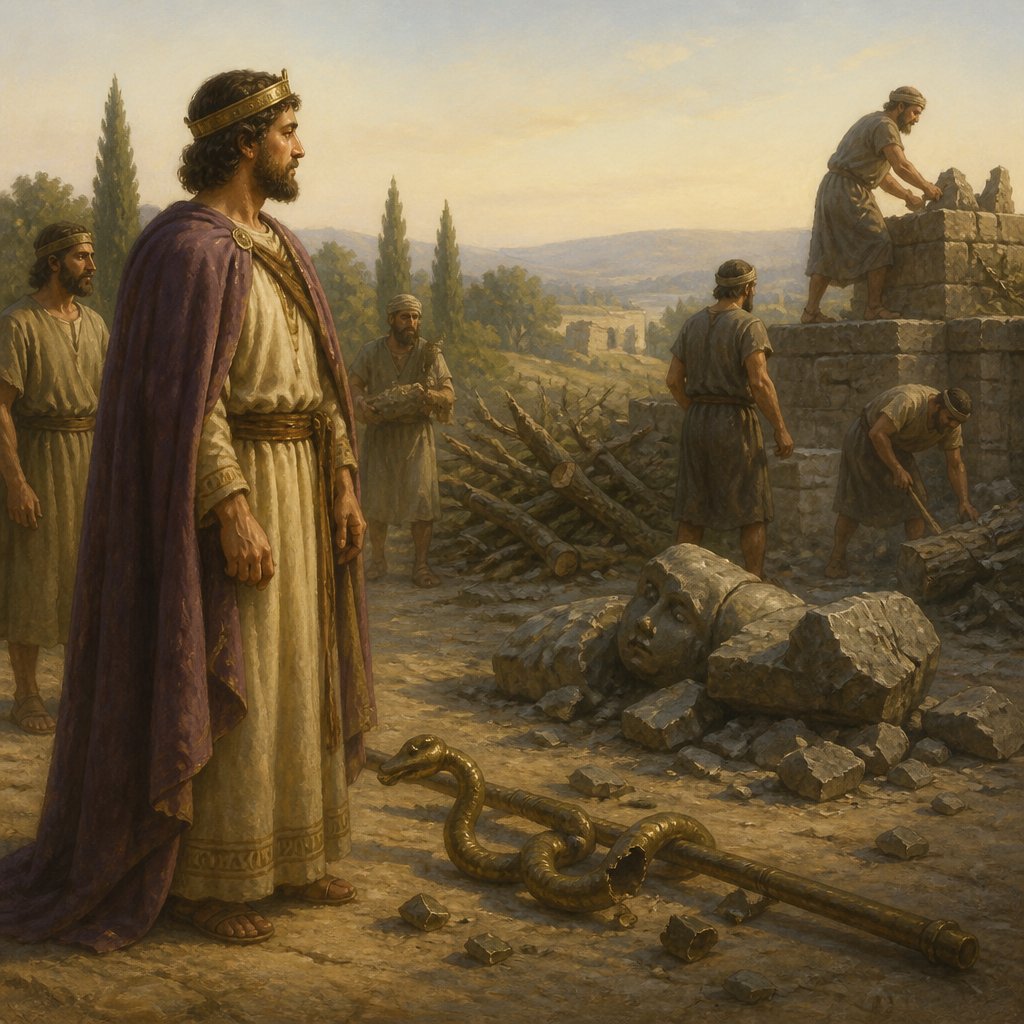
2 Kings 18:4 (KJV) reads, "He removed the high places, and brake the images, and cut down the groves, and brake in pieces the brasen serpent that Moses had made: for unto those days the children of Israel did burn incense to it: and he called it Nehushtan."
This verse is part of the historical narrative in the book of 2 Kings, which details the reign of King Hezekiah of Judah. Hezekiah was a righteous king who sought to bring religious reform to the people of Judah, and this verse specifically highlights his efforts to eradicate idolatry from the land. The verse demonstrates Hezekiah's commitment to purifying the worship of God and removing anything that could lead the people astray from the true faith.
The "high places" mentioned in the verse refer to the locations where the people of Israel would traditionally offer sacrifices and worship idols. These were often located in elevated areas and were associated with the Canaanite fertility cults. Hezekiah's actions in removing these high places were in line with the commandments given by God in the Mosaic Law, which prohibited the worship of other gods and the use of high places for sacrifices. By removing these sites, Hezekiah sought to centralize worship at the temple in Jerusalem and redirect the people's devotion to the true God.
The verse also mentions the breaking of images and cutting down of groves, which were associated with the worship of false gods and goddesses. In the ancient Near East, it was common for people to create and worship idols that represented various deities, but Hezekiah took a stand against this practice and actively destroyed these physical representations of idolatry. This act demonstrates Hezekiah's commitment to eliminating all forms of false worship and purifying the religious practices of his people.
The most striking action mentioned in this verse is Hezekiah's destruction of the bronze serpent that Moses had made. This reference harkens back to an incident recorded in the book of Numbers (21:4-9), where the people of Israel were afflicted by poisonous snakes as a punishment for their grumbling and disobedience. In response to their cries for help, God instructed Moses to make a bronze serpent and lift it up on a pole, so that anyone who had been bitten could look at it and live. The bronze serpent served as a symbol of God's healing and deliverance, but over time it became an object of worship for the Israelites. Hezekiah's decision to destroy this relic is a bold statement against the people's misuse of a sacred object and a reminder of the importance of keeping true faith in God and not in material symbols.
The verse ends with Hezekiah referring to the bronze serpent as "Nehushtan," which means "a thing of brass." This derogatory term reflects Hezekiah's contempt for the idolatrous practices of the people and his determination to expose the bronze serpent for what it had become—a mere piece of metal with no divine power.
In addition to its historical significance, 2 Kings 18:4 carries important theological themes related to the nature of true worship and the dangers of idolatry. The verse highlights the importance of exclusive devotion to the one true God and the rejection of false religious practices. Hezekiah's actions serve as a model for leaders and individuals in their commitment to upholding the purity of worship and adhering to the commandments of God.
This verse also serves as a cautionary tale about the potential for sacred objects and rituals to be distorted and misused, leading people away from genuine faith. It reminds us of the need to constantly evaluate our religious practices and ensure that they remain true to the teachings of God.
Symbolically, the actions of Hezekiah in 2 Kings 18:4 can also be seen as a prefiguration of the purifying work of Jesus Christ. Just as Hezekiah sought to cleanse the land of idolatry, Jesus came to cleanse the hearts of believers and lead them into a proper relationship with God. The destruction of the bronze serpent can be seen as a foreshadowing of the destruction of sin and death through the crucifixion and resurrection of Christ.
In conclusion, 2 Kings 18:4 is a significant and thought-provoking verse that offers valuable insights into the religious reforms initiated by King Hezekiah. It challenges readers to consider the nature of their own worship and the potential pitfalls of idolatry. It also points to the ultimate solution for sin and waywardness—restoration and reconciliation through Jesus Christ.
Get our apps


Artwork for 2 Kings 18:4

2 Kings 18:4 - "¶ He removed the high places, and brake the images, and cut down the groves, and brake in pieces the brasen serpent that Moses had made: for unto those days the children of Israel did burn incense to it: and he called it Nehushtan."
"¶ He removed the high places, and brake the images, and cut down the groves, and brake in pieces the brasen serpent that Moses had made: for unto those days the children of Israel did burn incense to it: and he called it Nehushtan." - 2 Kings 18:4

2 Kings 4:18 - "¶ And when the child was grown, it fell on a day, that he went out to his father to the reapers."

1 Kings 4:18 - "Shimei the son of Elah, in Benjamin:"

2 Kings 14:18 - "And the rest of the acts of Amaziah, are they not written in the book of the chronicles of the kings of Judah?"

"¶ And when the child was grown, it fell on a day, that he went out to his father to the reapers." - 2 Kings 4:18

2 Kings 4:4-5

2 Kings 1:18 - "Now the rest of the acts of Ahaziah which he did, are they not written in the book of the chronicles of the kings of Israel?"

"Shimei the son of Elah, in Benjamin:" - 1 Kings 4:18

2 Corinthians 4:18

1 Kings 2:18 - "And Bath-sheba said, Well; I will speak for thee unto the king."

2 Kings 18:18 - "And when they had called to the king, there came out to them Eliakim the son of Hilkiah, which was over the household, and Shebna the scribe, and Joah the son of Asaph the recorder."

2 Kings 8:18 - "And he walked in the way of the kings of Israel, as did the house of Ahab: for the daughter of Ahab was his wife: and he did evil in the sight of the LORD."

1 Kings 18:2 - "And Elijah went to shew himself unto Ahab. And there was a sore famine in Samaria."

2 Kings 18:15 - "And Hezekiah gave him all the silver that was found in the house of the LORD, and in the treasures of the king's house."

2 Kings 18:36 - "But the people held their peace, and answered him not a word: for the king's commandment was, saying, Answer him not."

"And the rest of the acts of Amaziah, are they not written in the book of the chronicles of the kings of Judah?" - 2 Kings 14:18

2 Kings 3:18 - "And this is but a light thing in the sight of the LORD: he will deliver the Moabites also into your hand."

2 Kings 18:33 - "Hath any of the gods of the nations delivered at all his land out of the hand of the king of Assyria?"

2 Kings 18:5 - "He trusted in the LORD God of Israel; so that after him was none like him among all the kings of Judah, nor any that were before him."

2 Kings 10:4 - "But they were exceedingly afraid, and said, Behold, two kings stood not before him: how then shall we stand?"

2 Kings 16:18 - "And the covert for the sabbath that they had built in the house, and the king's entry without, turned he from the house of the LORD for the king of Assyria."

2 Kings 2:18 - "And when they came again to him, (for he tarried at Jericho,) he said unto them, Did I not say unto you, Go not?"

2 Kings 18:3 - "And he did that which was right in the sight of the LORD, according to all that David his father did."

2 Kings 25:18 - "¶ And the captain of the guard took Seraiah the chief priest, and Zephaniah the second priest, and the three keepers of the door:"

2 Kings 18:28 - "Then Rabshakeh stood and cried with a loud voice in the Jews' language, and spake, saying, Hear the word of the great king, the king of Assyria:"

2 Kings 18:10 - "And at the end of three years they took it: even in the sixth year of Hezekiah, that is the ninth year of Hoshea king of Israel, Samaria was taken."

2 Kings 18:7 - "And the LORD was with him; and he prospered whithersoever he went forth: and he rebelled against the king of Assyria, and served him not."

2 Kings 18:8 - "He smote the Philistines, even unto Gaza, and the borders thereof, from the tower of the watchmen to the fenced city."

1 Kings 18:4 - "For it was so, when Jezebel cut off the prophets of the LORD, that Obadiah took an hundred prophets, and hid them by fifty in a cave, and fed them with bread and water.)"