What does 2 Kings 2:14 mean?
“And he took the mantle of Elijah that fell from him, and smote the waters, and said, Where is the LORD God of Elijah? and when he also had smitten the waters, they parted hither and thither: and Elisha went over.” — 2 Kings 2:14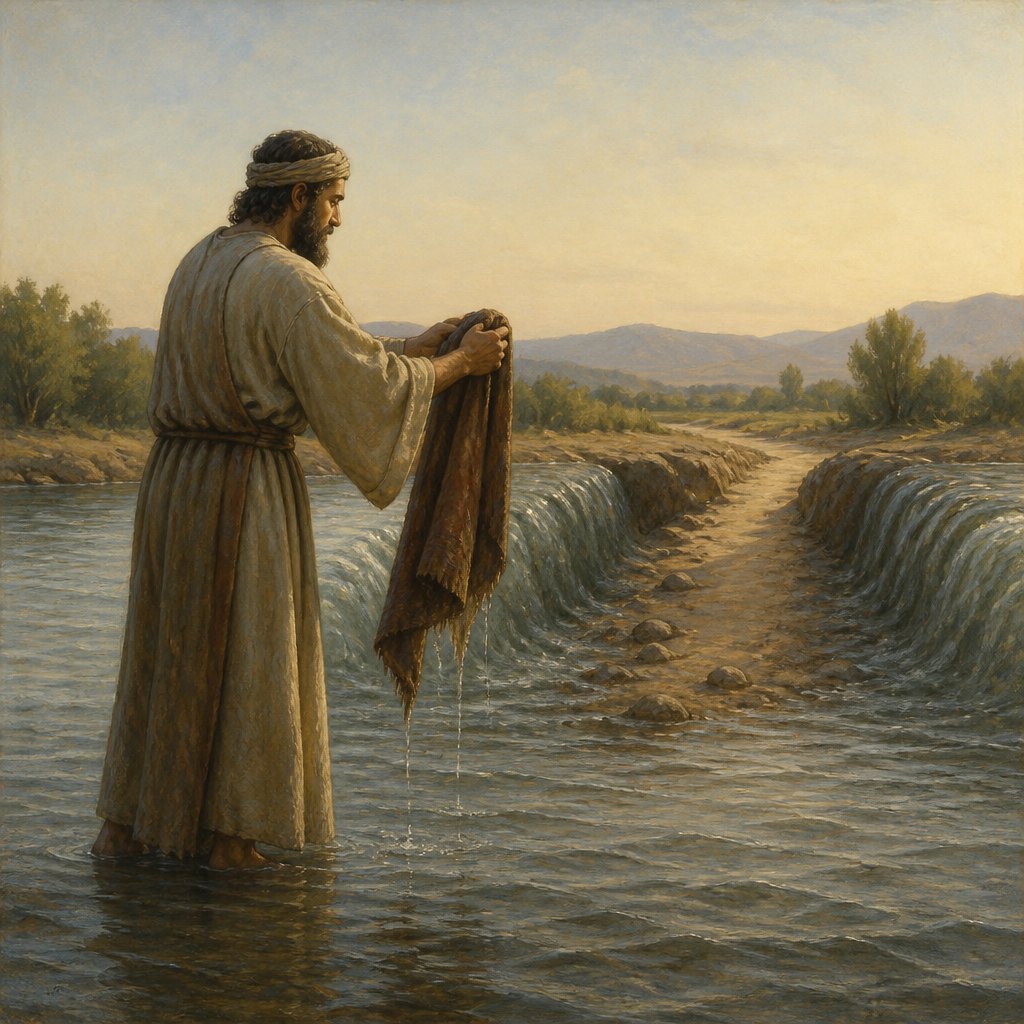
The Bible verse 2 Kings 2:14, as it appears in the King James Version, states, "And he took the mantle of Elijah that fell from him, and smote the waters, and said, Where is the Lord God of Elijah? and when he also had smitten the waters, they parted hither and thither: and Elisha went over." This verse comes from the Old Testament and is part of the narrative of the prophet Elijah's ascension to heaven and the passing of his mantle to his successor, Elisha.
The context of this verse is important for understanding its significance. The passage as a whole describes the events leading up to Elijah's departure, and the subsequent inheritance of his prophetic ministry by Elisha. In this specific verse, Elijah has just been taken up into heaven by a whirlwind, leaving behind his mantle, which was a long cloak or robe that symbolized his authority as a prophet. Elisha picks up the mantle, strikes the waters of the Jordan River, and miraculously parts the waters, following in the footsteps of his predecessor.
There are several themes and symbols present in this verse that are worthy of exploration. One of the key themes is the transfer of power and authority from one generation to the next. In ancient Israelite society, the passing of a mantle or cloak symbolized the transference of leadership and responsibility from one individual to another. This act signified the continuation of God's work through the prophetic ministry, even after Elijah's departure.
Another important theme is the concept of divine miracles and supernatural intervention. The parting of the waters of the Jordan River by Elisha mirrors the miraculous crossing of the Red Sea by the Israelites under the leadership of Moses. This event serves as a reminder of God's faithfulness and His ability to perform mighty acts on behalf of His people. The supernatural nature of this event underscores the idea that God is the one who empowers and guides His chosen servants, and that His presence is evident in the work they do.
The symbolism of the mantle itself is also significant. In the Bible, the mantle is often used as a symbol of authority, calling, and anointing. When Elisha takes up Elijah's mantle, it symbolizes his acceptance of the prophetic calling and the recognition of his new role as Elijah's successor. This act also signifies the continuity of God's purpose and plan, as the prophetic ministry is passed on from one faithful servant to another.
Furthermore, the question that Elisha poses – "Where is the Lord God of Elijah?" – reflects a deep sense of dependence and faith. Elisha is acknowledging that the power he needs to carry on Elijah's work comes from the same God who empowered Elijah. He is expressing his trust in God to continue to manifest His presence and authority through him, just as He had done with Elijah.
In summary, 2 Kings 2:14 carries rich symbolic and thematic significance within its narrative context. It portrays the passing of the prophetic mantle from Elijah to Elisha, the miraculous parting of the Jordan River, and the overarching themes of divine empowerment, continuity of God's plan, and the faithful transmission of God's work from one generation to the next. This verse serves as an inspiring reminder of God's faithfulness, the continuity of His purpose, and the empowerment of His chosen servants to carry out His work.
Get our apps


Artwork for 2 Kings 2:14

2 Kings 2:14 - "And he took the mantle of Elijah that fell from him, and smote the waters, and said, Where is the LORD God of Elijah? and when he also had smitten the waters, they parted hither and thither: and Elisha went over."
"And he took the mantle of Elijah that fell from him, and smote the waters, and said, Where is the LORD God of Elijah? and when he also had smitten the waters, they parted hither and thither: and Elisha went over." - 2 Kings 2:14

2 Kings 14:18 - "And the rest of the acts of Amaziah, are they not written in the book of the chronicles of the kings of Judah?"

2 Kings 12:14 - "But they gave that to the workmen, and repaired therewith the house of the LORD."

2 Kings 14:29 - "And Jeroboam slept with his fathers, even with the kings of Israel; and Zachariah his son reigned in his stead."

2 Kings 14:16 - "And Jehoash slept with his fathers, and was buried in Samaria with the kings of Israel; and Jeroboam his son reigned in his stead."

2 Kings 14:22 - "He built Elath, and restored it to Judah, after that the king slept with his fathers."

2 Kings 14:14 - "And he took all the gold and silver, and all the vessels that were found in the house of the LORD, and in the treasures of the king's house, and hostages, and returned to Samaria."

2 Kings 14:12 - "And Judah was put to the worse before Israel; and they fled every man to their tents."

2 Kings 14:2 - "He was twenty and five years old when he began to reign, and reigned twenty and nine years in Jerusalem. And his mother's name was Jehoaddan of Jerusalem."

2 Kings 14:20 - "And they brought him on horses: and he was buried at Jerusalem with his fathers in the city of David."

2 Kings 25:14 - "And the pots, and the shovels, and the snuffers, and the spoons, and all the vessels of brass wherewith they ministered, took they away."
2 Kings 14:15 - "¶ Now the rest of the acts of Jehoash which he did, and his might, and how he fought with Amaziah king of Judah, are they not written in the book of the chronicles of the kings of Israel?"

2 Kings 14:1 - "In the second year of Joash son of Jehoahaz king of Israel reigned Amaziah the son of Joash king of Judah."

2 Kings 7:14 - "They took therefore two chariot horses; and the king sent after the host of the Syrians, saying, Go and see."

1 Kings 2:14 - "He said moreover, I have somewhat to say unto thee. And she said, Say on."

"And the rest of the acts of Amaziah, are they not written in the book of the chronicles of the kings of Judah?" - 2 Kings 14:18

2 Kings 17:14 - "Notwithstanding they would not hear, but hardened their necks, like to the neck of their fathers, that did not believe in the LORD their God."

2 Kings 6:14 - "Therefore sent he thither horses, and chariots, and a great host: and they came by night, and compassed the city about."

2 Kings 14:17 - "¶ And Amaziah the son of Joash king of Judah lived after the death of Jehoash son of Jehoahaz king of Israel fifteen years."

2 Kings 19:14 - "¶ And Hezekiah received the letter of the hand of the messengers, and read it: and Hezekiah went up into the house of the LORD, and spread it before the LORD."

2 Kings 4:14 - "And he said, What then is to be done for her? And Gehazi answered, Verily she hath no child, and her husband is old."

2 Chronicles 9:14 - "Beside that which chapmen and merchants brought. And all the kings of Arabia and governors of the country brought gold and silver to Solomon."

2 Kings 14:4 - "Howbeit the high places were not taken away: as yet the people did sacrifice and burnt incense on the high places."

2 Kings 14:21 - "¶ And all the people of Judah took Azariah, which was sixteen years old, and made him king instead of his father Amaziah."

2 Kings 21:14 - "And I will forsake the remnant of mine inheritance, and deliver them into the hand of their enemies; and they shall become a prey and a spoil to all their enemies;"

2 Kings 14:7 - "He slew of Edom in the valley of salt ten thousand, and took Selah by war, and called the name of it Joktheel unto this day."

2 Kings 14:19 - "Now they made a conspiracy against him in Jerusalem: and he fled to Lachish; but they sent after him to Lachish, and slew him there."

2 Kings 23:14 - "And he brake in pieces the images, and cut down the groves, and filled their places with the bones of men." The image should not depict explicit or offensive content but be symbolic.

"But they gave that to the workmen, and repaired therewith the house of the LORD." - 2 Kings 12:14