What does 2 Samuel 12:3 mean?
“But the poor man had nothing, save one little ewe lamb, which he had bought and nourished up: and it grew up together with him, and with his children; it did eat of his own meat, and drank of his own cup, and lay in his bosom, and was unto him as a daughter.” — 2 Samuel 12:3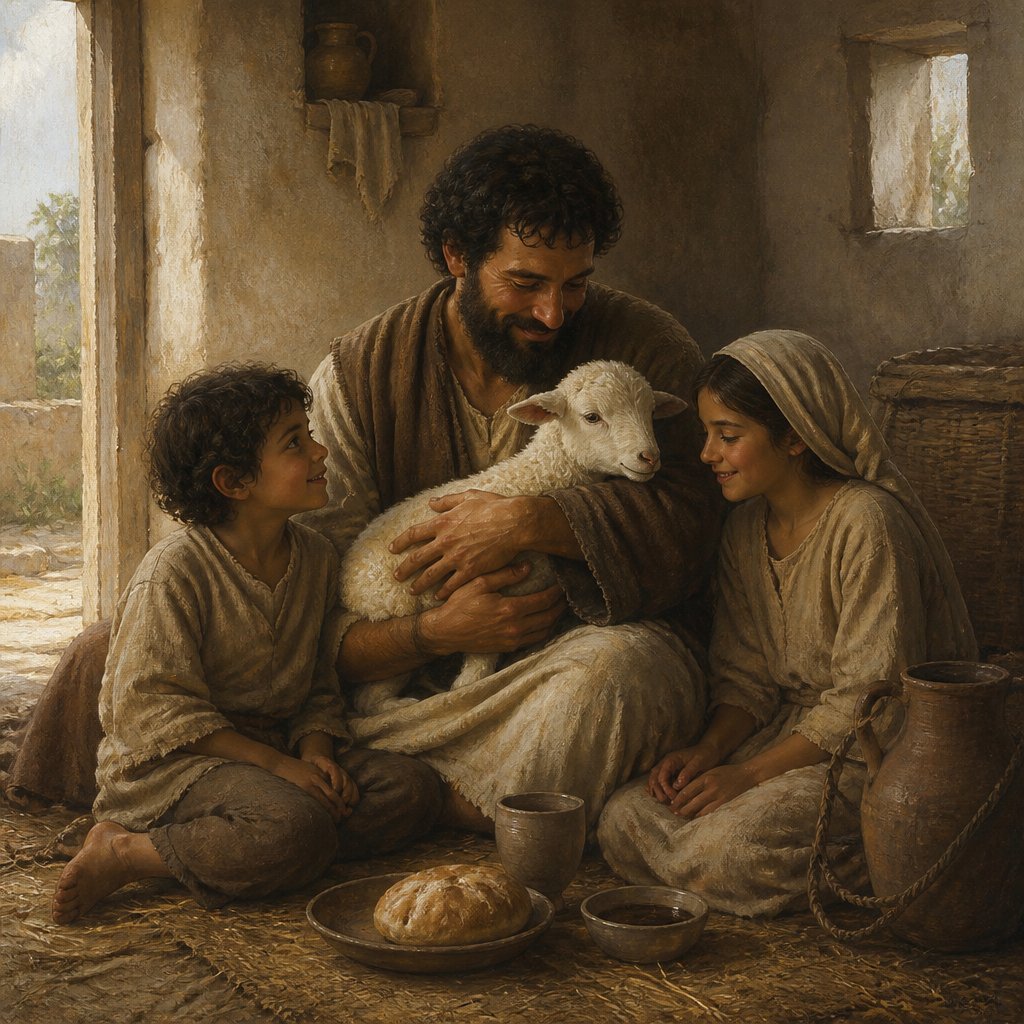
The verse 2 Samuel 12:3 from the King James Version of the Bible reads, "But the poor man had nothing, save one little ewe lamb, which he had bought and nourished up: and it grew up together with him, and with his children; it did eat of his own meat, and drank of his own cup, and lay in his bosom, and was unto him as a daughter." This verse is part of a larger passage in which the prophet Nathan confronts King David about his sin with Bathsheba and the subsequent murder of her husband, Uriah. Nathan uses this parable to expose David's guilt and compel him to acknowledge and confess his sin.
The verse provides a powerful illustration of injustice and the abuse of power. It tells the story of a poor man who had only one beloved ewe lamb, which he treated as a cherished member of his family. This lamb lived alongside him and his children, sharing in their food and drink and forming a close bond with them. The imagery of the little lamb evokes a sense of innocence and vulnerability, making it all the more poignant when the lamb is taken by a rich man to feed a traveler who has come to him.
The parable serves as a parallel to David's own behavior. David, in his role as king, had abused his power and taken something precious from another person—Uriah's wife, Bathsheba. He had committed adultery with her and then arranged for Uriah to be killed in battle to cover up his sin. Through the parable, Nathan is able to present David with the truth of his actions in a way that pierces through his pride and makes him see the gravity of his sin.
The use of the ewe lamb as a symbol is significant in several ways. Firstly, it represents the innocent and defenseless victim in the face of oppression and abuse. The lamb had no means to defend itself against the rich man's theft. This reflects the plight of the vulnerable in society who suffer at the hands of the powerful. It also embodies the idea of sacrificial love and companionship, as the poor man had invested time and care in nurturing and raising the lamb, forming a deep bond with it. This is contrasted with the callousness of the rich man who callously takes the lamb without consideration for the poor man's attachment to it.
In a broader context, this verse speaks to themes of justice, morality, and the responsibility of those in positions of power. It emphasizes the importance of empathy and compassion, and the consequences of abusing power and privilege. The parable reminds readers of the need to uphold justice and treat others with fairness and respect, regardless of their social status or economic standing. It is a warning against exploitation and a call to recognize the humanity and worth of every individual.
In conclusion, 2 Samuel 12:3 from the King James Version of the Bible is a profound and impactful passage that captures the essence of injustice and abuse of power. Its use of symbolism and imagery effectively conveys the message of the parable, serving as a powerful indictment of David's actions and a universal call to uphold justice and morality in all aspects of life. This verse continues to resonate with readers today, serving as a timeless reminder of the importance of compassion, empathy, and integrity in the face of power and privilege.
Get our apps


Artwork for 2 Samuel 12:3

2 Samuel 12:3 - "But the poor man had nothing, save one little ewe lamb, which he had bought and nourished up: and it grew up together with him, and with his children; it did eat of his own meat, and drank of his own cup, and lay in his bosom, and was unto him as a daughter."
"But the poor man had nothing, save one little ewe lamb, which he had bought and nourished up: and it grew up together with him, and with his children; it did eat of his own meat, and drank of his own cup, and lay in his bosom, and was unto him as a daughter." - 2 Samuel 12:3

2 Samuel 5:12

1 Samuel 2:12

2 Samuel 12:2 - "The rich man had exceeding many flocks and herds:"

2 Samuel 3:12 - "¶ And Abner sent messengers to David on his behalf, saying, Whose is the land? saying also, Make thy league with me, and, behold, my hand shall be with thee, to bring about all Israel unto thee."

2 Samuel 12:12 - "For thou didst it secretly: but I will do this thing before all Israel, and before the sun."

1 Samuel 2:12 Now the sons of Eli were sons of Belial; they knew not the LORD.

2 Samuel 2:12 - "¶ And Abner the son of Ner, and the servants of Ish-bosheth the son of Saul, went out from Mahanaim to Gibeon."

1 Samuel 2:12 - "¶ Now the sons of Eli were sons of Belial; they knew not the LORD."

2 Samuel 3:2 - "¶ And unto David were sons born in Hebron: and his firstborn was Amnon, of Ahinoam the Jezreelitess;"

2 Samuel 12:26 - "And Joab fought against Rabbah of the children of Ammon, and took the royal city."

2 Samuel 4:3 - "And the Beerothites fled to Gittaim, and were sojourners there until this day.)"

2 Samuel 12:29 - "And David gathered all the people together, and went to Rabbah, and fought against it, and took it."

2 Samuel 3:4 - "And the fourth, Adonijah the son of Haggith; and the fifth, Shephatiah the son of Abital;"

2 Samuel 3:3 - "And his second, Chileab, of Abigail the wife of Nabal the Carmelite; and the third, Absalom the son of Maacah the daughter of Talmai king of Geshur;"

2 Samuel 23:12 - "But he stood in the midst of the ground, and defended it, and slew the Philistines: and the LORD wrought a great victory."

2 Samuel 3:33 - "And the king lamented over Abner, and said, Died Abner as a fool dieth?"

2 Samuel 3:5 - "And the sixth, Ithream, by Eglah David's wife. These were born to David in Hebron."

2 Samuel 8:12 - "Of Syria, and of Moab, and of the children of Ammon, and of the Philistines, and of Amalek, and of the spoil of Hadadezer, son of Rehob, king of Zobah."

2 Samuel 22:12 - "And he made darkness pavilions round about him, dark waters, and thick clouds of the skies."

2 Samuel 16:12 - "It may be that the LORD will look on mine affliction, and that the LORD will requite me good for his cursing this day."

2 Samuel 12:25 - "And he sent by the hand of Nathan the prophet; and he called his name Jedidiah, because of the LORD."

"The rich man had exceeding many flocks and herds:" - 2 Samuel 12:2

2 Samuel 2:3 - "And his men that were with him did David bring up, every man with his household: and they dwelt in the cities of Hebron."

2 Samuel 7:3 - "And Nathan said to the king, Go, do all that is in thine heart; for the LORD is with thee."

2 Samuel 3:11 - "And he could not answer Abner a word again, because he feared him."

2 Samuel 12:6 - "And he shall restore the lamb fourfold, because he did this thing, and because he had no pity."

2 Samuel 12:16 - "David therefore besought God for the child; and David fasted, and went in, and lay all night upon the earth."

2 Samuel 3:37 - "For all the people and all Israel understood that day that it was not of the king to slay Abner the son of Ner."