What does 2 Samuel 14:30 mean?
"Therefore he said unto his servants, See, Joab's field is near mine, and he hath barley there; go and set it on fire. And Absalom's servants set the field on fire." - 2 Samuel 14:30
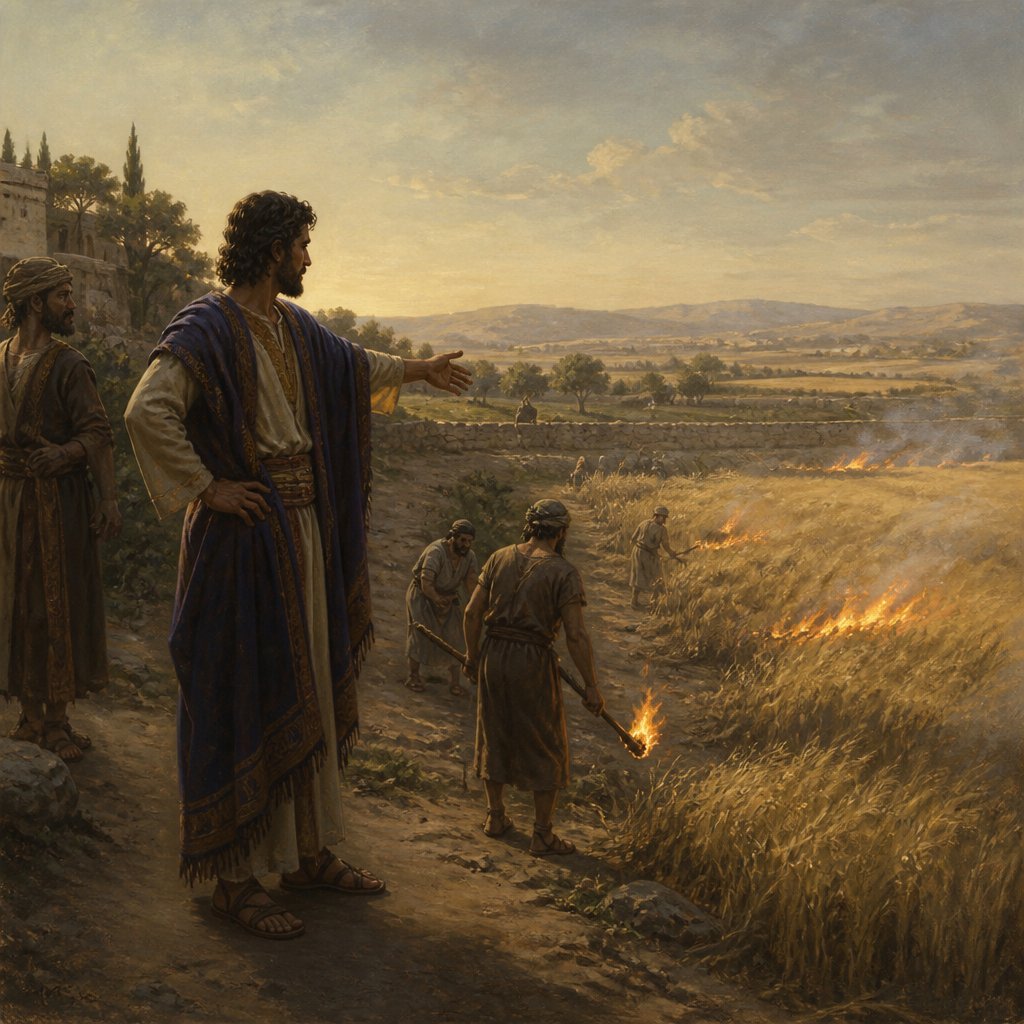
The Bible verse 2 Samuel 14:30 in the King James Version reads: "Therefore he said unto his servants, See, Joab's field is near mine, and he hath barley there; go and set it on fire. And Absalom's servants set the field on fire."
To understand the meaning and context of this verse, it is necessary to delve into the story of Absalom, the son of King David, and the events leading up to this particular incident. Absalom was a handsome and popular young man, and he had an undeniable charisma that endeared him to the people. He sought to overthrow his father and become king, and in pursuit of his ambition, he devised a plan to garner support from the people. He went to Hebron, a city in the territory of Judah, and there he proclaimed himself king, gathering a significant following.
King David, upon hearing the news of his son's treachery, was forced to flee Jerusalem in fear for his life. Absalom's rebellion led to a civil war between the supporters of King David and those of Absalom. The situation was emotionally distressing for David, as his own flesh and blood had risen against him. In the midst of this turmoil, a cunning and intelligent woman from Tekoa approached King David with a parable, appealing for his mercy and reconciliation with Absalom.
The verse 2 Samuel 14:30 occurs at a critical juncture in the narrative when Absalom, having returned to Jerusalem after a period of exile, sought to assert his authority and influence. He identified Joab’s property, which had a field of barley, as being adjacent to his own. By setting the field on fire, Absalom was making a bold and provocative move designed to assert his power and send a message to his father and Joab.
The burning of the field can be interpreted as a symbolic gesture, representing the turmoil and friction within the royal family and the wider nation. The act of arson was not only a display of aggression but also a calculated political move. Absalom aimed to demonstrate his dominance and willingness to confront opposition. Moreover, the fire symbolized the destruction and chaos that Absalom was willing to unleash in his quest for power.
This verse sheds light on the complex dynamics of familial relationships and political struggles. It illustrates the deep-seated tension and animosity that existed within the royal household, as well as the lengths to which individuals were willing to go in pursuit of power.
The themes of power, rebellion, and the consequences of one's actions are central to the narrative. The verse serves as a cautionary tale, highlighting the destructive outcomes of unchecked ambition and the breakdown of familial and societal bonds. Absalom's actions ultimately led to his downfall, as his rebellion was quashed, and he met a tragic end.
In conclusion, 2 Samuel 14:30 captures a pivotal moment in the narrative of Absalom's rebellion against King David. The verse offers a poignant reflection on the complexities of human relationships, the perils of pride and ambition, and the consequences of one's actions. It serves as a reminder of the destructive impact of selfish pursuits and the importance of humility, forgiveness, and reconciliation.
Have questions about 2 Samuel 14:30?
Dive deeper into this scripture with Bible Chat — an AI-powered tool for exploring God's Word through conversation. Ask questions, get context, and grow in your understanding of the Bible.
Get Our Apps


2 Samuel 14:30 Artwork

2 Samuel 14:30 - "Therefore he said unto his servants, See, Joab's field is near mine, and he hath barley there; go and set it on fire. And Absalom's servants set the field on fire."
"Therefore he said unto his servants, See, Joab's field is near mine, and he hath barley there; go and set it on fire. And Absalom's servants set the field on fire." - 2 Samuel 14:30

2 Samuel 23:30 - "Benaiah the Pirathonite, Hiddai of the brooks of Gaash,"

1 Samuel 30:14 - "We made an invasion upon the south of the Cherethites, and upon the coast which belongeth to Judah, and upon the south of Caleb; and we burned Ziklag with fire."

2 Samuel 6:14
1 Samuel 14:30 - "How much more, if haply the people had eaten freely to day of the spoil of their enemies which they found? for had there not been now a much greater slaughter among the Philistines?"

2 Samuel 6:14–22

2 Samuel 2:30 - "And Joab returned from following Abner: and when he had gathered all the people together, there lacked of David's servants nineteen men and Asahel."

"Benaiah the Pirathonite, Hiddai of the brooks of Gaash," - 2 Samuel 23:30

2 Samuel 18:30 - "And the king said unto him, Turn aside, and stand here. And he turned aside, and stood still."

2 Samuel 22:30 - "For by thee I have run through a troop: by my God have I leaped over a wall."

2 Samuel 23:14 - "And David was then in an hold, and the garrison of the Philistines was then in Beth-lehem."

2 Samuel 3:30 - "So Joab and Abishai his brother slew Abner, because he had slain their brother Asahel at Gibeon in the battle."

1 Samuel 30:2 - "And had taken the women captives, that were therein: they slew not any, either great or small, but carried them away, and went on their way."

2 Samuel 14:23 - "So Joab arose and went to Geshur, and brought Absalom to Jerusalem."

2 Samuel 22:14 - "The LORD thundered from heaven, and the most High uttered his voice."

2 Samuel 16:14 - "And the king, and all the people that were with him, came weary, and refreshed themselves there."

2 Samuel 14:1 - "Now Joab the son of Zeruiah perceived that the king's heart was toward Absalom."

2 Samuel 13:30 - "¶ And it came to pass, while they were in the way, that tidings came to David, saying, Absalom hath slain all the king's sons, and there is not one of them left."

2 Chronicles 30:14 - "And they arose and took away the altars that were in Jerusalem, and all the altars for incense took they away, and cast them into the brook Kidron."

2 Samuel 14:28 - "¶ So Absalom dwelt two full years in Jerusalem, and saw not the king's face."

2 Samuel 11:14 - "¶ And it came to pass in the morning, that David wrote a letter to Joab, and sent it by the hand of Uriah."

2 Samuel 2:14 - "And Abner said to Joab, Let the young men now arise, and play before us. And Joab said, Let them arise."

2 Samuel 5:14 - "And these be the names of those that were born unto him in Jerusalem; Shammua, and Shobab, and Nathan, and Solomon,"

2 Samuel 6:14 - "And David danced before the LORD with all his might; and David was girded with a linen ephod."

2 Samuel 19:30 - "And Mephibosheth said unto the king, Yea, let him take all, forasmuch as my lord the king is come again in peace unto his own house."

John 14:30

2 Samuel 14:3 - "And come to the king, and speak on this manner unto him. So Joab put the words in her mouth."

2 Samuel 14:8 - "And the king said unto the woman, Go to thine house, and I will give charge concerning thee."

1.samuel 15:30