What does 2 Samuel 14:9 mean?
"And the woman of Tekoah said unto the king, My lord, O king, the iniquity be on me, and on my father's house: and the king and his throne be guiltless." - 2 Samuel 14:9
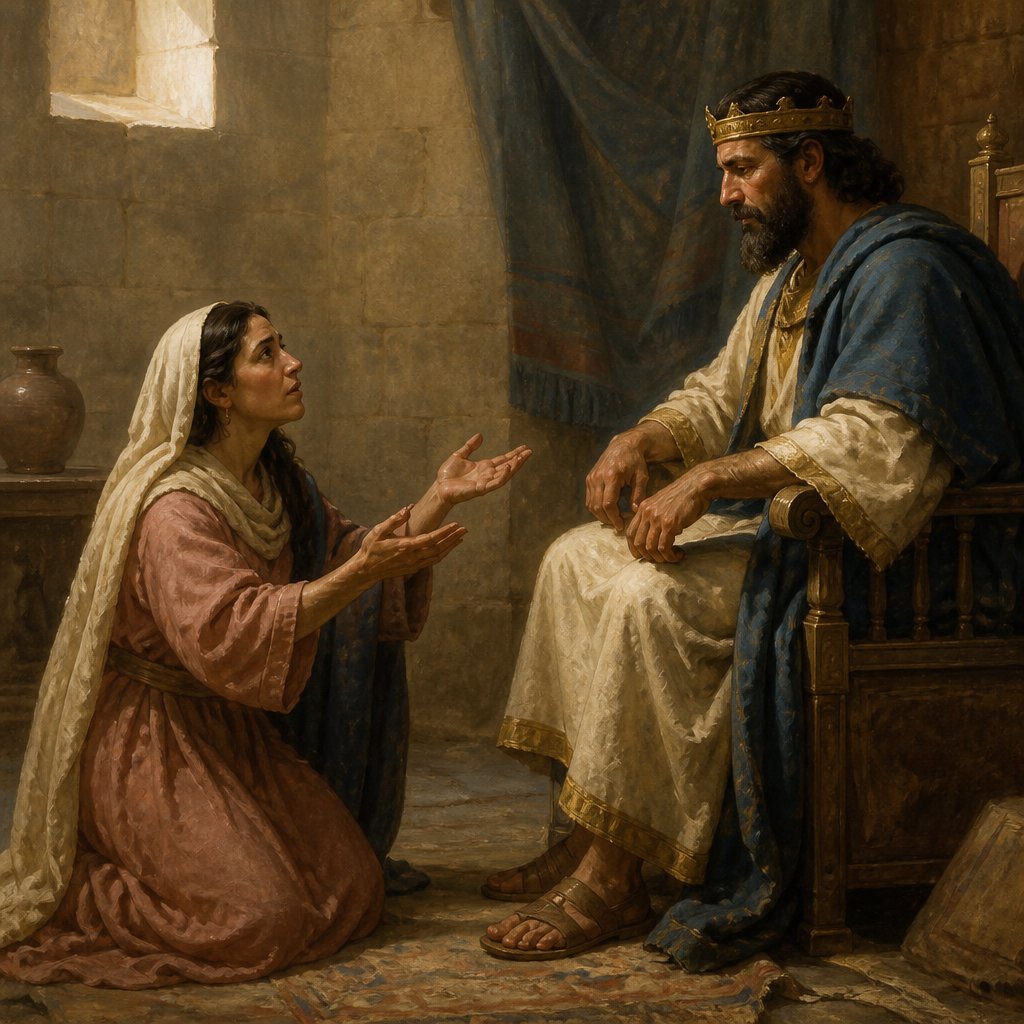
The verse 2 Samuel 14:9 in the King James Version of the Bible reads: "And the woman of Tekoah said unto the king, My lord, O king, the iniquity be on me, and on my father's house: and the king and his throne be guiltless."
This verse comes from the Old Testament book of 2 Samuel, which tells the story of King David's reign over Israel. In this particular chapter, a wise woman from the town of Tekoah comes to King David with a fictional story meant to persuade him to reconcile with his estranged son Absalom. The woman's story, and the ultimate message of this verse, sheds light on several important themes such as forgiveness, justice, and the power of persuasion.
The woman of Tekoah is a symbol of wisdom and shrewdness. She is aware of the tension between King David and his son Absalom, and she devises a plan to bring about reconciliation. In her appeal to the king, she takes on the guilt for her actions and implies that the burden of any wrongdoing should fall on her and her family, rather than on the king or his throne. This shows her willingness to sacrifice herself for the greater good, as well as her understanding of the complexities of human relationships and the moral complexities of justice and forgiveness.
The theme of forgiveness is central to this verse and the story as a whole. The woman of Tekoah's plea for reconciliation between David and Absalom demonstrates an understanding of the importance of forgiveness in healing relationships. By taking on the guilt herself, she is essentially asking for mercy and understanding from the king, emphasizing the importance of extending grace and compassion to others.
This verse also highlights the theme of justice. The woman of Tekoah’s willingness to take responsibility for her actions reflects a deep sense of justice and moral responsibility. She acknowledges that there is wrongdoing that needs to be addressed, but she is also willing to bear the consequences in order to set things right. This demonstrates a belief in the importance of accountability and the need for justice to be served, while also acknowledging the possibility for mercy and understanding.
Symbolism plays a significant role in this verse as well. The woman of Tekoah can be seen as a symbol of wisdom and cunning, using her knowledge of human nature and her persuasive abilities to bring about a positive outcome. Her willingness to take on the guilt for the greater good can be seen as a symbol of selflessness and sacrifice. In addition, King David and his throne can be seen as symbols of authority and justice, highlighting the importance of leadership and accountability in the pursuit of justice and reconciliation.
The historical and cultural context of this verse is also important to consider. In ancient Israel, the concept of justice and forgiveness were deeply rooted in religious and moral beliefs. The story of King David and his family also reflects the complexities of human relationships and the challenges of leadership and governance. The themes of forgiveness and justice explored in this verse would have resonated with the people of ancient Israel, who valued the principles of mercy and righteousness.
In conclusion, 2 Samuel 14:9 is a verse that encompasses themes of forgiveness, justice, and the power of persuasion. The story of the woman of Tekoah and her plea to King David sheds light on the complexities of human relationships and the moral responsibilities of leadership and governance. The verse serves as a powerful reminder of the importance of extending forgiveness and understanding, while also acknowledging the need for accountability and justice. It is a timeless message that continues to resonate with readers today, emphasizing the moral and ethical principles that are at the heart of the biblical narrative.
Have questions about 2 Samuel 14:9?
Dive deeper into this scripture with Bible Chat — an AI-powered tool for exploring God's Word through conversation. Ask questions, get context, and grow in your understanding of the Bible.
Get Our Apps


2 Samuel 14:9 Artwork

2 Samuel 14:9 - "And the woman of Tekoah said unto the king, My lord, O king, the iniquity be on me, and on my father's house: and the king and his throne be guiltless."
"And the woman of Tekoah said unto the king, My lord, O king, the iniquity be on me, and on my father's house: and the king and his throne be guiltless." - 2 Samuel 14:9

1 Samuel 9:14 - "And they went up into the city: and when they were come into the city, behold, Samuel came out against them, for to go up to the high place."

2 Samuel 6:14

2 Samuel 11:9

2 Samuel 6:14–22
1 Samuel 9:1-2

2 Samuel 23:14 - "And David was then in an hold, and the garrison of the Philistines was then in Beth-lehem."

2 samuel 9:7 fhdhdhdhhd

2 Samuel 14:23 - "So Joab arose and went to Geshur, and brought Absalom to Jerusalem."

2 Samuel 22:14 - "The LORD thundered from heaven, and the most High uttered his voice."

2 Samuel 16:14 - "And the king, and all the people that were with him, came weary, and refreshed themselves there."

2 Samuel 14:1 - "Now Joab the son of Zeruiah perceived that the king's heart was toward Absalom."

2 Samuel 14:28 - "¶ So Absalom dwelt two full years in Jerusalem, and saw not the king's face."

2 Samuel 11:14 - "¶ And it came to pass in the morning, that David wrote a letter to Joab, and sent it by the hand of Uriah."

1 Samuel 14:9 - "If they say thus unto us, Tarry until we come to you; then we will stand still in our place, and will not go up unto them."

2 Samuel 2:14 - "And Abner said to Joab, Let the young men now arise, and play before us. And Joab said, Let them arise."

2 Samuel 5:14 - "And these be the names of those that were born unto him in Jerusalem; Shammua, and Shobab, and Nathan, and Solomon,"

2 Samuel 6:14 - "And David danced before the LORD with all his might; and David was girded with a linen ephod."

2 Samuel 2:9 - "And made him king over Gilead, and over the Ashurites, and over Jezreel, and over Ephraim, and over Benjamin, and over all Israel."

2 Samuel 14:8 - "And the king said unto the woman, Go to thine house, and I will give charge concerning thee."

2 Samuel 14:3 - "And come to the king, and speak on this manner unto him. So Joab put the words in her mouth."

2 Samuel 8:9 - "¶ When Toi king of Hamath heard that David had smitten all the host of Hadadezer,"

2 Samuel 9:9 - "¶ Then the king called to Ziba, Saul's servant, and said unto him, I have given unto thy master's son all that pertained to Saul and to all his house."

2 Samuel 6:9 - "And David was afraid of the LORD that day, and said, How shall the ark of the LORD come to me?"

2 Samuel 15:9 - "And the king said unto him, Go in peace. So he arose, and went to Hebron."

2 Samuel 9:1 - "And David said, Is there yet any that is left of the house of Saul, that I may shew him kindness for Jonathan's sake?"

2 Samuel 11:9 - "But Uriah slept at the door of the king's house with all the servants of his lord, and went not down to his house."

1 Samuel 2:9 - "He will keep the feet of his saints, and the wicked shall be silent in darkness; for by strength shall no man prevail."

2 Samuel 9:5 - "¶ Then king David sent, and fetched him out of the house of Machir, the son of Ammiel, from Lo-debar."