What does 2 Samuel 14:26 mean?
“And when he polled his head, ( for it was at every year’s end that he polled it: because the hair was heavy on him, therefore he polled it:) he weighed the hair of his head at two hundred shekels after the king’s weight.” — 2 Samuel 14:26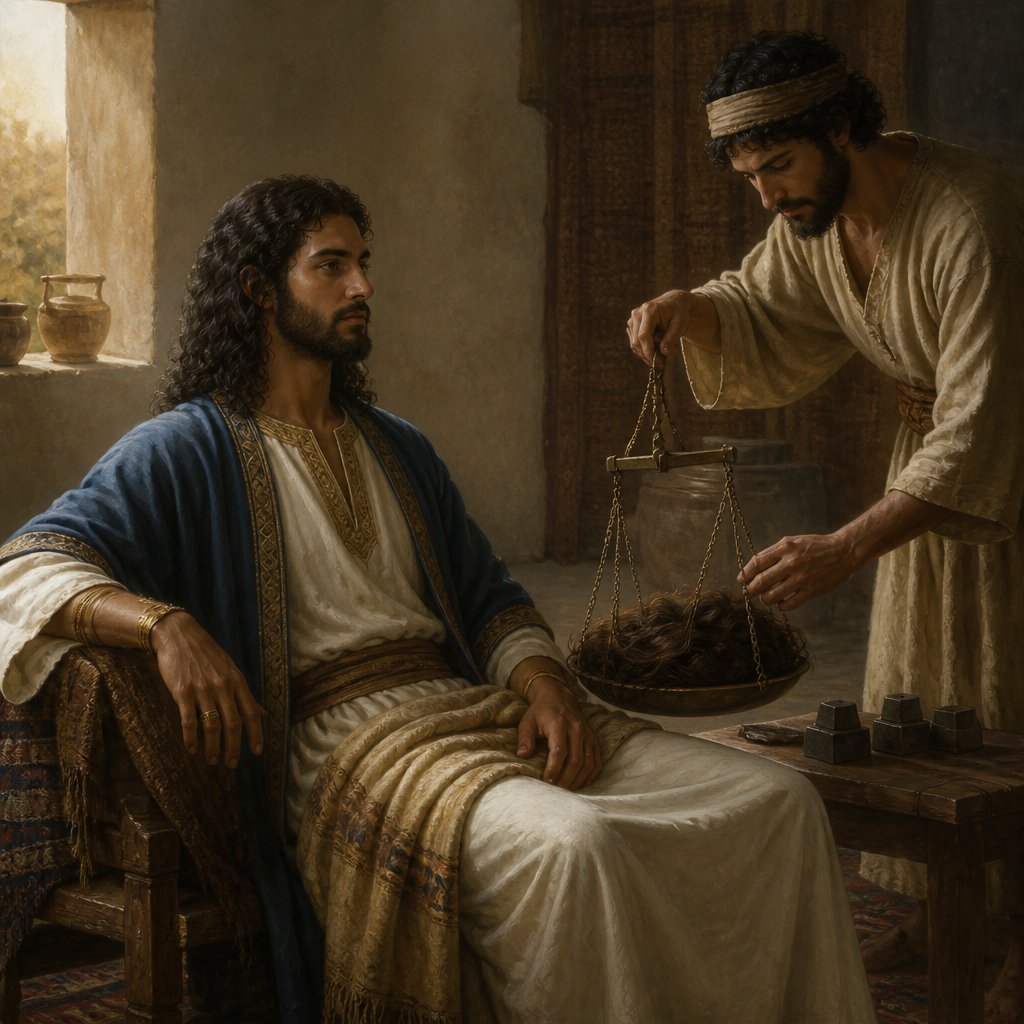
The verse 2 Samuel 14:26 in the King James Version of the Bible reads: "And when he polled his head, (for it was at every year's end that he polled it: because the hair was heavy on him, therefore he polled it:) he weighed the hair of his head at two hundred shekels after the king's weight."
This verse is a part of the story of Absalom, the third son of King David, and it describes his annual ritual of cutting his hair, as it became heavy and burdensome for him. The fact that Absalom's hair was weighed and found to be two hundred shekels, after the king's weight, is a symbol of his pride and vanity. The context of this verse is important to understand its significance.
Absalom was known for his handsome appearance and for his beautiful hair, which became a source of his pride and vanity. In fact, his hair is described as very thick and long in the Bible, symbolizing his physical beauty and his arrogance. The annual shearing of his hair was a symbol of his personal pride, and it is likely that he took great care of his appearance. The fact that his hair weighed two hundred shekels, which is a significant amount, further emphasizes the extent of his vanity and pride.
This verse is also indicative of Absalom's rebellion against his father, King David. Absalom's outward appearance and his extravagant display of his hair signify his growing ambition and desire for power. His rebellion against his father ultimately leads to his own downfall and death. Therefore, the verse serves as a foreshadowing of Absalom's eventual tragic fate.
Furthermore, the shaving of Absalom's hair carries a symbolic meaning in the Bible. In ancient Israelite culture, the cutting of one's hair was often a symbol of mourning or repentance. For Absalom to cut his hair annually is an act of vanity, but it can also be seen as a rejection of traditional values and a refusal to conform to his role as a prince. His luxurious hair becomes a symbol of his rebellion and his disregard for the expectations of his status.
The weight of Absalom's hair at two hundred shekels is also significant. In the Bible, the number two can signify division, conflict, or contrast. This could be reflective of Absalom's divided loyalties between his father and his own ambitions. Additionally, the shekel was a unit of measurement used for valuation, and in this context, it could represent a heavy burden or weight that Absalom bore due to his pride and rebellious nature.
In conclusion, 2 Samuel 14:26 serves as a powerful symbol of Absalom's pride, vanity, and rebellion against his father, King David. The annual shearing of his hair and the weight of it at two hundred shekels signify his arrogance and disregard for traditional values. The verse foreshadows Absalom's tragic fate and serves as a cautionary tale of the consequences of unchecked ambition and pride. It also offers a deeper insight into the complex themes of power, rebellion, and the human condition as depicted in the Bible.
Get our apps


Artwork for 2 Samuel 14:26

2 Samuel 14:26 - "And when he polled his head, (for it was at every year's end that he polled it: because the hair was heavy on him, therefore he polled it:) he weighed the hair of his head at two hundred shekels after the king's weight."
"And when he polled his head, (for it was at every year's end that he polled it: because the hair was heavy on him, therefore he polled it:) he weighed the hair of his head at two hundred shekels after the king's weight." - 2 Samuel 14:26

1 Samuel 2:26 - "And the child Samuel grew on, and was in favour both with the LORD, and also with men."

2 Samuel 17:26 - "So Israel and Absalom pitched in the land of Gilead."

2 Samuel 23:26 - "Helez the Paltite, Ira the son of Ikkesh the Tekoite,"

2 Samuel 20:26 - "And Ira also the Jairite was a chief ruler about David."

2 Samuel 6:14

1 Samuel 14:26 - "And when the people were come into the wood, behold, the honey dropped; but no man put his hand to his mouth: for the people feared the oath."

2 Samuel 12:26 - "And Joab fought against Rabbah of the children of Ammon, and took the royal city."

1 Samuel 26:14 - "And David cried to the people, and to Abner the son of Ner, saying, Answerest thou not, Abner? Then Abner answered and said, Who art thou that criest to the king?"

2 Samuel 6:14–22

"And the child Samuel grew on, and was in favour both with the LORD, and also with men." - 1 Samuel 2:26

2 Samuel 23:14 - "And David was then in an hold, and the garrison of the Philistines was then in Beth-lehem."

2 Samuel 11:26 - "¶ And when the wife of Uriah heard that Uriah her husband was dead, she mourned for her husband."

2 Samuel 22:26 - "With the merciful thou wilt shew thyself merciful, and with the upright man thou wilt shew thyself upright."

2 Samuel 14:23 - "So Joab arose and went to Geshur, and brought Absalom to Jerusalem."

2 Samuel 22:14 - "The LORD thundered from heaven, and the most High uttered his voice."

2 Samuel 16:14 - "And the king, and all the people that were with him, came weary, and refreshed themselves there."

2 Samuel 14:1 - "Now Joab the son of Zeruiah perceived that the king's heart was toward Absalom."

"Helez the Paltite, Ira the son of Ikkesh the Tekoite," - 2 Samuel 23:26

"So Israel and Absalom pitched in the land of Gilead." - 2 Samuel 17:26

1 Samuel 26:2 - "Then Saul arose, and went down to the wilderness of Ziph, having three thousand chosen men of Israel with him, to seek David in the wilderness of Ziph."

2 Samuel 14:28 - "¶ So Absalom dwelt two full years in Jerusalem, and saw not the king's face."

2 Samuel 11:14 - "¶ And it came to pass in the morning, that David wrote a letter to Joab, and sent it by the hand of Uriah."

2 Samuel 2:14 - "And Abner said to Joab, Let the young men now arise, and play before us. And Joab said, Let them arise."

2 Samuel 5:14 - "And these be the names of those that were born unto him in Jerusalem; Shammua, and Shobab, and Nathan, and Solomon,"

2 Samuel 6:14 - "And David danced before the LORD with all his might; and David was girded with a linen ephod."

2 Chronicles 26:14 - "And Uzziah prepared for them throughout all the host shields, and spears, and helmets, and habergeons, and bows, and slings to cast stones."

"And Ira also the Jairite was a chief ruler about David." - 2 Samuel 20:26

2 Samuel 14:8 - "And the king said unto the woman, Go to thine house, and I will give charge concerning thee."