What does 2 Samuel 14:8 mean?
“And the king said unto the woman, Go to thine house, and I will give charge concerning thee.” — 2 Samuel 14:8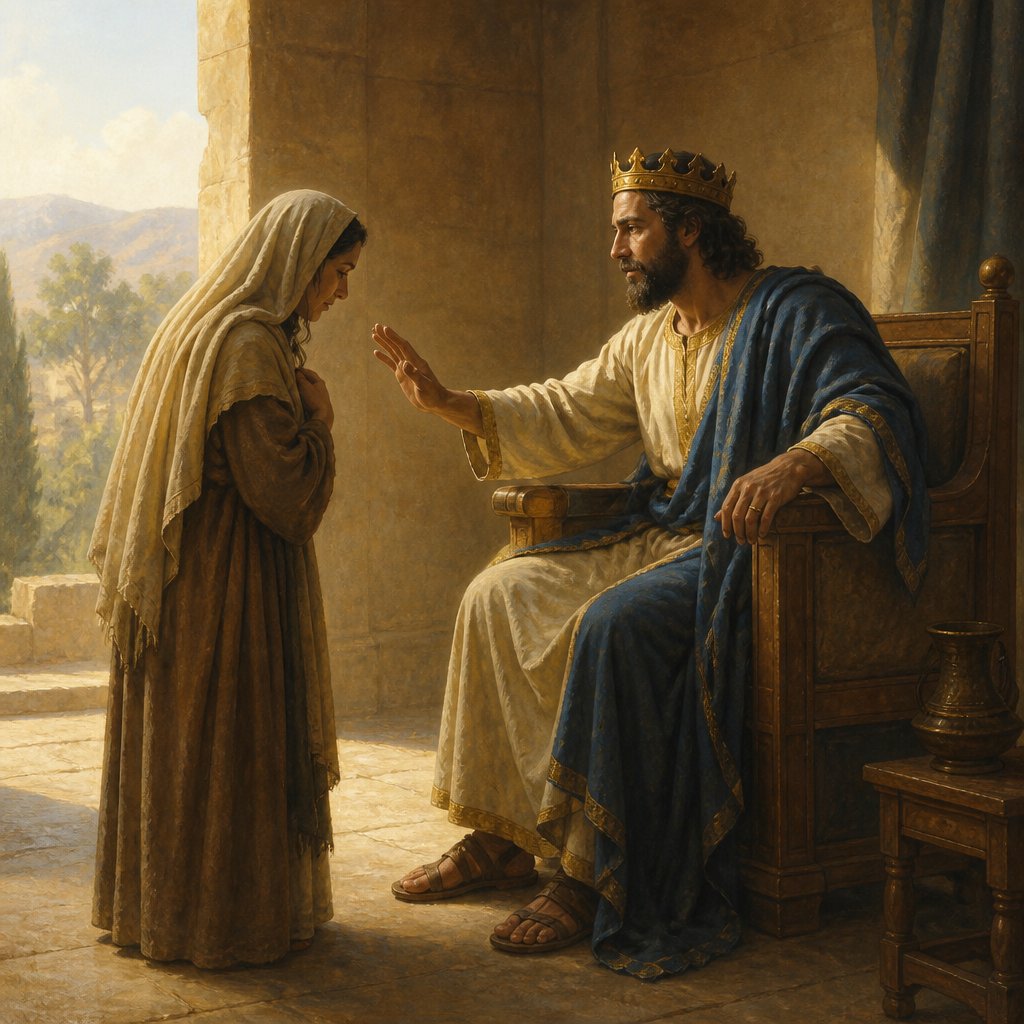
In 2 Samuel 14:8, the King James Version of the Bible states, "And the king said unto the woman, Go to thine house, and I will give charge concerning thee." This verse is part of a larger narrative in the book of 2 Samuel that follows the story of King David and his reign over Israel. The verse comes in the midst of a conversation between King David and a woman from Tekoa who is pleading for the king's intervention in a family dispute.
To fully understand the significance of this verse, it is important to consider the context in which it occurs. The woman from Tekoa is speaking to King David on behalf of her employer, Joab, who is seeking a way to reconcile David with his son Absalom. Absalom had killed his half-brother Amnon after he had raped his sister Tamar, and as a result, Absalom was subsequently banished from Jerusalem. The woman from Tekoa uses a parable to persuade David to reunite with Absalom, which ultimately leads to the king's decision to allow Absalom to return to Jerusalem.
The verse holds several important themes and lessons that can be applied to our lives today. One of the central themes is the idea of justice and mercy. The woman from Tekoa is advocating for compassion and forgiveness in the case of Absalom. She emphasizes the importance of reconciliation and the restoration of relationships within families, even in situations where wrongs have been committed. This theme reminds us of the importance of forgiveness and second chances, even when individuals have made grave mistakes. It also serves as a reminder of the power of reconciliation and the opportunity for healing and restoration in difficult circumstances.
Furthermore, the verse also touches upon the theme of leadership and governance. King David's response to the woman from Tekoa reflects his role as a leader and ruler. His decision to allow Absalom to return to Jerusalem is a demonstration of his wisdom and willingness to listen to the concerns of his subjects. It also highlights the responsibility of a leader to strive for justice and mercy in their decisions, even when faced with difficult choices. This theme provides a valuable lesson in the qualities of a good leader and the importance of prioritizing the well-being of the people they govern.
Symbolism also plays a significant role in this verse. The woman from Tekoa represents the voice of wisdom and reason, advocating for justice and mercy to the king. Her words serve as a symbol of the moral compass that guides leaders in their decision-making. Additionally, the act of the king giving charge concerning the woman signifies his willingness to take action and make a decision based on the woman's plea. It symbolizes the power and authority of a king to enact change and make a positive impact within his kingdom.
In conclusion, 2 Samuel 14:8 holds several important themes that resonate with readers today. The verse conveys a powerful message about justice, mercy, and leadership, while also providing valuable lessons on the importance of reconciliation and the qualities of a good leader. The verse's symbolism further reinforces these themes and adds depth to the narrative. Overall, this verse serves as a timeless reminder of the significance of compassion and forgiveness in resolving conflicts and the responsibilities of leaders in seeking justice and mercy for their people.
Get our apps


Artwork for 2 Samuel 14:8

2 Samuel 14:8 - "And the king said unto the woman, Go to thine house, and I will give charge concerning thee."
"And the king said unto the woman, Go to thine house, and I will give charge concerning thee." - 2 Samuel 14:8

2 Samuel 8:14 - "¶ And he put garrisons in Edom; throughout all Edom put he garrisons, and all they of Edom became David's servants. And the LORD preserved David whithersoever he went."

2 Samuel 6:14

2 Samuel 19:8

2 Samuel 19:8

2 Samuel 19:8

2 Samuel 19:8

2 Samuel 6:14–22

1 Samuel 14:8 - "Then said Jonathan, Behold, we will pass over unto these men, and we will discover ourselves unto them."

2 samuel 23:8-21

2 Samuel 23:14 - "And David was then in an hold, and the garrison of the Philistines was then in Beth-lehem."

2 Samuel 8:8 - "And from Betah, and from Berothai, cities of Hadadezer, king David took exceeding much brass."

1 Samuel 8:14 - "And he will take your fields, and your vineyards, and your oliveyards, even the best of them, and give them to his servants."

2 Samuel 14:23 - "So Joab arose and went to Geshur, and brought Absalom to Jerusalem."

2 Samuel 22:14 - "The LORD thundered from heaven, and the most High uttered his voice."

2 Samuel 16:14 - "And the king, and all the people that were with him, came weary, and refreshed themselves there."

2 Samuel 14:1 - "Now Joab the son of Zeruiah perceived that the king's heart was toward Absalom."

2 Samuel 2:8 - "¶ But Abner the son of Ner, captain of Saul's host, took Ish-bosheth the son of Saul, and brought him over to Mahanaim;"

2 Samuel 14:28 - "¶ So Absalom dwelt two full years in Jerusalem, and saw not the king's face."

2 Samuel 11:14 - "¶ And it came to pass in the morning, that David wrote a letter to Joab, and sent it by the hand of Uriah."

2 Samuel 8:16 - "And Joab the son of Zeruiah was over the host; and Jehoshaphat the son of Ahilud was recorder;"

2 Samuel 2:14 - "And Abner said to Joab, Let the young men now arise, and play before us. And Joab said, Let them arise."

2 Samuel 5:14 - "And these be the names of those that were born unto him in Jerusalem; Shammua, and Shobab, and Nathan, and Solomon,"

2 Samuel 6:14 - "And David danced before the LORD with all his might; and David was girded with a linen ephod."

2 Samuel 22:8 - "Then the earth shook and trembled; the foundations of heaven moved and shook, because he was wroth."

2 Samuel 8:17 - "And Zadok the son of Ahitub, and Ahimelech the son of Abiathar, were the priests; and Seraiah was the scribe;"

2 Samuel 8:7 - "And David took the shields of gold that were on the servants of Hadadezer, and brought them to Jerusalem."

2 Samuel 14:3 - "And come to the king, and speak on this manner unto him. So Joab put the words in her mouth."

2 Samuel 8:9 - "¶ When Toi king of Hamath heard that David had smitten all the host of Hadadezer,"