What does 2 Samuel 19:30 mean?
"And Mephibosheth said unto the king, Yea, let him take all, forasmuch as my lord the king is come again in peace unto his own house." - 2 Samuel 19:30
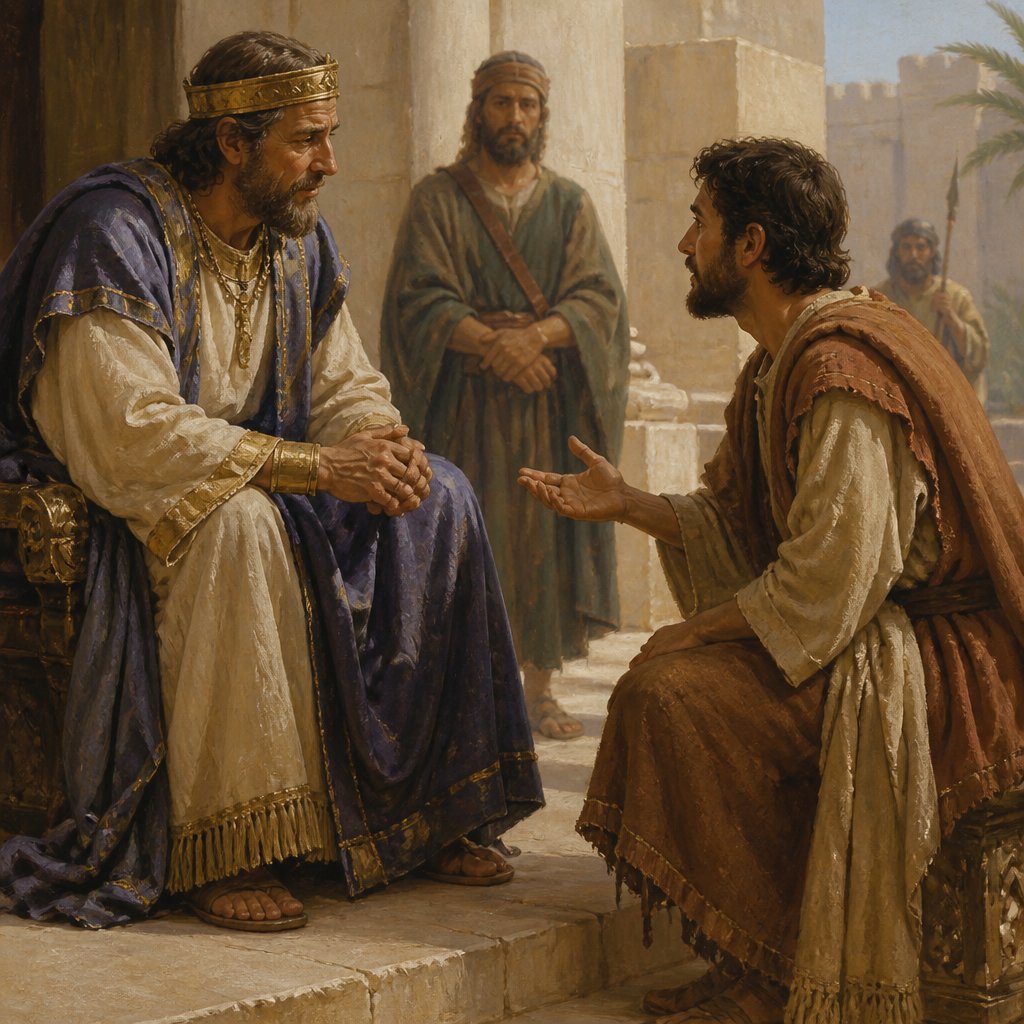
In the King James Version, 2 Samuel 19:30 reads, "And Mephibosheth said unto the king, Yea, let him take all, forasmuch as my lord the king is come again in peace unto his own house." This verse comes at a pivotal moment in the story of King David's reign, as he is returning to Jerusalem after his son Absalom's failed rebellion. In this verse, Mephibosheth, the grandson of King Saul and the son of Jonathan, makes a selfless and generous offer to King David, demonstrating loyalty and forgiveness in the midst of political upheaval and personal betrayal.
To fully understand the significance of Mephibosheth's statement, it is important to first consider the context in which it is spoken. Mephibosheth had been a recipient of King David's kindness and generosity, as David had shown him favor and provided for him despite his physical disabilities. However, during David's exile from Jerusalem, Mephibosheth's servant, Ziba, had deceived the king by claiming that Mephibosheth had turned against him. This led David to believe Ziba's deceit and subsequently give Mephibosheth's inheritance to Ziba.
Now, as David returns victorious to his throne, Mephibosheth has the opportunity to plead his case and reclaim what was rightfully his. However, instead of seeking retribution or vengeance, Mephibosheth humbly relinquishes his claim to the inheritance, recognizing that the king's peaceful return to his own house is of greater importance than his personal gain. In doing so, Mephibosheth demonstrates an incredible level of grace and selflessness, choosing to prioritize reconciliation and the well-being of the kingdom over his own interests.
One of the key themes in this verse is the idea of forgiveness and reconciliation. Mephibosheth's response to King David reflects a deep understanding of the importance of forgiveness, even in the face of betrayal and injustice. His willingness to let go of his own rights and material possessions in order to support the king's reign shows a remarkable level of humility and a commitment to peace. In a similar manner, the verse also highlights the theme of loyalty and fidelity. Mephibosheth's loyalty to King David is evident in his willingness to support and honor the king, despite the mistreatment he had endured.
Moreover, the verse also holds significant symbolic value within the larger narrative of King David's reign. Mephibosheth's act of selflessness and generosity can be seen as a reflection of the values that David sought to uphold as a leader. By choosing to prioritize the well-being of the kingdom over personal gain, Mephibosheth embodies the ideal of a true servant leader, willing to make sacrifices for the greater good. His actions serve as a testament to the values of integrity, compassion, and selflessness that were essential to David's vision for a just and righteous kingdom.
In conclusion, 2 Samuel 19:30 captures a pivotal moment in the narrative of King David's reign, depicting a powerful example of forgiveness, loyalty, and selflessness. Mephibosheth's decision to relinquish his inheritance in support of the king's return reflects the transformative power of grace and the enduring importance of prioritizing reconciliation and unity. As such, this verse serves as a timeless reminder of the values that are essential to good governance and righteous leadership, and continues to inspire readers to aspire to emulate the qualities of humility, forgiveness, and sacrificial love demonstrated by Mephibosheth.
Have questions about 2 Samuel 19:30?
Dive deeper into this scripture with Bible Chat — an AI-powered tool for exploring God's Word through conversation. Ask questions, get context, and grow in your understanding of the Bible.
Get Our Apps


2 Samuel 19:30 Artwork

2 Samuel 19:30 - "And Mephibosheth said unto the king, Yea, let him take all, forasmuch as my lord the king is come again in peace unto his own house."
"And Mephibosheth said unto the king, Yea, let him take all, forasmuch as my lord the king is come again in peace unto his own house." - 2 Samuel 19:30

Philippians 2:19-30

2 Samuel 23:30 - "Benaiah the Pirathonite, Hiddai of the brooks of Gaash,"

2 Samuel 19:8

2 Samuel 19:8

2 Samuel 19:8

2 Samuel 19:8

2 Samuel 19:24

1 Samuel 30:19 - "And there was nothing lacking to them, neither small nor great, neither sons nor daughters, neither spoil, nor any thing that they had taken to them: David recovered all."

2 Samuel 19:1 - "And it was told Joab, Behold, the king weepeth and mourneth for Absalom."

2 Samuel 2:30 - "And Joab returned from following Abner: and when he had gathered all the people together, there lacked of David's servants nineteen men and Asahel."

"Benaiah the Pirathonite, Hiddai of the brooks of Gaash," - 2 Samuel 23:30

2 Samuel 18:30 - "And the king said unto him, Turn aside, and stand here. And he turned aside, and stood still."

2 Samuel 22:30 - "For by thee I have run through a troop: by my God have I leaped over a wall."

2 Samuel 22:19 - "They prevented me in the day of my calamity: but the LORD was my stay."

2 Samuel 24:19 - "And David, according to the saying of Gad, went up as the LORD commanded."

2 Kings 19:30 - "And the remnant that is escaped of the house of Judah shall yet again take root downward, and bear fruit upward."

2 Samuel 3:30 - "So Joab and Abishai his brother slew Abner, because he had slain their brother Asahel at Gibeon in the battle."

2 Samuel 2:19 - "And Asahel pursued after Abner; and in going he turned not to the right hand nor to the left from following Abner."

1 Samuel 30:2 - "And had taken the women captives, that were therein: they slew not any, either great or small, but carried them away, and went on their way."

2 Samuel 1:19 - "The beauty of Israel is slain upon thy high places: how are the mighty fallen!"

2 Chronicles 30:19 - "That prepareth his heart to seek God, the LORD God of his fathers, though he be not cleansed according to the purification of the sanctuary."

2 Samuel 19:2 - "And the victory that day was turned into mourning unto all the people: for the people heard say that day how the king was grieved for his son."

2 Samuel 13:30 - "¶ And it came to pass, while they were in the way, that tidings came to David, saying, Absalom hath slain all the king's sons, and there is not one of them left."

2 Samuel 19:23 - "Therefore the king said unto Shimei, Thou shalt not die. And the king sware unto him."

2 Samuel 11:19 - "And charged the messenger, saying, When thou hast made an end of telling the matters of the war unto the king,"

2 Samuel 23:19 - "Was he not most honourable of three? therefore he was their captain: howbeit he attained not unto the first three."

2 Samuel 17:19 - "And the woman took and spread a covering over the well's mouth, and spread ground corn thereon; and the thing was not known."

2 Samuel 19:33 - "And the king said unto Barzillai, Come thou over with me, and I will feed thee with me in Jerusalem."