What does 2 Samuel 23:13 mean?
“And three of the thirty chief went down, and came to David in the harvest time unto the cave of Adullam: and the troop of the Philistines pitched in the valley of Rephaim.” — 2 Samuel 23:13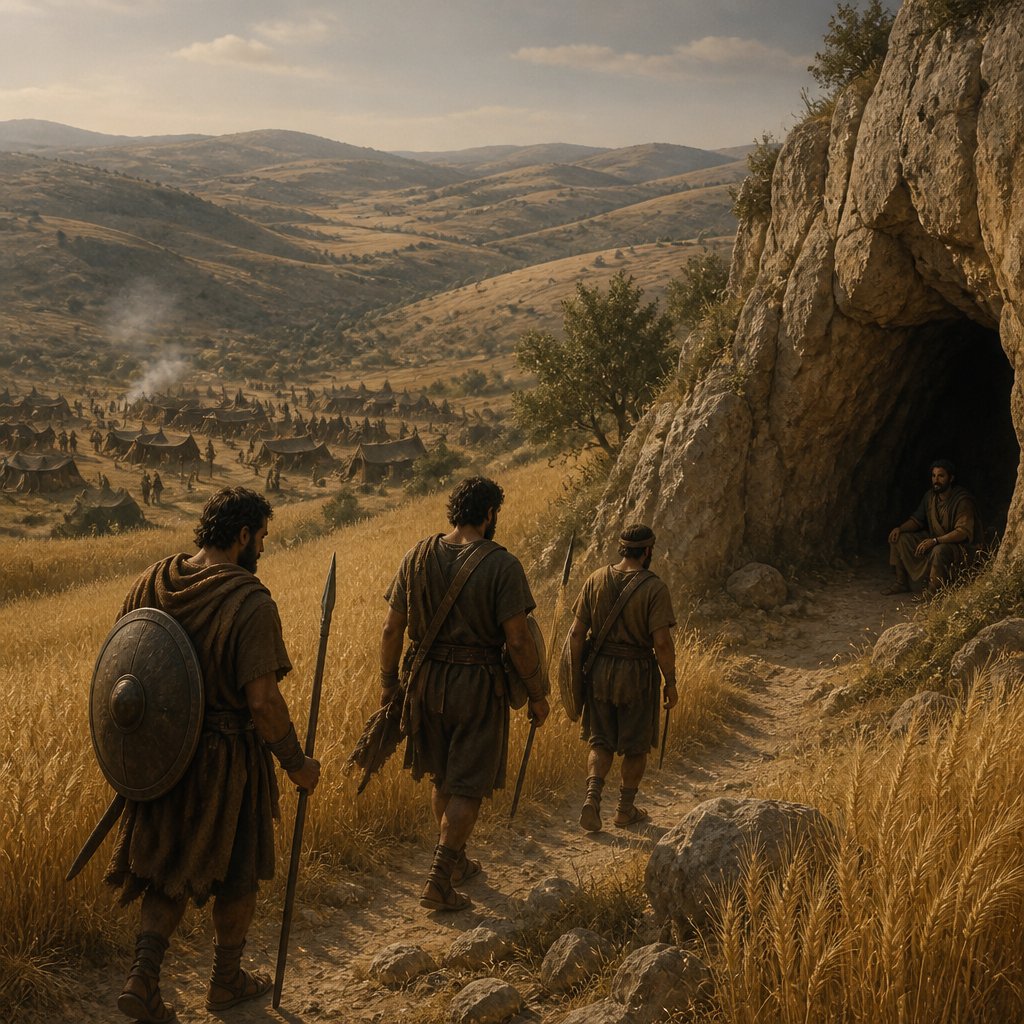
2 Samuel 23:13 (KJV): "And three of the thirty chief went down, and came to David in the harvest time unto the cave of Adullam: and the troop of the Philistines pitched in the valley of Rephaim."
This verse is a part of a larger passage that describes the exploits of David's mighty men, who were renowned for their courage, loyalty, and skill in battle. In this specific verse, we see three of the "thirty chief" warriors going to join David during the harvest time, seeking refuge in the cave of Adullam while the Philistine army encamped in the valley of Rephaim.
The historical context of this verse is important for understanding its meaning. As the verse indicates, the Philistines were a constant threat to the Israelites during this time. David, who was not yet king but had been anointed as the future ruler of Israel, was often on the run from King Saul, who sought to kill him out of jealousy. The cave of Adullam served as a hiding place for David and his men, and it was during this time that he gathered a group of loyal followers who would become known as his mighty men.
One of the key themes in this verse is the idea of loyalty and bravery in the face of adversity. The fact that these three warriors sought out David during the harvest time, when they could have been occupied with their own responsibilities, demonstrates their unwavering commitment to their leader. Despite the dangers posed by the Philistine army, they chose to align themselves with David and stand by him in his time of need.
The cave of Adullam itself holds symbolic significance in the biblical narrative. It represents a place of refuge and safety amidst turmoil and danger. Just as David and his men sought shelter in the cave, believers today can find comfort in the knowledge that God offers protection and sustenance in times of trouble. This imagery is echoed throughout the Bible, such as in Psalm 57:1, where David calls out to God for mercy and refuge in the shadow of His wings.
Additionally, the mention of the harvest time in this verse carries spiritual connotations. In the Bible, the harvest is often used as a metaphor for the gathering of souls and the fulfillment of God's purposes. Jesus himself spoke of the harvest in this way, urging his followers to pray for laborers to be sent into the harvest field (Matthew 9:38). The fact that these warriors came to David during the harvest time may symbolize a readiness to participate in the work of God's kingdom, even in the midst of external threats and challenges.
The presence of the Philistine army in the valley of Rephaim serves as a reminder of the constant spiritual warfare that believers face. Throughout the Bible, the Philistines are depicted as enemies of God's people, representing the forces of darkness and opposition to God's purposes. In this verse, their encampment in the valley of Rephaim underscores the ongoing struggle between good and evil, and the need for unwavering faith and courage in the face of such opposition.
In conclusion, 2 Samuel 23:13 offers a rich tapestry of themes and symbolism that are relevant to both its original historical context and to believers today. It speaks to the importance of loyalty, bravery, and seeking refuge in God in the midst of adversity. It also serves as a reminder of the ongoing spiritual battle that believers are called to engage in, and the assurance of God's protection and sustenance in the midst of turmoil. As such, this verse continues to inspire and encourage believers to stand firm in their faith and commitment to God, even in the face of daunting challenges.
Get our apps


Artwork for 2 Samuel 23:13

2 Samuel 23:13 - "And three of the thirty chief went down, and came to David in the harvest time unto the cave of Adullam: and the troop of the Philistines pitched in the valley of Rephaim."
"And three of the thirty chief went down, and came to David in the harvest time unto the cave of Adullam: and the troop of the Philistines pitched in the valley of Rephaim." - 2 Samuel 23:13

2 Samuel 13:23 - "¶ And it came to pass after two full years, that Absalom had sheepshearers in Baal-hazor, which is beside Ephraim: and Absalom invited all the king's sons."

1 Samuel 13:23 - "And the garrison of the Philistines went out to the passage of Michmash."

2 Samuel 23:38 - "Ira an Ithrite, Gareb an Ithrite,"

2 Samuel 23:28 - "Zalmon the Ahohite, Maharai the Netophathite,"

2 Samuel 23:35 - "Hezrai the Carmelite, Paarai the Arbite,"

2 Samuel 23:27 - "Abiezer the Anethothite, Mebunnai the Hushathite,"

2 Samuel 23:25 - "Shammah the Harodite, Elika the Harodite,"

2 Samuel 23:2 - "The Spirit of the LORD spake by me, and his word was in my tongue."

2 Samuel 23:31 - "Abi-albon the Arbathite, Azmaveth the Barhumite,"

2 Samuel 23:39 - "Uriah the Hittite: thirty and seven in all."

2 Samuel 23:30 - "Benaiah the Pirathonite, Hiddai of the brooks of Gaash,"

2 samuel 23:8-21

2 Samuel 23:32 - "Eliahba the Shaalbonite, of the sons of Jashen, Jonathan,"

2 Samuel 23:33 - "Shammah the Hararite, Ahiam the son of Sharar the Hararite,"

2 Samuel 23:14 - "And David was then in an hold, and the garrison of the Philistines was then in Beth-lehem."

2 Samuel 23:26 - "Helez the Paltite, Ira the son of Ikkesh the Tekoite,"

2 Samuel 23:36 - "Igal the son of Nathan of Zobah, Bani the Gadite,"

"And the garrison of the Philistines went out to the passage of Michmash." - 1 Samuel 13:23

2 Samuel 23:23 - "He was more honourable than the thirty, but he attained not to the first three. And David set him over his guard."

2 Samuel 14:23 - "So Joab arose and went to Geshur, and brought Absalom to Jerusalem."

2 Samuel 23:37 - "Zelek the Ammonite, Naharai the Beerothite, armourbearer to Joab the son of Zeruiah,"

2 Samuel 6:23 - "Therefore Michal the daughter of Saul had no child unto the day of her death."

2 Samuel 23:34 - "Eliphelet the son of Ahasbai, the son of the Maachathite, Eliam the son of Ahithophel the Gilonite,"

2 Samuel 23:24 - "Asahel the brother of Joab was one of the thirty; Elhanan the son of Dodo of Beth-lehem,"

2 Samuel 23:29 - "Heleb the son of Baanah, a Netophathite, Ittai the son of Ribai out of Gibeah of the children of Benjamin,"

2 Samuel 23:12 - "But he stood in the midst of the ground, and defended it, and slew the Philistines: and the LORD wrought a great victory."

2 Samuel 13:38 - "So Absalom fled, and went to Geshur, and was there three years."

"Shammah the Harodite, Elika the Harodite," - 2 Samuel 23:25