What does 2 Samuel 3:27 mean?
"And when Abner was returned to Hebron, Joab took him aside in the gate to speak with him quietly, and smote him there under the fifth rib, that he died, for the blood of Asahel his brother." - 2 Samuel 3:27
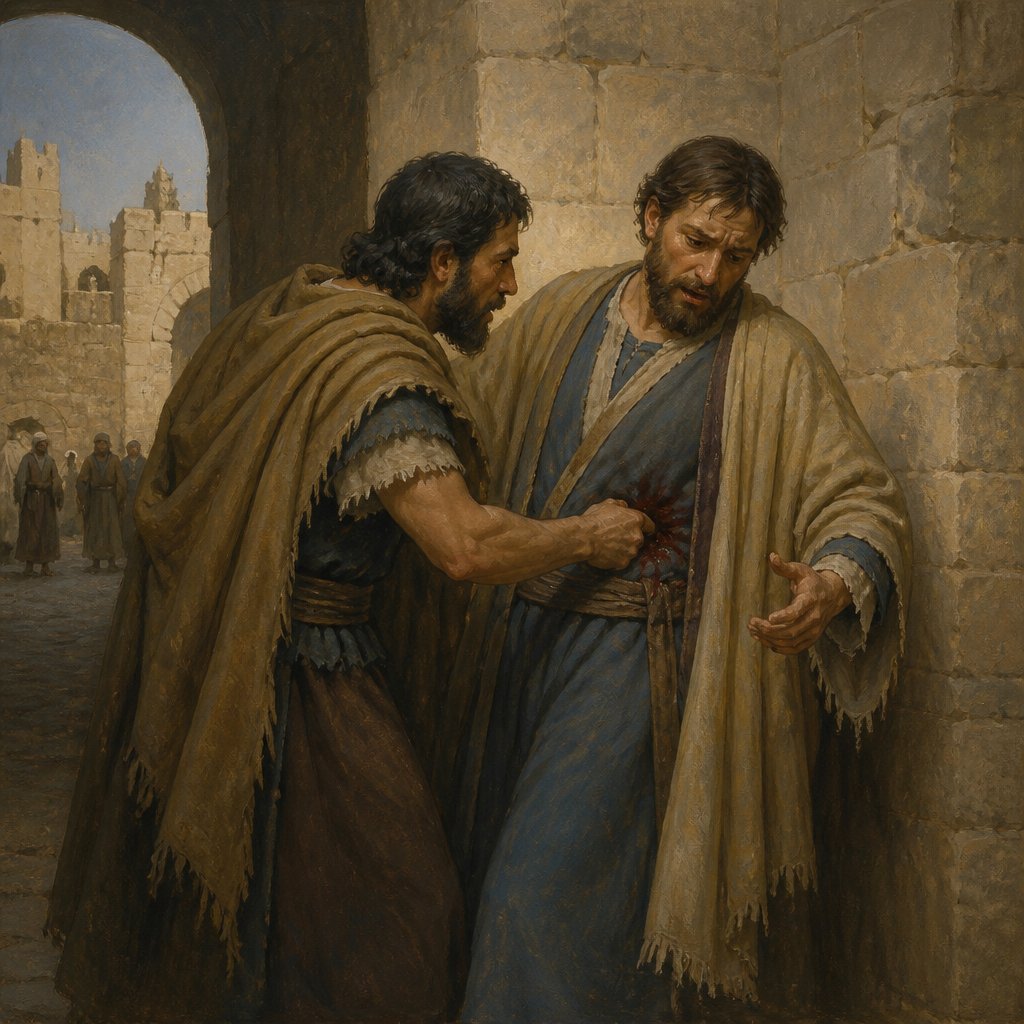
The Bible verse 2 Samuel 3:27 from the King James Version (KJV) reads, "And when Abner was returned to Hebron, Joab took him aside in the gate to speak with him quietly, and smote him there under the fifth rib, that he died, for the blood of Asahel his brother."
This verse comes from a tumultuous and violent time in the history of Israel, during the reign of King David. 2 Samuel 3:27 describes the treacherous murder of Abner, the commander of Saul's army, who had defected to David's side after Saul's death. The context of this verse is crucial to understanding its meaning and significance within the larger narrative of the Bible.
The themes present in this verse are betrayal, revenge, and the consequences of violence. The verse captures the power struggle and political maneuvering that characterized the time. Joab, David's commander, takes advantage of Abner's trust by killing him in a covert and dishonorable manner. The act was a response to the death of Joab's brother Asahel, whom Abner had killed in battle. This cycle of violence and revenge highlights the destructive nature of human conflict and the tragic consequences it brings.
The symbolism in this verse is rich and multifaceted. Abner's murder reflects the moral corruption and deceit that can arise from the pursuit of power. It illustrates how even those who are supposed to be allies can turn against each other in the quest for dominance. The gate, where the murder takes place, is a symbol of authority and justice, yet it becomes a place of treachery and death. The fifth rib, where Abner is fatally struck, is a vulnerable and vital part of the body, symbolizing the unexpected and deceitful nature of his death.
From a theological perspective, this verse raises important questions about the nature of forgiveness and justice. The cycle of violence and revenge demonstrated in this verse exemplifies the brokenness of humanity and the need for divine intervention. It serves as a harsh reminder of the consequences of sin and the destructive power of human nature when left unchecked. The verse also foreshadows the enduring repercussions of these actions, as David laments Abner's death and ultimately brings justice upon Joab for his betrayal.
In a broader context, this verse can be seen as a cautionary tale about the consequences of unchecked ambition and the destructive effects of human pride. It serves as a warning against the lure of power and the lengths to which people will go to achieve it, as seen in the tragic outcome of Abner and Joab's rivalry.
In conclusion, 2 Samuel 3:27 is a poignant and disturbing reflection on the consequences of betrayal and violence. It serves as a reminder of the destructive nature of human conflict and the need for divine intervention to break the cycle of revenge and bring about true justice and forgiveness. The verse offers valuable insights into the flawed nature of humanity and the moral complexities of power and authority. It challenges readers to examine their own motivations and actions, and to seek reconciliation and peace in the face of conflict and betrayal.
Have questions about 2 Samuel 3:27?
Dive deeper into this scripture with Bible Chat — an AI-powered tool for exploring God's Word through conversation. Ask questions, get context, and grow in your understanding of the Bible.
Get Our Apps


2 Samuel 3:27 Artwork

2 Samuel 3:27 - "And when Abner was returned to Hebron, Joab took him aside in the gate to speak with him quietly, and smote him there under the fifth rib, that he died, for the blood of Asahel his brother."
"And when Abner was returned to Hebron, Joab took him aside in the gate to speak with him quietly, and smote him there under the fifth rib, that he died, for the blood of Asahel his brother." - 2 Samuel 3:27

2 Samuel 23:27 - "Abiezer the Anethothite, Mebunnai the Hushathite,"

2 Samuel 1. 17-27

2 Samuel 1:27 - "How are the mighty fallen, and the weapons of war perished!"

Psalm 27:2-3

2 Samuel 13:27 - "But Absalom pressed him, that he let Amnon and all the king's sons go with him."

"Abiezer the Anethothite, Mebunnai the Hushathite," - 2 Samuel 23:27

2 Samuel 22:27 - "With the pure thou wilt shew thyself pure; and with the froward thou wilt shew thyself unsavoury."

2 Samuel 12:27 - "And Joab sent messengers to David, and said, I have fought against Rabbah, and have taken the city of waters."

2 Samuel 2:27 - "And Joab said, As God liveth, unless thou hadst spoken, surely then in the morning the people had gone up every one from following his brother."

2 Samuel 14:27 - "And unto Absalom there were born three sons, and one daughter, whose name was Tamar: she was a woman of a fair countenance."

"How are the mighty fallen, and the weapons of war perished!" - 2 Samuel 1:27

1 Samuel 27:2 - "And David arose, and he passed over with the six hundred men that were with him unto Achish, the son of Maoch, king of Gath."

2 Samuel 3:2 - "¶ And unto David were sons born in Hebron: and his firstborn was Amnon, of Ahinoam the Jezreelitess;"

1 Samuel 27:3 - "And David dwelt with Achish at Gath, he and his men, every man with his household, even David with his two wives, Ahinoam the Jezreelitess, and Abigail the Carmelitess, Nabal's wife."

2 Samuel 4:3 - "And the Beerothites fled to Gittaim, and were sojourners there until this day.)"

2 Samuel 3:4 - "And the fourth, Adonijah the son of Haggith; and the fifth, Shephatiah the son of Abital;"

2 Samuel 3:3 - "And his second, Chileab, of Abigail the wife of Nabal the Carmelite; and the third, Absalom the son of Maacah the daughter of Talmai king of Geshur;"

2 Chronicles 27:3 - "He built the high gate of the house of the LORD, and on the wall of Ophel he built much."

2 Samuel 3:11 - "And he could not answer Abner a word again, because he feared him."

2 Samuel 18:27 - "And the watchman said, Me thinketh the running of the foremost is like the running of Ahimaaz the son of Zadok. And the king said, He is a good man, and cometh with good tidings."

2 Samuel 3:33 - "And the king lamented over Abner, and said, Died Abner as a fool dieth?"

2 Samuel 3:5 - "And the sixth, Ithream, by Eglah David's wife. These were born to David in Hebron."

2 Samuel 19:27 - "And he hath slandered thy servant unto my lord the king; but my lord the king is as an angel of God: do therefore what is good in thine eyes."

2 Samuel 2:3 - "And his men that were with him did David bring up, every man with his household: and they dwelt in the cities of Hebron."

2 Samuel 17:27 - "¶ And it came to pass, when David was come to Mahanaim, that Shobi the son of Nahash of Rabbah of the children of Ammon, and Machir the son of Ammiel of Lo-debar, and Barzillai the Gileadite of Rogelim,"

2 Samuel 7:3 - "And Nathan said to the king, Go, do all that is in thine heart; for the LORD is with thee."

2 Samuel 3:37 - "For all the people and all Israel understood that day that it was not of the king to slay Abner the son of Ner."

2 Samuel 11:27 - "And when the mourning was past, David sent and fetched her to his house, and she became his wife, and bare him a son. But the thing that David had done displeased the LORD."