What does 2 Samuel 5:6 mean?
"¶ And the king and his men went to Jerusalem unto the Jebusites, the inhabitants of the land: which spake unto David, saying, Except thou take away the blind and the lame, thou shalt not come in hither: thinking, David cannot come in hither." - 2 Samuel 5:6
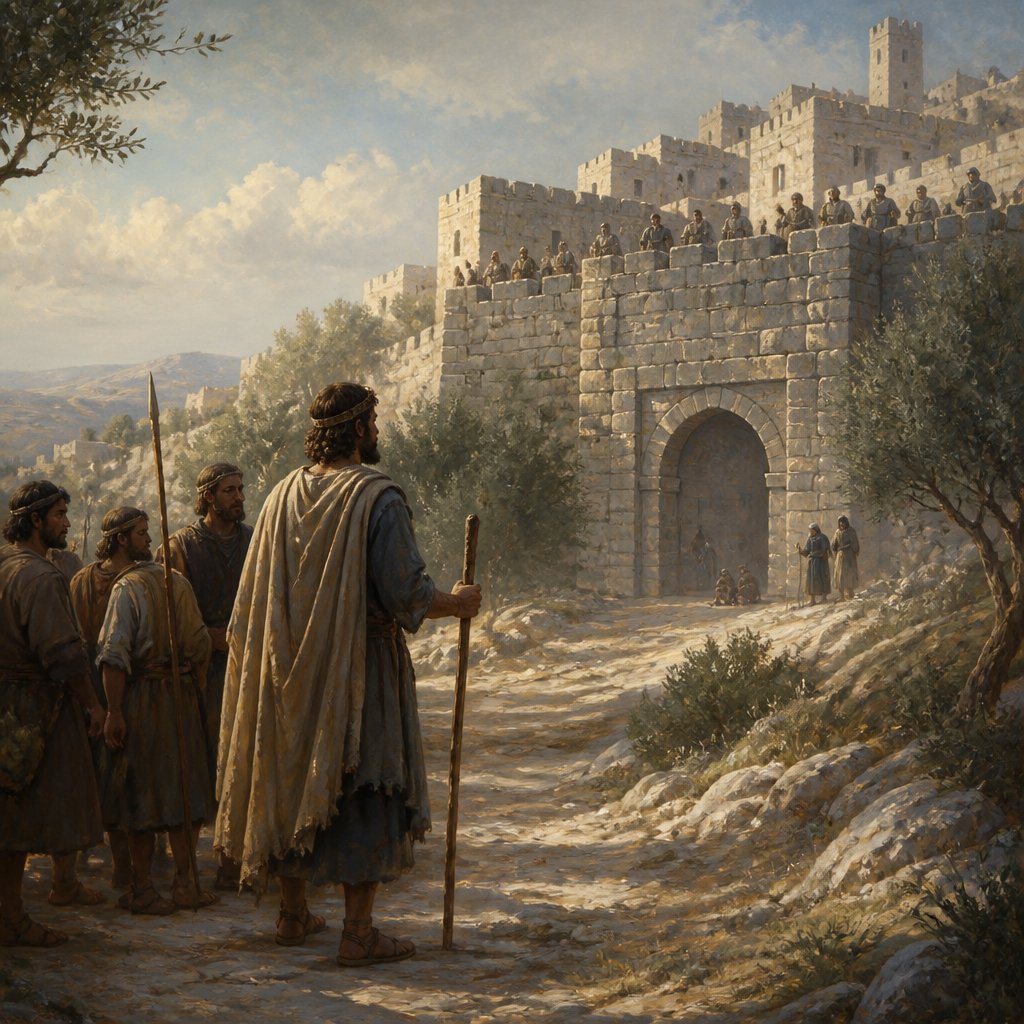
2 Samuel 5:6 (KJV) - "And the king and his men went to Jerusalem unto the Jebusites, the inhabitants of the land: which spake unto David, saying, Except thou take away the blind and the lame, thou shalt not come in hither: thinking, David cannot come in hither."
This verse marks a significant moment in the life of David, the second king of Israel. David and his men went to Jerusalem, which was then inhabited by the Jebusites. The Jebusites were a Canaanite tribe that had lived in the land for centuries. The city of Jerusalem was a strategic and fortified city that was difficult to conquer, which is why it remained under Jebusite control even after the Israelites had entered the Promised Land.
The Jebusites, confident in their defenses, taunted David saying that even the blind and the lame could defend the city against his army. This challenge did not deter David, and with unwavering determination, he and his men set out to conquer Jerusalem. King David conquered the city of Jerusalem and made it the capital of his kingdom, renaming it the "City of David".
The themes present in this verse are determination, faith, and the sovereignty of God. David's determination to conquer Jerusalem despite the taunts of the Jebusites reflects his strong faith in God and his belief that God would give him victory. This passage also emphasizes the importance of perseverance and the willingness to face challenges head-on. David's triumph over the Jebusites demonstrates the sovereignty of God and how he can use the weak to shame the strong.
The context of this verse is important to consider in order to fully understand its significance. David's rise to power and his eventual establishment of Jerusalem as the capital of Israel was a crucial moment in the history of the nation. Jerusalem became the center of worship and the political center of the kingdom of Israel. This conquest also fulfilled a promise made by God to his people that they would possess the land of Canaan.
Symbolism is also prevalent in this verse. The blind and the lame mentioned by the Jebusites can be seen as symbolic of weakness and vulnerability, which the Jebusites believed were enough to defend the city. However, David's victory over them conveys the message that God's strength is made perfect in weakness. This can also be seen as a foreshadowing of the biblical principle that God often uses the foolish things of the world to shame the wise.
In summary, 2 Samuel 5:6 showcases David's determination and faith in God as he conquers Jerusalem, a city that was considered unconquerable. This event signified the rise of Jerusalem as the religious and political center of the nation of Israel. The verse also serves as a reminder of God's sovereignty and his ability to use the weak to achieve great things. It is a powerful testimony to the strength of faith and the willingness to face challenges head-on, knowing that with God all things are possible.
Have questions about 2 Samuel 5:6?
Dive deeper into this scripture with Bible Chat — an AI-powered tool for exploring God's Word through conversation. Ask questions, get context, and grow in your understanding of the Bible.
Get Our Apps


2 Samuel 5:6 Artwork

2 Samuel 5:6 - "¶ And the king and his men went to Jerusalem unto the Jebusites, the inhabitants of the land: which spake unto David, saying, Except thou take away the blind and the lame, thou shalt not come in hither: thinking, David cannot come in hither."
"¶ And the king and his men went to Jerusalem unto the Jebusites, the inhabitants of the land: which spake unto David, saying, Except thou take away the blind and the lame, thou shalt not come in hither: thinking, David cannot come in hither." - 2 Samuel 5:6

2 Samuel 5:12

2 Samuel 6:5 - "And David and all the house of Israel played before the LORD on all manner of instruments made of fir wood, even on harps, and on psalteries, and on timbrels, and on cornets, and on cymbals."

2 Samuel 5:15 - "Ibhar also, and Elishua, and Nepheg, and Japhia,"

2 Samuel 5:16 - "And Elishama, and Eliada, and Eliphalet."

2 Samuel 6:14

"And Elishama, and Eliada, and Eliphalet." - 2 Samuel 5:16

2 Samuel 6:14–22

2 Samuel 5:18 - "The Philistines also came and spread themselves in the valley of Rephaim."

2 Samuel 5:7 - "Nevertheless David took the strong hold of Zion: the same is the city of David."

2 Samuel 5:22 - "¶ And the Philistines came up yet again, and spread themselves in the valley of Rephaim."

2 Samuel 5:21 - "And there they left their images, and David and his men burned them."

1 Samuel 5:6 - "But the hand of the LORD was heavy upon them of Ashdod, and he destroyed them, and smote them with emerods, even Ashdod and the coasts thereof."

2 Samuel 6:6 - "¶ And when they came to Nachon's threshingfloor, Uzzah put forth his hand to the ark of God, and took hold of it; for the oxen shook it."

"Ibhar also, and Elishua, and Nepheg, and Japhia," - 2 Samuel 5:15

2 Samuel 5:10 - "And David went on, and grew great, and the LORD God of hosts was with him."

2 Samuel 6:23 - "Therefore Michal the daughter of Saul had no child unto the day of her death."

2 Samuel 5:4 - "¶ David was thirty years old when he began to reign, and he reigned forty years."

2 Samuel 11:5 - "And the woman conceived, and sent and told David, and said, I am with child."

2 Samuel 22:6 - "The sorrows of hell compassed me about; the snares of death prevented me;"

2 Samuel 3:5 - "And the sixth, Ithream, by Eglah David's wife. These were born to David in Hebron."

1 Samuel 5:2 - "When the Philistines took the ark of God, they brought it into the house of Dagon, and set it by Dagon."

2 Samuel 6:1 - "Again, David gathered together all the chosen men of Israel, thirty thousand."

2 Samuel 18:6 - "¶ So the people went out into the field against Israel: and the battle was in the wood of Ephraim;"

1 Samuel 2:6 - "The LORD killeth, and maketh alive: he bringeth down to the grave, and bringeth up."

2 Samuel 24:6 - "Then they came to Gilead, and to the land of Tahtim-hodshi; and they came to Dan-jaan, and about to Zidon,"

2 Samuel 5:5 - "In Hebron he reigned over Judah seven years and six months: and in Jerusalem he reigned thirty and three years over all Israel and Judah."

2 Samuel 6:9 - "And David was afraid of the LORD that day, and said, How shall the ark of the LORD come to me?"

2 Samuel 6:14 - "And David danced before the LORD with all his might; and David was girded with a linen ephod."