What does 2 Samuel 5:4 mean?
“David was thirty years old when he began to reign, and he reigned forty years.” — 2 Samuel 5:4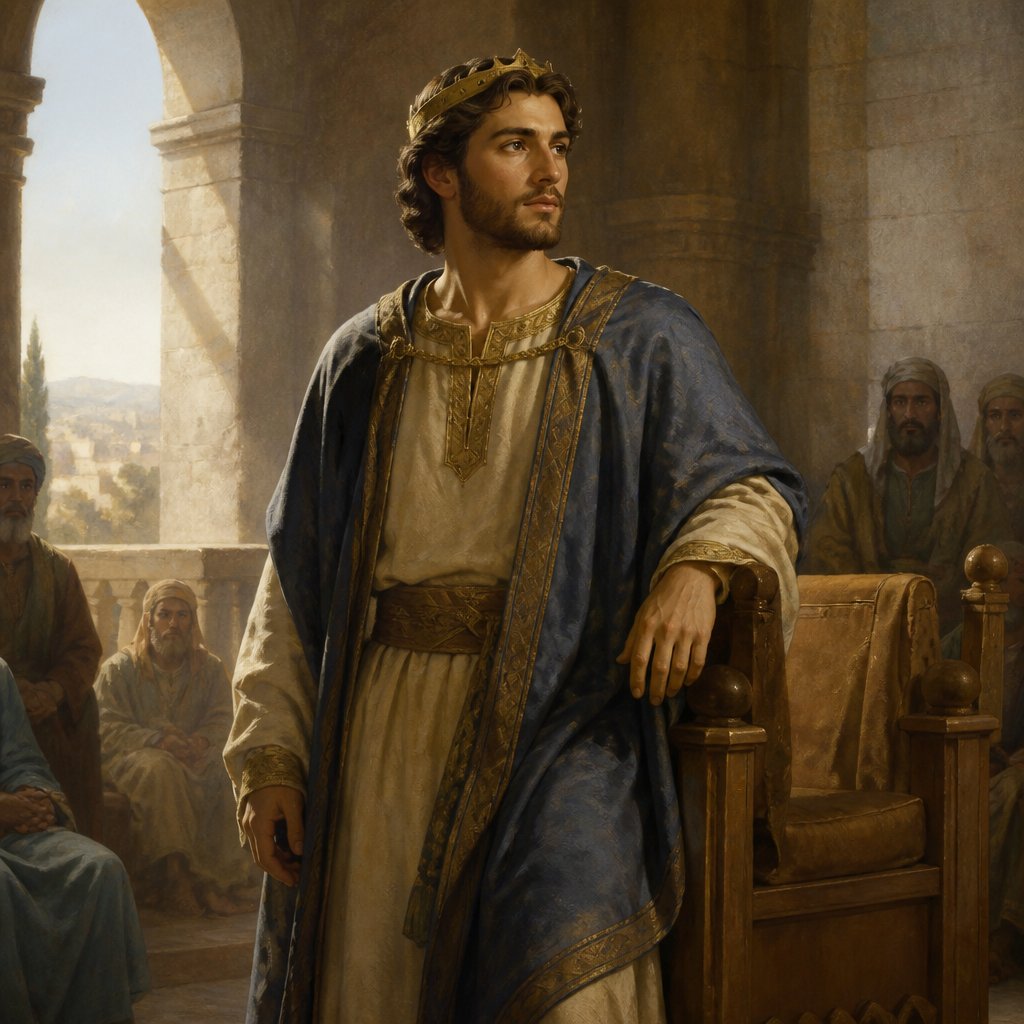
2 Samuel 5:4 (KJV) - "David was thirty years old when he began to reign, and he reigned forty years."
In this verse, we witness the beginning of David's reign as the king of Israel. David is a central figure in the Bible, and his reign is a pivotal point in the history of the nation of Israel. This verse marks the culmination of years of struggle and hardship for David, as he finally assumes the throne.
The book of 2 Samuel is predominantly concerned with David's reign and its consequences. The verse 2 Samuel 5:4 occurs within the wider context of David's reign, and the verse serves as a transitional moment in the biblical narrative. It signifies the fulfillment of God's promise to David, the establishment of the Davidic monarchy, and the beginning of a new era for the nation of Israel.
The theme of divine promise and fulfillment is a recurring motif in the biblical narrative. Throughout the Old Testament, God makes numerous promises to his people, and 2 Samuel 5:4 represents the fulfillment of one such promise. In 2 Samuel 7:12-13, God promises to establish the throne of David forever, and this verse marks the beginning of that eternal dynasty.
David's reign is also marked by his status as a "man after God's own heart." Despite his flaws and failings, David is depicted as a leader who seeks after God and desires to establish a kingdom based on righteousness and justice. This theme of divine kingship is significant in the biblical narrative, as it foreshadows the coming of Jesus Christ, who is later described as the "Son of David" in the New Testament.
The context surrounding 2 Samuel 5:4 is important for understanding its significance. Prior to assuming the throne, David had endured years of conflict and struggle, first as a fugitive from King Saul and then as a military leader. His journey to kingship was marked by adversity, and his reign is not free from challenges and hardships. This context gives added weight to the verse, as it represents the culmination of David's personal and political struggles.
The symbolism of David's reign extends beyond his individual rule. In the biblical narrative, David is often seen as a type of Christ, a foreshadowing of the coming Messiah. His reign is seen as a precursor to the establishment of God's kingdom on earth, and his dynasty is a prefiguration of the eternal reign of Jesus Christ.
The number thirty in the verse is also significant, as it symbolizes maturity and readiness for leadership. In the Bible, the age of thirty is often associated with the beginning of significant roles and responsibilities. Jesus himself began his public ministry at the age of thirty, and in ancient Jewish culture, thirty was the age at which a man could become a priest or assume other leadership roles.
In conclusion, 2 Samuel 5:4 is a verse of great significance in the biblical narrative. It marks the beginning of David's reign as king of Israel, the fulfillment of God's promise, and the establishment of the Davidic dynasty. The themes of divine promise and fulfillment, divine kingship, and the symbolism of age all contribute to the deep and profound meaning of this verse within the wider context of the Bible. David's reign is a crucial moment in the history of the nation of Israel, and his significance reverberates throughout the biblical narrative, pointing forward to the ultimate fulfillment of God's plan in the person of Jesus Christ.
Get our apps


Artwork for 2 Samuel 5:4

2 Samuel 5:4 - "¶ David was thirty years old when he began to reign, and he reigned forty years."
"¶ David was thirty years old when he began to reign, and he reigned forty years." - 2 Samuel 5:4

2 Samuel 5:12

2 Samuel 4:5 - "And the sons of Rimmon the Beerothite, Rechab and Baanah, went, and came about the heat of the day to the house of Ish-bosheth, who lay on a bed at noon."

1 Samuel 5: 3-4

2 Samuel 5:15 - "Ibhar also, and Elishua, and Nepheg, and Japhia,"

2 Samuel 5:16 - "And Elishama, and Eliada, and Eliphalet."

"And Elishama, and Eliada, and Eliphalet." - 2 Samuel 5:16

2 Samuel 10:4

2 Samuel 10:4

2 Kings 4:4-5

2 Samuel 5:18 - "The Philistines also came and spread themselves in the valley of Rephaim."

2 Samuel 5:7 - "Nevertheless David took the strong hold of Zion: the same is the city of David."

2 Samuel 5:22 - "¶ And the Philistines came up yet again, and spread themselves in the valley of Rephaim."

2 Samuel 5:21 - "And there they left their images, and David and his men burned them."

"Ibhar also, and Elishua, and Nepheg, and Japhia," - 2 Samuel 5:15

2 Samuel 5:10 - "And David went on, and grew great, and the LORD God of hosts was with him."

2 Samuel 4:3 - "And the Beerothites fled to Gittaim, and were sojourners there until this day.)"

1 Samuel 2:4 - "The bows of the mighty men are broken, and they that stumbled are girded with strength."

2 Samuel 17:4 - "And the saying pleased Absalom well, and all the elders of Israel."

2 Samuel 11:5 - "And the woman conceived, and sent and told David, and said, I am with child."

1 Samuel 4:5 - "And when the ark of the covenant of the LORD came into the camp, all Israel shouted with a great shout, so that the earth rang again."

2 Samuel 3:5 - "And the sixth, Ithream, by Eglah David's wife. These were born to David in Hebron."

2 Timothy 4:5

2 Samuel 3:4 - "And the fourth, Adonijah the son of Haggith; and the fifth, Shephatiah the son of Abital;"

1 Samuel 5:2 - "When the Philistines took the ark of God, they brought it into the house of Dagon, and set it by Dagon."

2 Samuel 7:4 - "¶ And it came to pass that night, that the word of the LORD came unto Nathan, saying,"

2 Samuel 5:5 - "In Hebron he reigned over Judah seven years and six months: and in Jerusalem he reigned thirty and three years over all Israel and Judah."

2 Samuel 22:5 - "When the waves of death compassed me, the floods of ungodly men made me afraid;"

2 Samuel 5:14 - "And these be the names of those that were born unto him in Jerusalem; Shammua, and Shobab, and Nathan, and Solomon,"