What does 2 Samuel 5:8 mean?
“And David said on that day, Whosoever getteth up to the gutter, and smiteth the Jebusites, and the lame and the blind, that are hated of David’s soul, he shall be chief and captain. Wherefore they said, The blind and the lame shall not come into the house.” — 2 Samuel 5:8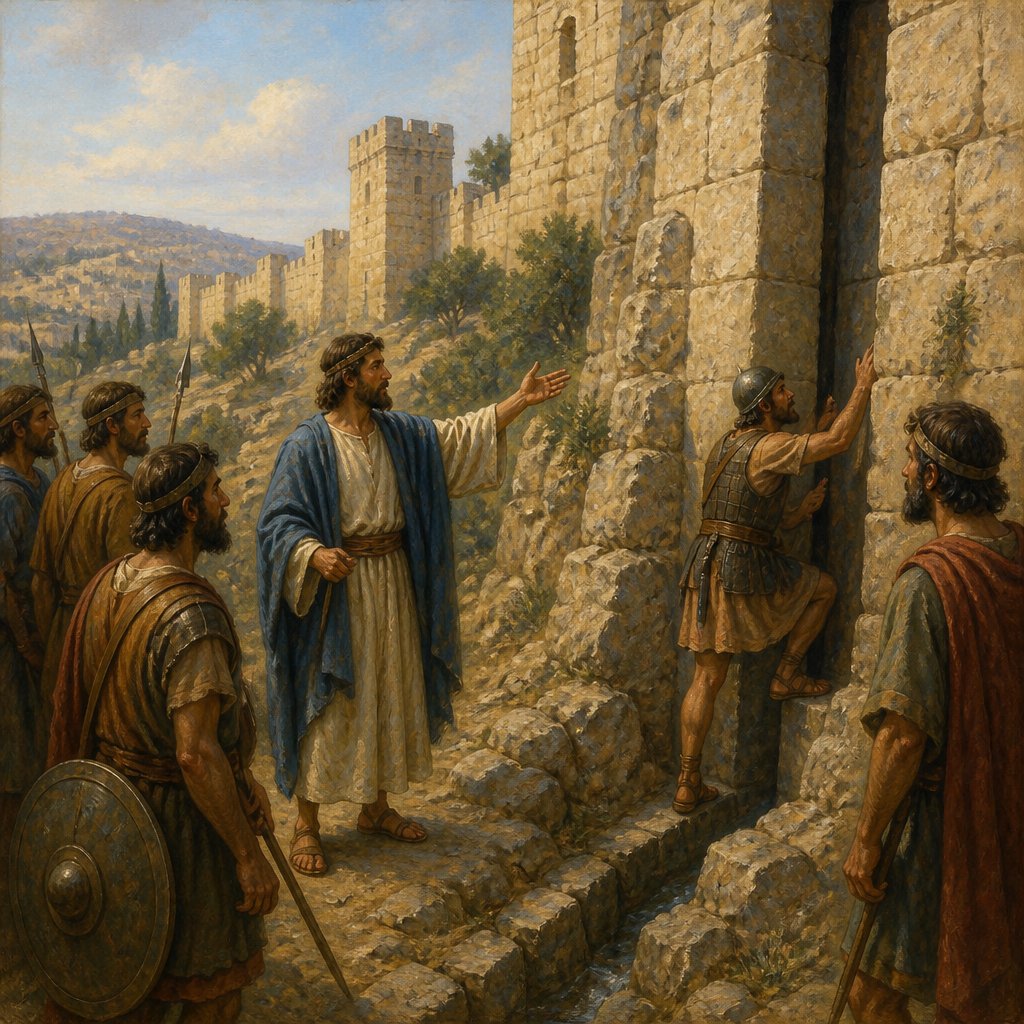
The Bible verse 2 Samuel 5:8 from the King James Version (KJV) states, "And David said on that day, Whosoever getteth up to the gutter, and smiteth the Jebusites, and the lame and the blind, that are hated of David's soul, he shall be chief and captain. Wherefore they said, The blind and the lame shall not come into the house."
This verse is part of a larger passage which describes how King David captured the stronghold of Zion and made it his own city, the City of David. This event is significant in David's reign as it established Jerusalem as the capital of the Israelite nation and is also symbolic of David's rise to power, not only as a military leader but as a statesman and a unifier of the tribes of Israel.
In this verse, it is evident that David is addressing his warriors and making a declaration about the qualifications for leadership in his army. The phrase "Whosoever getteth up to the gutter" refers to a challenging and dangerous mission that someone must undertake in order to prove their worthiness for leadership. The "gutter" is a narrow, water-conducting channel that ran through the city and would have been a difficult and precarious place to navigate. By issuing this challenge, David is testing the courage, skill, and loyalty of his warriors.
The reference to "smiting the Jebusites, and the lame and the blind" is a reflection of the attitudes and customs of the time. The Jebusites were the previous inhabitants of Jerusalem, and David's defeat of them symbolizes his dominance and authority over the city. The mention of the "lame and the blind" who are "hated of David's soul" is a metaphor for the obstacles and weaknesses that David's army will need to overcome in battle. It also serves as a reminder that in ancient times, disability was often viewed as a sign of impurity or unworthiness, and David is setting a standard for his troops that only the strongest and most capable will be allowed to serve in leadership positions.
The phrase "he shall be chief and captain" emphasizes the significance of the task and the reward for successful completion. David is making it clear that the individual who accomplishes this mission will be given a position of great honor and responsibility within his army. This demonstrates David's leadership style of promoting meritocracy and rewarding courage and skill, rather than simply relying on lineage or nepotism.
Finally, the declaration "The blind and the lame shall not come into the house" reflects David's determination to maintain the purity and strength of his army and his kingdom. This statement extends beyond the immediate context of the military challenge and can be viewed as a broader metaphor for David's commitment to upholding standards of excellence and integrity within his administration. It also underscores the importance of physical and spiritual wholeness in David's society, as only those who are strong and capable will be permitted to have a role in shaping the nation's future.
Overall, 2 Samuel 5:8 is a powerful and multi-layered verse that offers insight into the character of King David and the values of his era. It reveals his strategic thinking, his expectations for his followers, and his determination to lead with strength and conviction. The verse also contains themes of leadership, courage, and the quest for excellence, which continue to resonate with readers today. It serves as a reminder that, even in ancient times, great leaders sought to surround themselves with the best and the brightest, and to inspire their followers to rise to the challenge and prove their worthiness.
Get our apps


Artwork for 2 Samuel 5:8

2 Samuel 5:8 - "And David said on that day, Whosoever getteth up to the gutter, and smiteth the Jebusites, and the lame and the blind, that are hated of David's soul, he shall be chief and captain. Wherefore they said, The blind and the lame shall not come into the house."
"And David said on that day, Whosoever getteth up to the gutter, and smiteth the Jebusites, and the lame and the blind, that are hated of David's soul, he shall be chief and captain. Wherefore they said, The blind and the lame shall not come into the house." - 2 Samuel 5:8

2 Samuel 8:5 - "And when the Syrians of Damascus came to succour Hadadezer king of Zobah, David slew of the Syrians two and twenty thousand men."

2 Samuel 5:12

2 Samuel 5:15 - "Ibhar also, and Elishua, and Nepheg, and Japhia,"

2 Samuel 5:16 - "And Elishama, and Eliada, and Eliphalet."

2 Samuel 19:8

2 Samuel 19:8

2 Samuel 19:8

2 Samuel 19:8

"And Elishama, and Eliada, and Eliphalet." - 2 Samuel 5:16

2 samuel 23:8-21

2 Samuel 8:8 - "And from Betah, and from Berothai, cities of Hadadezer, king David took exceeding much brass."

2 Samuel 5:18 - "The Philistines also came and spread themselves in the valley of Rephaim."

2 Samuel 5:7 - "Nevertheless David took the strong hold of Zion: the same is the city of David."

2 Samuel 5:22 - "¶ And the Philistines came up yet again, and spread themselves in the valley of Rephaim."

2 Samuel 5:21 - "And there they left their images, and David and his men burned them."

2 Samuel 2:8 - "¶ But Abner the son of Ner, captain of Saul's host, took Ish-bosheth the son of Saul, and brought him over to Mahanaim;"

"Ibhar also, and Elishua, and Nepheg, and Japhia," - 2 Samuel 5:15

2 Samuel 5:10 - "And David went on, and grew great, and the LORD God of hosts was with him."

"And when the Syrians of Damascus came to succour Hadadezer king of Zobah, David slew of the Syrians two and twenty thousand men." - 2 Samuel 8:5

2 Samuel 8:16 - "And Joab the son of Zeruiah was over the host; and Jehoshaphat the son of Ahilud was recorder;"

2 Samuel 5:4 - "¶ David was thirty years old when he began to reign, and he reigned forty years."

2 Samuel 11:5 - "And the woman conceived, and sent and told David, and said, I am with child."

2 Samuel 3:5 - "And the sixth, Ithream, by Eglah David's wife. These were born to David in Hebron."

2 Samuel 22:8 - "Then the earth shook and trembled; the foundations of heaven moved and shook, because he was wroth."

2 Samuel 8:17 - "And Zadok the son of Ahitub, and Ahimelech the son of Abiathar, were the priests; and Seraiah was the scribe;"

2 Samuel 8:7 - "And David took the shields of gold that were on the servants of Hadadezer, and brought them to Jerusalem."

1 Samuel 5:2 - "When the Philistines took the ark of God, they brought it into the house of Dagon, and set it by Dagon."

2 Samuel 8:9 - "¶ When Toi king of Hamath heard that David had smitten all the host of Hadadezer,"