What does 2 Samuel 8:2 mean?
“And he smote Moab, and measured them with a line, casting them down to the ground; even with two lines measured he to put to death, and with one full line to keep alive. And so the Moabites became David’s servants, and brought gifts.” — 2 Samuel 8:2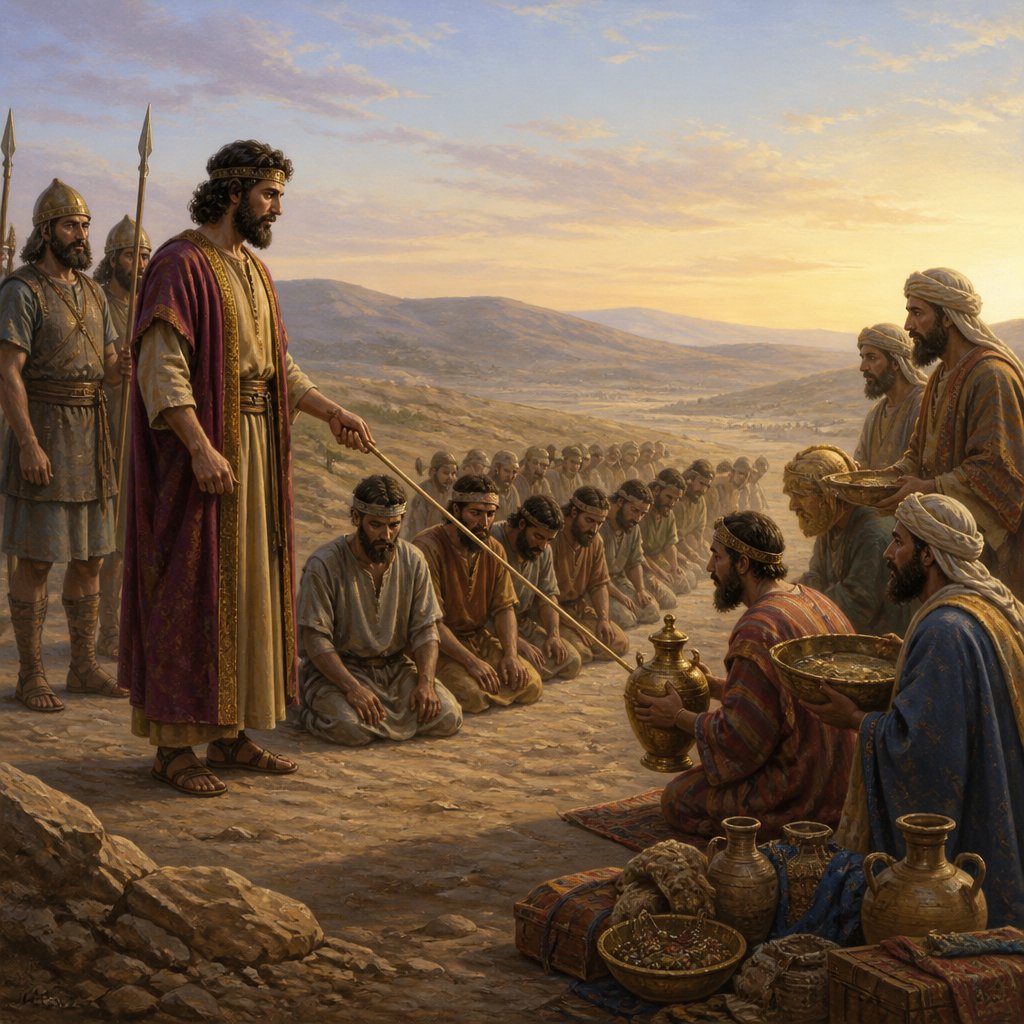
The Bible verse 2 Samuel 8:2, according to the King James Version (KJV) reads, "And he smote Moab, and measured them with a line, casting them down to the ground; even with two lines measured he to put to death, and with one full line to keep alive. And so the Moabites became David's servants, and brought gifts."
This verse is part of a larger passage in the book of 2 Samuel that describes King David's military conquests and the expansion of his kingdom. In this particular verse, David is shown defeating the Moabites and subjugating them into his service, imposing a harsh judgment upon them but also allowing for some to remain alive.
The themes present in this verse include the exercise of power and control, the consequences of war, and the concept of mercy within judgment. These themes are interwoven within the historical and religious context of the ancient Israelite society, and they continue to have relevance and applicability to contemporary ethical and moral considerations.
The historical context of this verse is crucial for understanding its significance. King David, the protagonist of this passage, was a central figure in the history of ancient Israel. He is depicted as a powerful and successful leader who united the tribes of Israel and established a prosperous and secure kingdom. The military conquests described in 2 Samuel 8 represent David's expansionist policies and his efforts to secure Israel's borders and assert his dominion over neighboring territories.
The verse specifically addresses David's actions towards the Moabites, who were an ancient Semitic people located east of the Dead Sea. By defeating the Moabites and forcing them into servitude, David demonstrated his military prowess and his ability to exert control over other nations. The act of measuring the Moabites with lines, and the distinction between those who were put to death and those who were spared, reflects the exercise of judgment and the allocation of mercy within the context of war and conquest.
The symbolism within this verse is multi-layered and provides insight into the moral and ethical implications of David's military campaigns. The act of measuring the Moabites with lines can be interpreted as a symbolic representation of the division between life and death, and the exercise of judgment and power. This imagery conveys the idea of the Moabites being subjected to the will of David and the Israelites, and the arbitrary nature of their fate being determined by the ruler's decree.
Furthermore, the distinction between those who were put to death and those who were kept alive with one full line serves as a metaphor for the concept of mercy within judgment. Despite the harshness of the conquest, David's decision to spare some of the Moabites demonstrates a sense of compassion and restraint, suggesting that mercy can coexist with the exercise of power and authority.
The verse also raises important moral and ethical questions about the consequences of war and the treatment of conquered peoples. David's subjugation of the Moabites and their forced servitude raises questions about the justifiability of conquest and the implication of imposing one's rule upon others. The verse prompts reflection on the ethical implications of military actions and the responsibilities of those in power towards those they conquer.
In conclusion, 2 Samuel 8:2 from the King James Version encapsulates significant themes regarding power, judgment, and mercy within the context of King David's military conquests. The historical and religious context of this verse, along with its symbolism, provides a thought-provoking insight into the moral and ethical implications of war and conquest. The verse challenges readers to reflect on the exercise of power, mercy within judgment, and the ethical responsibilities of those in positions of authority.
Get our apps


Artwork for 2 Samuel 8:2

2 Samuel 8:2 - "And he smote Moab, and measured them with a line, casting them down to the ground; even with two lines measured he to put to death, and with one full line to keep alive. And so the Moabites became David's servants, and brought gifts."
"And he smote Moab, and measured them with a line, casting them down to the ground; even with two lines measured he to put to death, and with one full line to keep alive. And so the Moabites became David's servants, and brought gifts." - 2 Samuel 8:2

2 Samuel 19:8

2 Samuel 19:8

2 Samuel 19:8

2 Samuel 19:8

2 samuel 23:8-21

2 Samuel 2:8 - "¶ But Abner the son of Ner, captain of Saul's host, took Ish-bosheth the son of Saul, and brought him over to Mahanaim;"

2 Samuel 8:8 - "And from Betah, and from Berothai, cities of Hadadezer, king David took exceeding much brass."

2 Samuel 8:16 - "And Joab the son of Zeruiah was over the host; and Jehoshaphat the son of Ahilud was recorder;"

2 Samuel 22:8 - "Then the earth shook and trembled; the foundations of heaven moved and shook, because he was wroth."

2 Samuel 8:17 - "And Zadok the son of Ahitub, and Ahimelech the son of Abiathar, were the priests; and Seraiah was the scribe;"

2 Samuel 8:7 - "And David took the shields of gold that were on the servants of Hadadezer, and brought them to Jerusalem."

2 Samuel 8:9 - "¶ When Toi king of Hamath heard that David had smitten all the host of Hadadezer,"

2 Samuel 14:8 - "And the king said unto the woman, Go to thine house, and I will give charge concerning thee."

2 Samuel 8:12 - "Of Syria, and of Moab, and of the children of Ammon, and of the Philistines, and of Amalek, and of the spoil of Hadadezer, son of Rehob, king of Zobah."

2 Samuel 8:18 - "And Benaiah the son of Jehoiada was over both the Cherethites and the Pelethites; and David's sons were chief rulers."

1 Samuel 8:2 - "Now the name of his firstborn was Joel; and the name of his second, Abiah: they were judges in Beer-sheba."

2 Samuel 1:8 - "And he said unto me, Who art thou? And I answered him, I am an Amalekite."

2 Samuel 8:15 - "And David reigned over all Israel; and David executed judgment and justice unto all his people."

2 Samuel 24:8 - "So when they had gone through all the land, they came to Jerusalem at the end of nine months and twenty days."

2 Samuel 18:8 - "For the battle was there scattered over the face of all the country: and the wood devoured more people that day than the sword devoured."

2 Samuel 9:8 - "And he bowed himself, and said, What is thy servant, that thou shouldest look upon such a dead dog as I am?"

2 Samuel 8:5 - "And when the Syrians of Damascus came to succour Hadadezer king of Zobah, David slew of the Syrians two and twenty thousand men."

2 Samuel 8:3 - "¶ David smote also Hadadezer, the son of Rehob, king of Zobah, as he went to recover his border at the river Euphrates."

2 Samuel 8:1 - "And after this it came to pass, that David smote the Philistines, and subdued them: and David took Metheg-ammah out of the hand of the Philistines."

2 Samuel 8:13 - "And David gat him a name when he returned from smiting of the Syrians in the valley of salt, being eighteen thousand men."

2 Samuel 6:8 - "And David was displeased, because the LORD had made a breach upon Uzzah: and he called the name of the place Perez-uzzah to this day."

2 Samuel 8:6 - "Then David put garrisons in Syria of Damascus: and the Syrians became servants to David, and brought gifts. And the LORD preserved David whithersoever he went."

2 Samuel 10:8 - "And the children of Ammon came out, and put the battle in array at the entering in of the gate: and the Syrians of Zoba, and of Rehob, and Ish-tob, and Maacah, were by themselves in the field."