What does Acts 25:21 mean?
“But when Paul had appealed to be reserved unto the hearing of Augustus, I commanded him to be kept till I might send him to Cæsar.” — Acts 25:21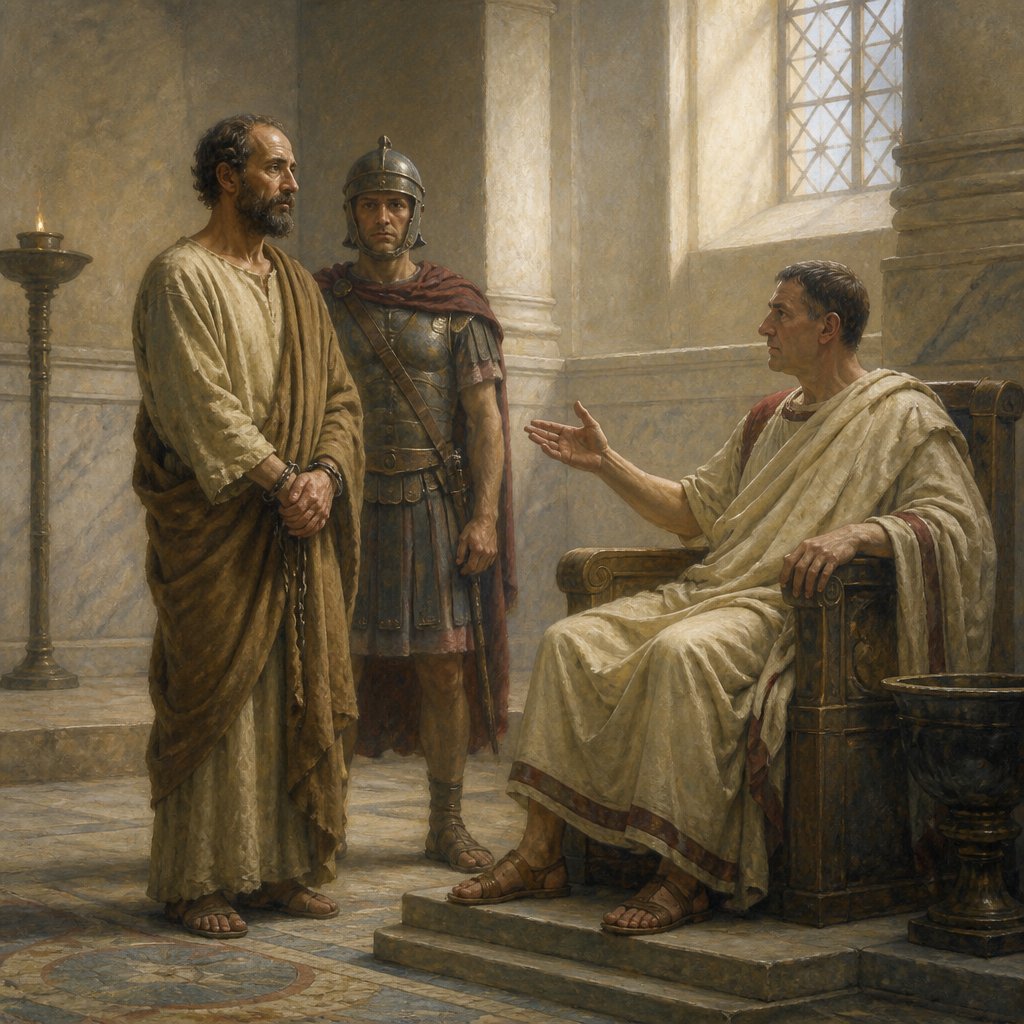
Acts 25:21 (KJV) states, "But when Paul had appealed to be reserved unto the hearing of Augustus, I commanded him to be kept till I might send him to Caesar."
This verse is part of a passage in the Book of Acts that details the trial of the apostle Paul before the Roman governor, Festus. In the previous verses, the Jewish leaders had brought accusations against Paul, and Festus, not knowing what to do with him, suggested that Paul go to Jerusalem to be judged. However, Paul, knowing the dangers he would face in Jerusalem, appealed to Caesar, invoking his rights as a Roman citizen to have his case heard by the highest authority in the Roman Empire.
The verse captures the decision of Festus to keep Paul in custody until he could arrange for him to be sent to Caesar. This decision echoes the political and legal complexities of Paul's situation. It also underscores the theme of Paul's missionary journey and the spread of Christianity in the midst of political and legal challenges.
The context of Acts 25:21 is significant for understanding the broader message of the Book of Acts. The book is the sequel to the Gospel of Luke and serves as a historical account of the early Christian church. It details the growth of the church as well as the persecution and challenges faced by the apostles, including Paul. Acts 25:21 is a key moment in Paul's journey as he seeks justice and protection under Roman law, ultimately fulfilling his mission to spread the teachings of Christ to the highest authority in the Roman Empire.
The verse also highlights the tension between the Roman legal system and the spread of Christianity. By appealing to Caesar, Paul asserts his rights as a Roman citizen and uses the legal system to his advantage, ultimately advancing the cause of the gospel. This theme of navigating legal and political systems in service of the gospel is a recurring motif in the Book of Acts, underscoring the importance of strategic and diplomatic approaches to advancing the Christian faith in a complex and often hostile world.
Symbolically, Acts 25:21 represents the broader journey of faith and perseverance in the face of adversity. Paul's decision to appeal to Caesar reflects his unwavering commitment to spreading the message of Jesus Christ, despite the challenges and dangers he faces. The verse also symbolizes the divine providence at work in Paul's life, as his appeal to Caesar ultimately fulfills God's plan for him to testify in Rome—a prophetic promise given to him earlier in the book (Acts 23:11).
Overall, Acts 25:21 captures the legal, political, and spiritual complexities of Paul's journey and the broader themes of faith, perseverance, and divine providence. It serves as a pivotal moment in the narrative of the early church, highlighting the strategic and diplomatic efforts to advance the gospel and the unwavering commitment of the apostles to fulfill their mission, regardless of the obstacles they face. As such, this verse continues to inspire and challenge believers in navigating the complexities of the world while remaining steadfast in their faith and commitment to spreading the good news of Jesus Christ.
Get our apps


Artwork for Acts 25:21

Acts 25:21 - "But when Paul had appealed to be reserved unto the hearing of Augustus, I commanded him to be kept till I might send him to Caesar."
"But when Paul had appealed to be reserved unto the hearing of Augustus, I commanded him to be kept till I might send him to Caesar." - Acts 25:21

2 Kings 21:25 - "Now the rest of the acts of Amon which he did, are they not written in the book of the chronicles of the kings of Judah?"
Acts 21:25 - "As touching the Gentiles which believe, we have written and concluded that they observe no such thing, save only that they keep themselves from things offered to idols, and from blood, and from strangled, and from fornication."

"Now the rest of the acts of Amon which he did, are they not written in the book of the chronicles of the kings of Judah?" - 2 Kings 21:25

Proverbs 21:25-26 - "The desire of the lazy man kills him, For his hands refuse to labor. He covets greedily all day long, But the righteous gives and does not spare."

Matthew 25:21

Matthew 25:21

Genesis 21-25

Genesis 21:25

Acts 23:25 - "And he wrote a letter after this manner:"

Acts 11:25 - "Then departed Barnabas to Tarsus, for to seek Saul:"

John 21:25

Genesis 21:25

Matthew 21:25

Acts 1:21-23

Acts 1:21-22

Acts 21:5-6

Acts 1:21-22

Jeremiah 25:21 - "Edom, and Moab, and the children of Ammon,"

Acts 14:25 - "And when they had preached the word in Perga, they went down into Attalia:"

Acts 25:25 - "But when I found that he had committed nothing worthy of death, and that he himself hath appealed to Augustus, I have determined to send him."

Acts 9:25 - "Then the disciples took him by night, and let him down by the wall in a basket."

Exodus 21:25 - "Burning for burning, wound for wound, stripe for stripe."

Acts 25:2 - "Then the high priest and the chief of the Jews informed him against Paul, and besought him,"

Revelation 21:25 - "And the gates of it shall not be shut at all by day: for there shall be no night there."

Acts 21:36 - "For the multitude of the people followed after, crying, Away with him."

Acts 16:25 - "¶ And at midnight Paul and Silas prayed, and sang praises unto God: and the prisoners heard them."

Acts 25:27 - "For it seemeth to me unreasonable to send a prisoner, and not withal to signify the crimes laid against him."

Acts 10:25 - "And as Peter was coming in, Cornelius met him, and fell down at his feet, and worshipped him."