What does Acts 27:1 mean?
“And when it was determined that we should sail into Italy, they delivered Paul and certain other prisoners unto one named Julius, a centurion of Augustus’ band.” — Acts 27:1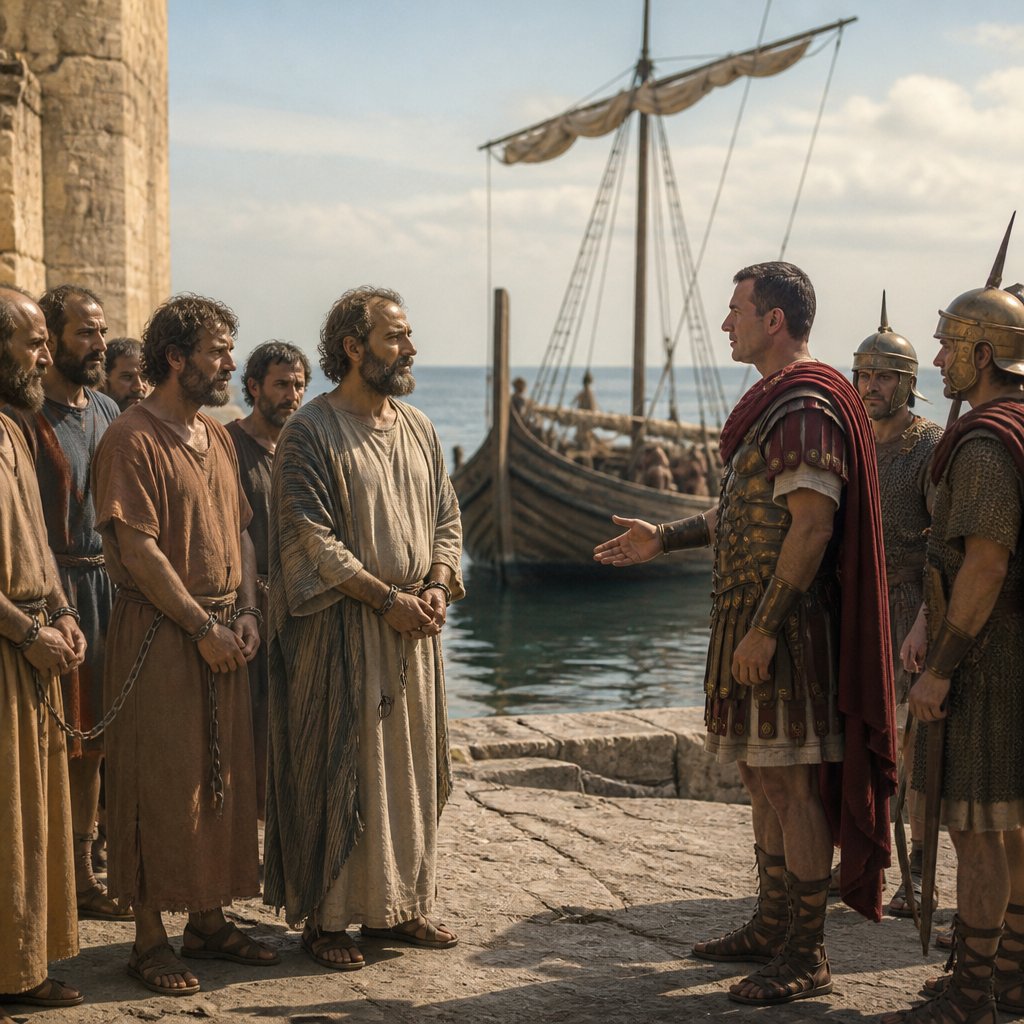
Acts 27:1 in the King James Version (KJV) of the Bible reads, "And when it was determined that we should sail into Italy, they delivered Paul and certain other prisoners unto one named Julius, a centurion of Augustus' band." This verse is a part of the larger narrative in the book of Acts that details the apostle Paul's journey to Rome as a prisoner. This journey was perilous, and the events that took place during the voyage are filled with symbolism and meaning that can be applied to our own lives.
The context of this verse is that Paul, along with other prisoners, was being transported to Rome under the guard of a centurion named Julius. Paul's journey to Rome was not of his own desire, but rather it was part of God's plan for him to spread the gospel in the heart of the Roman Empire. The act of sailing to Italy was not one that Paul had chosen for himself, but it was a means to an end, demonstrating the sovereign will of God in guiding Paul's life and ministry.
One of the key themes in this verse is the theme of divine providence. The fact that Paul, a faithful follower of Christ, was being sent to Rome as a prisoner might have seemed like a setback, but in reality, it was all part of God's plan for him. This speaks to the idea that God can use even the most difficult and challenging circumstances to bring about His purposes in our lives.
The symbolism of the voyage to Italy is also significant. The perilous journey that Paul embarked on serves as a symbol of the trials and tribulations that Christians may face in their own lives. Just as Paul faced storms, shipwrecks, and other dangers on his way to Rome, so too do believers encounter difficulties and challenges as they journey through life. This verse serves as a reminder that God is with us in the midst of our struggles, and He can use even the most difficult circumstances for His glory and our ultimate good.
The character of Julius, the centurion, also holds symbolic significance. Centurions in the Roman army were known for their discipline, leadership, and loyalty. In the midst of the storm and chaos of the voyage, Julius remained steadfast in his duty to safeguard the prisoners, including Paul. His character serves as an example of faithfulness and integrity, even in the face of adversity.
In the broader context of the book of Acts, the journey to Rome represents the spread of the gospel beyond the confines of Jerusalem and the surrounding regions. It is a testament to the faith and courage of the early church in taking the message of Christ to the ends of the earth, despite the challenges and opposition they faced.
Ultimately, Acts 27:1 serves as a reminder that God is in control of our lives, even in the midst of uncertainty and difficulty. Like Paul, we may find ourselves on journeys that are not of our own choosing, but we can trust that God is working out His purposes through it all. The symbolism and themes present in this verse provide timeless truths that can be applied to our own lives, as we navigate the storms and trials that come our way.
Get our apps


Artwork for Acts 27:1

Acts 27:1 - "And when it was determined that we should sail into Italy, they delivered Paul and certain other prisoners unto one named Julius, a centurion of Augustus' band."
"And when it was determined that we should sail into Italy, they delivered Paul and certain other prisoners unto one named Julius, a centurion of Augustus' band." - Acts 27:1

1 Kings 16:27 - "Now the rest of the acts of Omri which he did, and his might that he shewed, are they not written in the book of the chronicles of the kings of Israel?"

Acts 17:27

Acts 27:26 - "Howbeit we must be cast upon a certain island."

Acts 27:27 - "But when the fourteenth night was come, as we were driven up and down in Adria, about midnight the shipmen deemed that they drew near to some country;"

Acts 11:27 - "¶ And in these days came prophets from Jerusalem unto Antioch."

Acts 27:36 - "Then were they all of good cheer, and they also took some meat."

Acts 27:14 - "But not long after there arose against it a tempestuous wind, called Euroclydon."

Acts 27:32 - "Then the soldiers cut off the ropes of the boat, and let her fall off."

James 1:26-27 - "James 1:26-27: If anyone considers himself religious and yet does not keep a tight rein on his tongue, he deceives himself and his religion is worthless. Religion that God our Father accepts as pure and faultless is this: to look after orphans and widows in their distress and to keep oneself from being polluted by the world."

Acts 27:18 - "And we being exceedingly tossed with a tempest, the next day they lightened the ship;"

Acts 27:37 - "And we were in all in the ship two hundred threescore and sixteen souls."

Acts 20:27 - "For I have not shunned to declare unto you all the counsel of God."

Acts 26:27 - "King Agrippa, believest thou the prophets? I know that thou believest."

Acts 27:38 - "And when they had eaten enough, they lightened the ship, and cast out the wheat into the sea."

Acts 27:19 - "And the third day we cast out with our own hands the tackling of the ship."
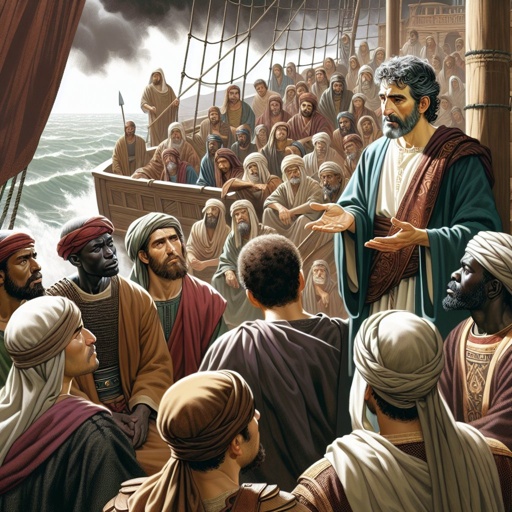
Acts 27:31 - "Paul said to the centurion and to the soldiers, Except these abide in the ship, ye cannot be saved."

Acts 10:27 - "And as he talked with him, he went in, and found many that were come together."

Acts 27:6 - "And there the centurion found a ship of Alexandria sailing into Italy; and he put us therein."

Acts 27:23 - "For there stood by me this night the angel of God, whose I am, and whom I serve,"

Acts 27:42 - "And the soldiers' counsel was to kill the prisoners, lest any of them should swim out, and escape."

Acts 25:27 - "For it seemeth to me unreasonable to send a prisoner, and not withal to signify the crimes laid against him."

Acts 27:25 - "Wherefore, sirs, be of good cheer: for I believe God, that it shall be even as it was told me."

Acts 27:15 - "And when the ship was caught, and could not bear up into the wind, we let her drive."

Acts 5:27 - "And when they had brought them, they set them before the council: and the high priest asked them,"

Acts 27:16 - "And running under a certain island which is called Clauda, we had much work to come by the boat:"

Acts 27:5 - "And when we had sailed over the sea of Cilicia and Pamphylia, we came to Myra, a city of Lycia."

Acts 27:8 - "And, hardly passing it, came unto a place which is called The fair havens; nigh whereunto was the city of Lasea."

Acts 27:22 - "And now I exhort you to be of good cheer: for there shall be no loss of any man's life among you, but of the ship."