What does Deuteronomy 1:3 mean?
“And it came to pass in the fortieth year, in the eleventh month, on the first day of the month, that Moses spake unto the children of Israel, according unto all that the LORD had given him in commandment unto them;” — Deuteronomy 1:3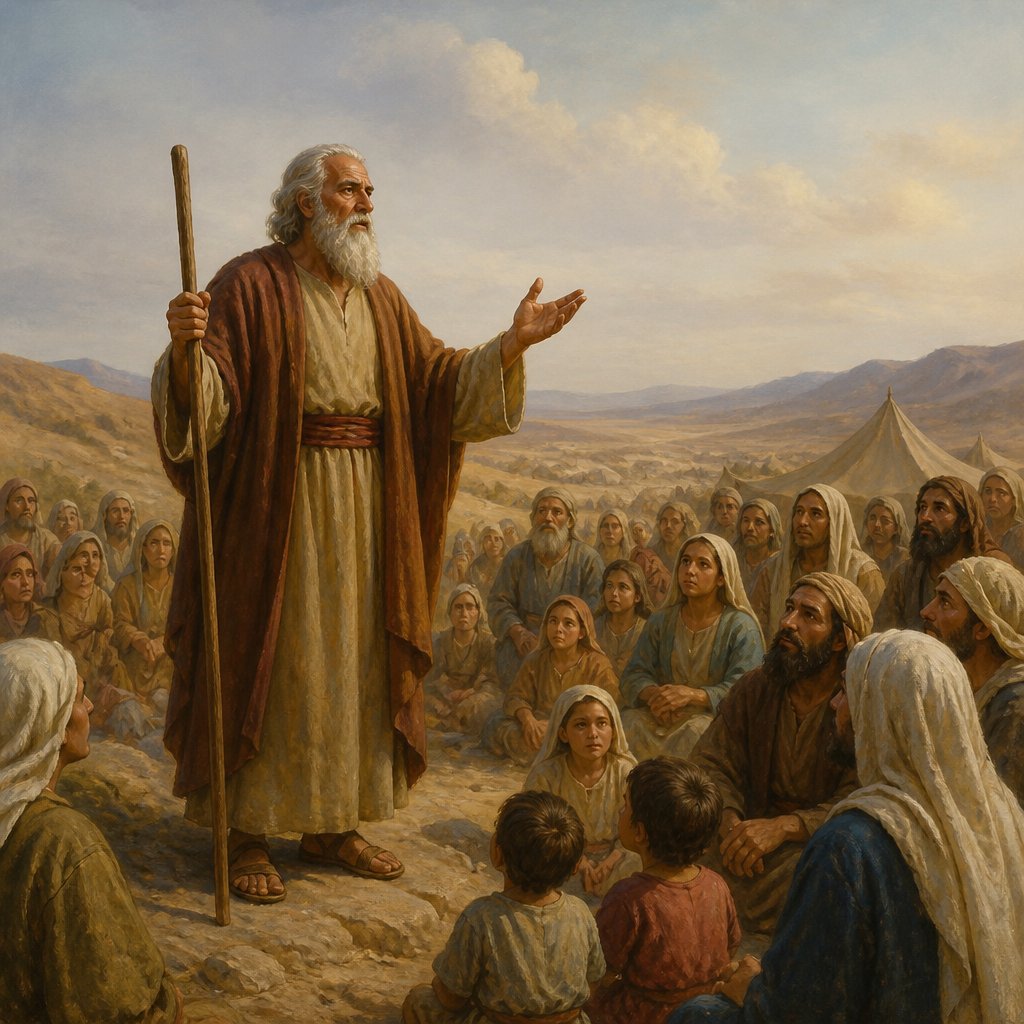
Deuteronomy 1:3 (KJV): "And it came to pass in the fortieth year, in the eleventh month, on the first day of the month, that Moses spake unto the children of Israel, according unto all that the Lord had given him in commandment unto them;"
The book of Deuteronomy is the fifth book in the Old Testament, and it is attributed to Moses. The verse Deuteronomy 1:3 marks the beginning of Moses' address to the Israelites, recounting the events that had transpired over the previous forty years. This verse sets the stage for the rest of the book, providing a specific time frame for when Moses spoke to the people and establishing the authority with which he spoke, as he was relaying the commandments given to him by the Lord.
The opening phrase "And it came to pass in the fortieth year" immediately draws attention to the passage of time. This is a significant period for the Israelites, as it represents the length of time they spent wandering in the wilderness as a result of their disobedience to God. The journey from Egypt to the Promised Land should have taken a significantly shorter time, but due to their lack of faith and rebellion, the Israelites were condemned to wander for forty years before entering the land of Canaan.
The eleventh month and the first day of the month mentioned in the verse also indicate a specific date, further emphasizing the precision and detail of the historical account being relayed. This attention to detail highlights the importance of the events being described and the significance of the message that Moses is about to deliver to the Israelites.
The verse goes on to state that Moses spoke to the children of Israel "according unto all that the Lord had given him in commandment unto them." This phrase underscores the authority of Moses as a messenger of God. He was not speaking of his own accord but was delivering the specific instructions and commandments that had been given to him by the Lord. This reinforces the divine inspiration and the sacred nature of the message that was being conveyed to the people.
The themes present in Deuteronomy 1:3 are numerous, but some of the most prominent include obedience, faithfulness, and the covenant relationship between God and His people. The verse serves as a reminder of the consequences of disobedience and the faithfulness of God, who continued to guide and instruct His people even after their wandering in the wilderness. It also emphasizes the importance of heeding the commandments of the Lord and following them with unwavering commitment.
The context of Deuteronomy 1:3 is situated within the broader narrative of the Israelites' journey from Egypt to the Promised Land. The book of Deuteronomy serves as a series of speeches delivered by Moses to the Israelites, recounting their history, reiterating the laws and commandments of God, and providing instructions for their future as they prepare to enter the land of Canaan. This verse marks the beginning of Moses' address, setting the stage for the rest of the book and framing the subsequent content within a specific historical and religious context.
Symbolism in Deuteronomy 1:3 can be found in the time frame mentioned, particularly the significance of the number forty. In the Bible, the number forty often represents a period of testing, trial, or probation. For the Israelites, the forty years of wandering in the wilderness served as a period of purification and discipline, during which they were tested and refined as a people. This period was also a time of preparation for the future challenges they would face in claiming the land of Canaan. Additionally, the eleventh month and the first day of the month can symbolize a new beginning or a fresh start, as the Israelites stood on the brink of entering the long-awaited Promised Land.
In conclusion, Deuteronomy 1:3 marks the beginning of Moses' address to the Israelites, providing a specific time frame for when he spoke to the people and emphasizing the authority with which he delivered the commandments of the Lord. The verse serves as a reminder of the consequences of disobedience, the faithfulness of God, and the importance of heeding His commandments. The context of the verse within the broader narrative of the Israelites' journey from Egypt to the Promised Land and the symbolism of the time frame mentioned all contribute to the depth and significance of this passage.
Get our apps


Artwork for Deuteronomy 1:3

Deuteronomy 1:3 - "And it came to pass in the fortieth year, in the eleventh month, on the first day of the month, that Moses spake unto the children of Israel, according unto all that the LORD had given him in commandment unto them;"

Create an image capturing a moment from Deuteronomy 1:3, set in the historical era. Depict Moses as a 75 year old Middle-Eastern man, donned in traditional Hebrew attire and headdress with his staff in hand, facing a large and mixed group of Hebrew men, women, and children, most of whom are sitting on the ground. The backdrop includes a verdant plain with the 200 foot wide Jordan River flowing in the background. Ensure this representation of the Biblical event remains respectful and aligns with the sentiments of Christianity. Recreate this scene using digital art, reminiscent of the visual art characteristics seen during the Renaissance era with its emphasis on realism and depth.
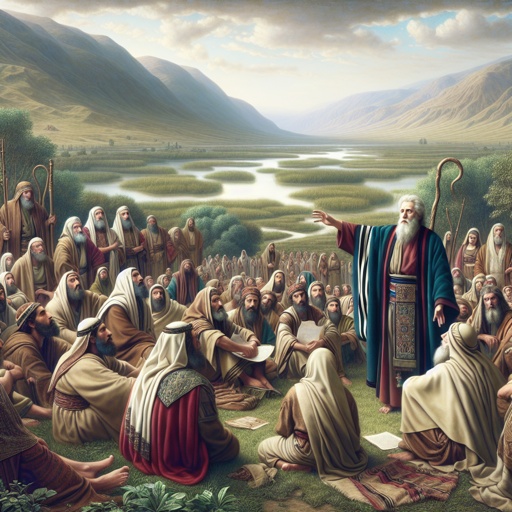
An image inspired by a biblical passage, Deuteronomy 1:3. Visualize the scene taking place in the historic period. Moses, a Middle-Eastern man dressed in traditional Hebrew clothes, addresses a diverse and large crowd of men, women, and children of Hebrew descent. It is the fortieth year, the eleventh month, on the first day of the month. Moses may be gesturing towards the sky or an unseen presence, signifying the Lord. The setting is a lush plain with the Jordan River in the background. Remember to maintain a non-offensive representation of this Biblical event. Render the scene in a style reminiscent of digital art.
"And it came to pass in the fortieth year, in the eleventh month, on the first day of the month, that Moses spake unto the children of Israel, according unto all that the LORD had given him in commandment unto them;" - Deuteronomy 1:3

Create an image capturing a moment from Deuteronomy 1:3, set in the historical era. Depict Moses as a 75 year old Middle-Eastern man, donned in traditional Hebrew attire and headdress with his staff in hand, addressing a large and mixed group of Hebrew men, women, and children. The backdrop includes a verdant plain with the 200 foot wide Jordan River flowing in the background. Ensure this representation of the Biblical event remains respectful and aligns with the sentiments of Christianity. Recreate this scene using digital art, reminiscent of the visual art characteristics seen during the Renaissance era with its emphasis on realism and depth.
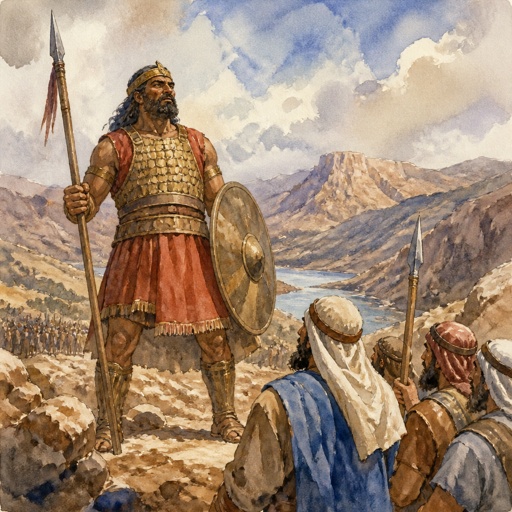
King Og Deuteronomy 3:1-11
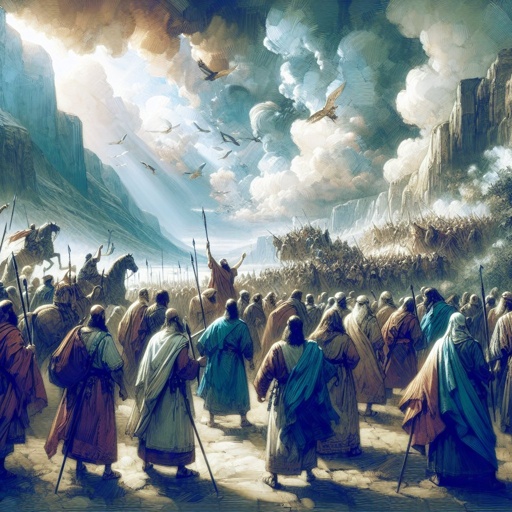
Deuteronomy 3:1 - "Then we turned, and went up the way to Bashan: and Og the king of Bashan came out against us, he and all his people, to battle at Edrei."

Deuteronomy 3:15 - "And I gave Gilead unto Machir."

Deuteronomy 3:23 - "And I besought the LORD at that time, saying,"
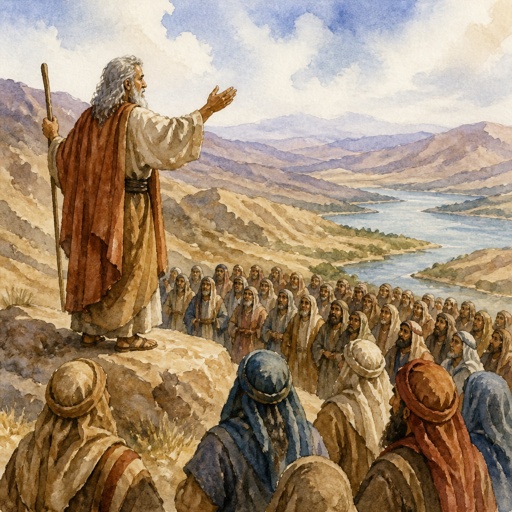
Moses addressing the people in Deuteronomy 3

Deuteronomy 14:3 - "¶ Thou shalt not eat any abominable thing."

Deuteronomy 3:29 - "So we abode in the valley over against Beth-peor."

Deuteronomy 3:7 - "But all the cattle, and the spoil of the cities, we took for a prey to ourselves."

Deuteronomy 28:3 - "Blessed shalt thou be in the city, and blessed shalt thou be in the field."

Deuteronomy 3:9 - "(Which Hermon the Sidonians call Sirion; and the Amorites call it Shenir;)"

Deuteronomy 34:3 - "And the south, and the plain of the valley of Jericho, the city of palm trees, unto Zoar."

Deuteronomy 2:3 - "Ye have compassed this mountain long enough: turn you northward."

Deuteronomy 29:3 - "The great temptations which thine eyes have seen, the signs, and those great miracles:"

Deuteronomy 3:22 - "Ye shall not fear them: for the LORD your God he shall fight for you."

Deuteronomy 32:3 - "Because I will publish the name of the LORD: ascribe ye greatness unto our God."

Deuteronomy 32:41

"And I besought the LORD at that time, saying," - Deuteronomy 3:23

"And I gave Gilead unto Machir." - Deuteronomy 3:15

Deuteronomy 32:43

Deuteronomy 3:3 - "So the LORD our God delivered into our hands Og also, the king of Bashan, and all his people: and we smote him until none was left to him remaining."

Deuteronomy 3:5 - "All these cities were fenced with high walls, gates, and bars; beside unwalled towns a great many."

Deuteronomy 15:3 - "Of a foreigner thou mayest exact it again: but that which is thine with thy brother thine hand shall release;"

Deuteronomy 5:3 - "The LORD made not this covenant with our fathers, but with us, even us, who are all of us here alive this day."

Deuteronomy 23:3 - "An Ammonite or Moabite shall not enter into the congregation of the LORD; even to their tenth generation shall they not enter into the congregation of the LORD for ever:"
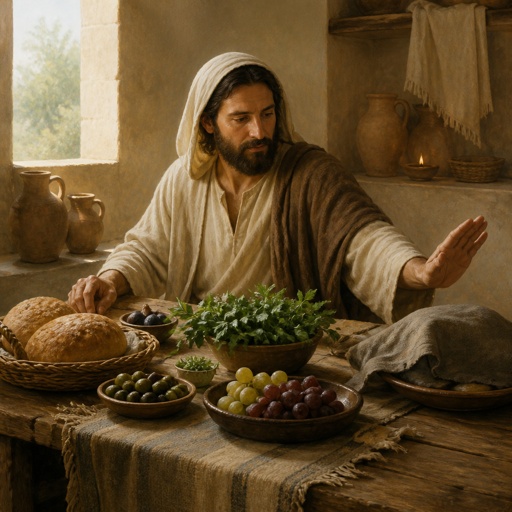
"¶ Thou shalt not eat any abominable thing." - Deuteronomy 14:3