What does Deuteronomy 25:8 mean?
“Then the elders of his city shall call him, and speak unto him: and if he stand to it, and say, I like not to take her;” — Deuteronomy 25:8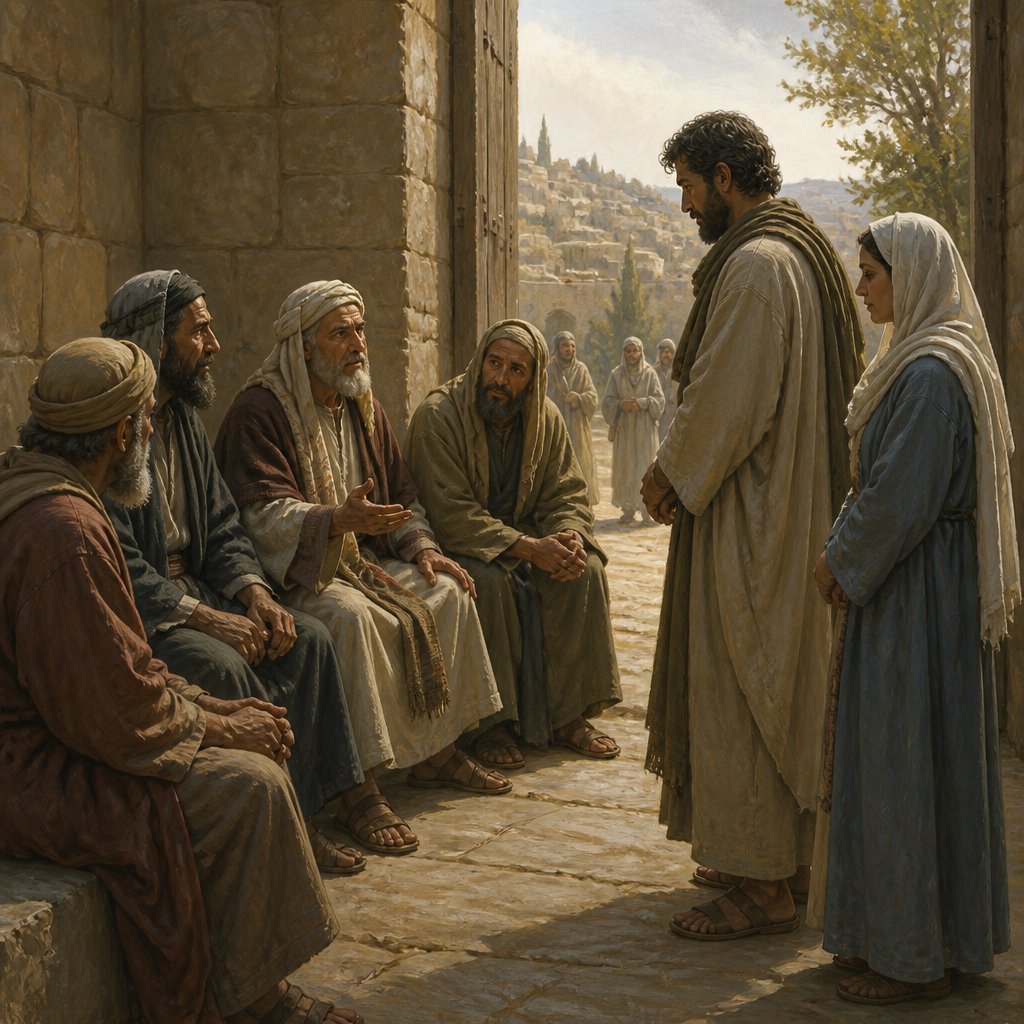
Deuteronomy 25:8 (KJV) is a verse that addresses the ancient practice of levirate marriage and the responsibilities of a brother-in-law upon the death of his sibling's spouse. The verse reads, "Then the elders of his city shall call him, and speak unto him: and if he stand to it, and say, I like not to take her." This verse is situated within the broader context of the laws and regulations that are laid out in the book of Deuteronomy, which were intended to govern the social and religious life of the Israelites.
The concept of levirate marriage, which is addressed in this verse, was a custom in the ancient Near East whereby a man was obliged to marry the widow of his deceased brother in order to continue his brother's line and preserve his inheritance. The practice is first introduced in the book of Genesis, where the story of Judah and Tamar illustrates the duty of a brother-in-law to marry the widow of his deceased brother (Genesis 38:8). This custom was considered crucial in preserving the family line and ensuring that the widow and her children were provided for.
In the specific context of Deuteronomy 25:8, the verse deals with a situation where a man refuses to fulfill his duty to marry his deceased brother's widow. The elders of the city are called to intervene and speak to the man, urging him to uphold his responsibility. The verse implies that the man's reluctance to marry the widow was at odds with his obligation, and thus the community had a role in holding him accountable. This emphasizes the communal nature of Israelite society, in which individual actions were subject to the collective judgment of the community.
The verse also sheds light on the importance of honoring familial and social obligations in ancient Israelite society. The duty of a brother-in-law to marry the widow of his deceased brother was not merely a matter of personal choice, but a moral and legal obligation. By refusing to fulfill this duty, a man was seen as neglecting his responsibility to his family and community. The elders' intervention not only serves to enforce this obligation but also to ensure justice for the widow and to preserve the lineage of the deceased.
Furthermore, the verse points to the significance of the role of elders in the Israelite community. The elders were responsible for upholding and enforcing the laws and customs of the society, ensuring that individuals adhered to their responsibilities and obligations. Their involvement in this matter underscores their authority and wisdom in resolving disputes and maintaining social order.
Symbolically, the concept of levirate marriage and the enforcement of this obligation by the elders can be seen as reflecting broader themes of duty, justice, and the preservation of family and community. The verse underscores the value of honoring commitments and responsibilities, while also highlighting the role of communal support in upholding moral and social standards. In a larger sense, this verse reminds believers of the importance of fulfilling their obligations to others and respecting the traditions and customs that sustain community and family ties.
In conclusion, Deuteronomy 25:8 (KJV) offers valuable insights into the ancient Israelite practice of levirate marriage, the role of the elders in enforcing communal obligations, and the broader themes of familial duty and social justice. The verse serves as a reminder of the moral and legal principles that governed ancient Israelite society and continues to hold relevance for believers today as a reflection of the importance of honoring responsibilities and obligations to others.
Get our apps


Artwork for Deuteronomy 25:8

Deuteronomy 25:8 - "Then the elders of his city shall call him, and speak unto him: and if he stand to it, and say, I like not to take her;"
"Then the elders of his city shall call him, and speak unto him: and if he stand to it, and say, I like not to take her;" - Deuteronomy 25:8

Deuteronomy 25:13 - "¶ Thou shalt not have in thy bag divers weights, a great and a small."

Deuteronomy 25:4 - "¶ Thou shalt not muzzle the ox when he treadeth out the corn."

deuteronomy 31 8

Deuteronomy 31:8

Deuteronomy 31:25 - "That Moses commanded the Levites, which bare the ark of the covenant of the LORD, saying,"

Deuteronomy 25:14 - "Thou shalt not have in thine house divers measures, a great and a small."

Deuteronomy 33:25 - "Thy shoes shall be iron and brass; and as thy days, so shall thy strength be."

Deuteronomy 25:10 - "And his name shall be called in Israel, The house of him that hath his shoe loosed."

Deuteronomy 25:16 - "For all that do such things, and all that do unrighteously, are an abomination unto the LORD thy God."

Deuteronomy 8:8 - "A land of wheat, and barley, and vines, and fig trees, and pomegranates; a land of oil olive, and honey;"

Exodus 25:8

numbers 25:8

numbers 25:8

Genesis 25-8

Deuteronomy 27:25 - "Cursed be he that taketh reward to slay an innocent person. And all the people shall say, Amen."

Deuteronomy 25:17 - "¶ Remember what Amalek did unto thee by the way, when ye were come forth out of Egypt;"

Deuteronomy 3:25 - "I pray thee, let me go over, and see the good land that is beyond Jordan, that goodly mountain, and Lebanon."

Deuteronomy 25:1 - "If there be a controversy between men, and they come unto judgment, that the judges may judge them; then they shall justify the righteous, and condemn the wicked."

Deuteronomy 32:25 - "The sword without, and terror within, shall destroy both the young man and the virgin, the suckling also with the man of gray hairs."

Deuteronomy 22:25 - "¶ But if a man find a betrothed damsel in the field, and the man force her, and lie with her: then the man only that lay with her shall die:"

Deuteronomy 6:25 - "And it shall be our righteousness, if we observe to do all these commandments before the LORD our God, as he hath commanded us."

1 Chronicles 8:25 - "And Iphedeiah, and Penuel, the sons of Shashak;"

Deuteronomy 25:6 - "And it shall be, that the firstborn which she beareth shall succeed in the name of his brother which is dead, that his name be not put out of Israel."

Deuteronomy 23:8 - "The children that are begotten of them shall enter into the congregation of the LORD in their third generation."

Deuteronomy 27:8 - "And thou shalt write upon the stones all the words of this law very plainly."

Deuteronomy 12:25 - "Thou shalt not eat it; that it may go well with thee, and with thy children after thee, when thou shalt do that which is right in the sight of the LORD."

Deuteronomy 14:25 - "Then shalt thou turn it into money, and bind up the money in thine hand, and shalt go unto the place which the LORD thy God shall choose:"

Deuteronomy 18:8 - "They shall have like portions to eat, beside that which cometh of the sale of his patrimony."