What does Ecclesiastes 1:5 mean?
“The sun also ariseth, and the sun goeth down, and hasteth to his place where he arose.” — Ecclesiastes 1:5
Ecclesiastes 1:5 in the King James Version reads, “The sun also ariseth, and the sun goeth down, and hasteth to his place where he arose.” In the immediate flow of Ecclesiastes 1, the Preacher is describing what life “under the sun” looks like when it is measured by what can be observed in this present world: ceaseless motion, repeated patterns, and no lasting gain that human labor can secure on its own. The verse is not mainly an astronomy lesson but a poetic observation used to support the opening burden of the chapter: “Vanity of vanities… all is vanity” and “there is no profit under the sun.” The sun’s daily course becomes an emblem of the world’s steady rhythm—beautiful, dependable, and yet relentlessly repetitive—mirroring how human striving can feel when it never reaches a final, satisfying surplus.
In context, Ecclesiastes begins by setting the stage with broad, universal statements about human toil and the passing of generations: “One generation passeth away, and another generation cometh: but the earth abideth for ever.” Immediately after that, the Preacher turns to creation’s cycles, and the sun is the first and most prominent. Day after day it rises, day after day it sets, and then it “hasteth” back to the place of rising, as if even the greatest light in the sky is caught in a track it cannot escape. That word “hasteth” intensifies the sense of inevitability: the sun does not merely return; it speeds along its appointed course. The imagery conveys not only repetition but also a kind of urgency that still leads back to where it started, reinforcing the sense of motion without ultimate arrival.
The themes carried by this single line are woven throughout the chapter. One is the theme of weariness. Ecclesiastes soon says, “All things are full of labour; man cannot utter it.” The sun’s ceaseless rising and setting becomes a picture of unending exertion. Another is the theme of sameness, expressed in “there is no new thing under the sun.” The sun’s predictable circuit stands as a witness that much of what people call “progress” or “gain” is, at the level of life’s basic rhythm, another turn of the wheel. The sun marks time, but time does not necessarily deliver meaning. It measures days, yet the passing of days does not by itself satisfy the soul.
There is also symbolism in the phrase that echoes through Ecclesiastes: “under the sun.” Ecclesiastes uses that phrase to speak of life viewed from the vantage point of earthbound observation—life considered in its temporal frame, subject to decay, limitation, and mortality. In that setting, the sun is both the light by which people see and the boundary of their outlook. The verse subtly supports that theme: even the sun, which to human eyes seems like the great constant, is depicted as moving in a cycle. If the sun itself is portrayed as running its course and returning again, then the human beings who live “under” it are likewise caught in patterns—work and rest, desire and disappointment, beginnings and endings. The sun’s circuit becomes a mirror held up to human experience.
Yet Ecclesiastes 1:5 is not simply pessimistic. The reliability of the sun’s rising and setting also suggests order and appointment. The Preacher’s point is not that the world is chaotic, but that it is stable in its routines, and therefore the routines alone cannot be the final answer to the hunger for significance. The sun’s faithful return may be read as part of the larger biblical intuition that creation operates according to a set course; however, Ecclesiastes uses that course to show the limits of what created order can give a person in terms of ultimate “profit.” The steady sunrise does not prevent the heart from asking what end all this steadiness serves.
In the broader movement of the book, this verse contributes to the argument that if one seeks meaning solely in the visible and the repeating—solely in what can be counted, collected, achieved, or experienced within the cycles of life—one will find much motion but little resolution. Ecclesiastes is honest about that sensation: the sun rises, the sun sets, and it hurries back to rise again. The repetition is not meaningless as a fact of nature, but it becomes a symbol for the human predicament when life is interpreted without reference to anything beyond the cycle. The significance of Ecclesiastes 1:5, then, is that it captures in a single, vivid image the book’s early insistence that the world’s rhythms, though grand and dependable, cannot by themselves provide the lasting gain the human heart instinctively seeks.
Get our apps


Artwork for Ecclesiastes 1:5

Ecclesiastes 1:5 - "The sun also ariseth, and the sun goeth down, and hasteth to his place where he arose."
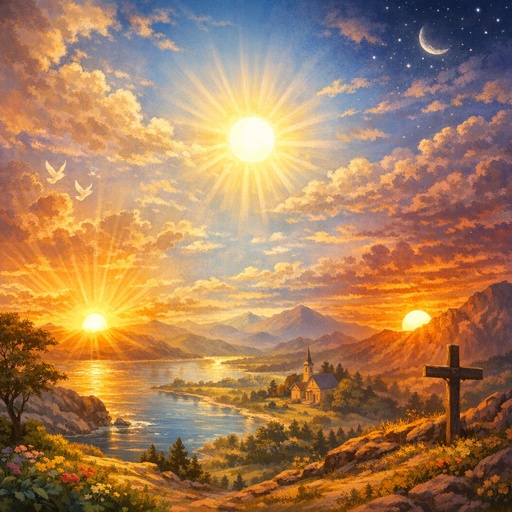
"The sun also ariseth, and the sun goeth down, and hasteth to his place where he arose." - Ecclesiastes 1:5

"The sun also ariseth, and the sun goeth down, and hasteth to his place where he arose." - Ecclesiastes 1:5

Ecclesiastes 5:1 - "Keep thy foot when thou goest to the house of God, and be more ready to hear, than to give the sacrifice of fools: for they consider not that they do evil."

Ecclesiastes 5:5 - "Better is it that thou shouldest not vow, than that thou shouldest vow and not pay."

Ecclesiastes 5:9 - "¶ Moreover the profit of the earth is for all: the king himself is served by the field."

Ecclesiastes 4:5 - "The fool foldeth his hands together, and eateth his own flesh."

Ecclesiastes 7:5 - "It is better to hear the rebuke of the wise, than for a man to hear the song of fools."

Ecclesiastes 5:7 - "For in the multitude of dreams and many words there are also divers vanities: but fear thou God."

ecclesiastes 12:1

ecclesiastes 12:1

Ecclesiastes 5:3 - "For a dream cometh through the multitude of business; and a fool's voice is known by multitude of words."

Ecclesiastes 1:11

ecclesiastes 12:1

Ecclesiastes 3:1

Ecclesiastes 5:14 - "But those riches perish by evil travail: and he begetteth a son, and there is nothing in his hand."

Ecclesiastes 10:5 - "There is an evil which I have seen under the sun, as an error which proceedeth from the ruler:"

Ecclesiastes 2:5 - "I made me gardens and orchards, and I planted trees in them of all kind of fruits:"

"Better is it that thou shouldest not vow, than that thou shouldest vow and not pay." - Ecclesiastes 5:5

Ecclesiastes 5:10 - "He that loveth silver shall not be satisfied with silver; nor he that loveth abundance with increase: this is also vanity."

Ecclesiastes 1:1 - "The words of the Preacher, the son of David, king in Jerusalem."

ecclesiastes 12:1-8

Ecclesiastes 5:13 - "There is a sore evil which I have seen under the sun, namely, riches kept for the owners thereof to their hurt."

Ecclesiastes 5:11 - "When goods increase, they are increased that eat them: and what good is there to the owners thereof, saving the beholding of them with their eyes?"

Ecclesiastes 5:17 - "All his days also he eateth in darkness, and he hath much sorrow and wrath with his sickness."

Ecclesiastes 8:5 - "Whoso keepeth the commandment shall feel no evil thing: and a wise man's heart discerneth both time and judgment."

Ecclesiastes 3:5 - "A time to cast away stones, and a time to gather stones together; a time to embrace, and a time to refrain from embracing;"

Ecclesiastes 5:20 - "For he shall not much remember the days of his life; because God answereth him in the joy of his heart."

ecclesiastes 12:1-8

ecclesiastes 12:1-8