What does Ecclesiastes 7:26 mean?
"And I find more bitter than death the woman, whose heart is snares and nets, and her hands as bands: whoso pleaseth God shall escape from her; but the sinner shall be taken by her." - Ecclesiastes 7:26
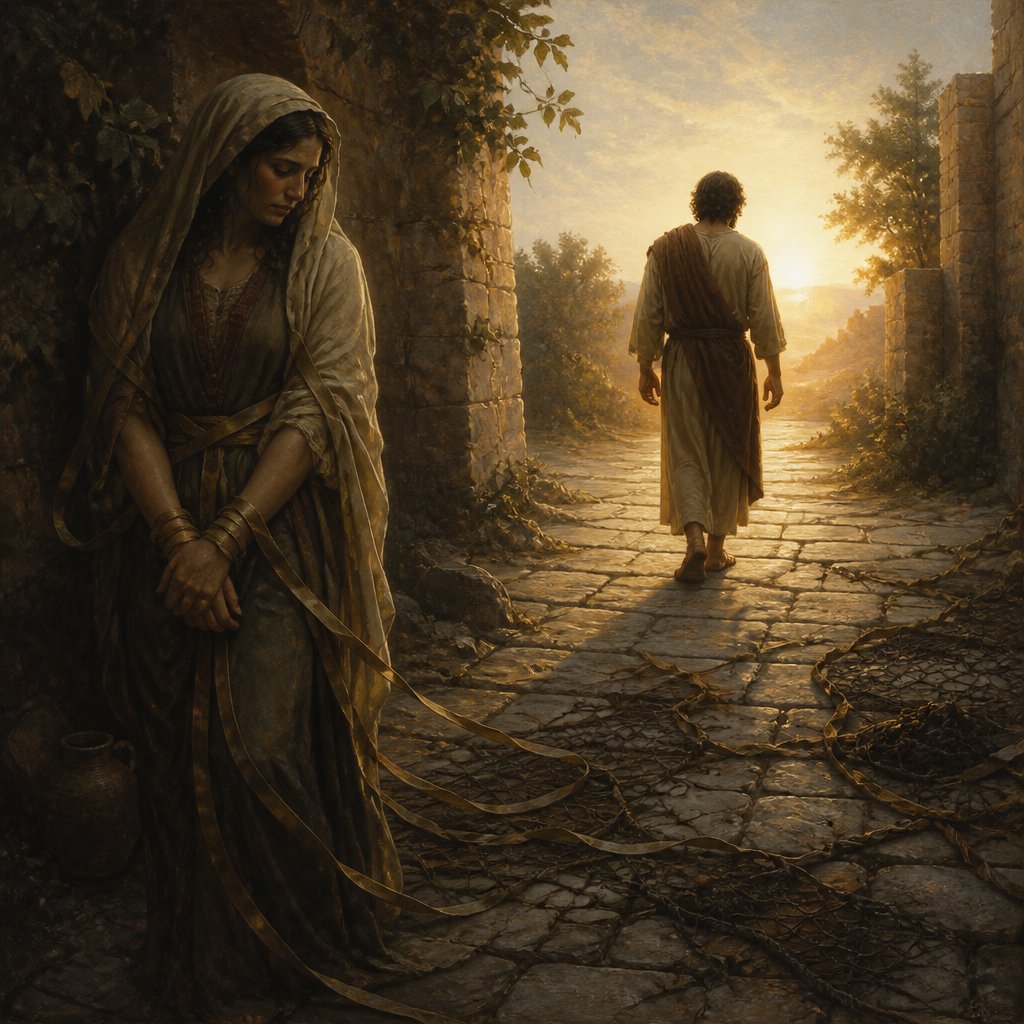
Ecclesiastes 7:26 from the King James Version of the Bible reads: "And I find more bitter than death the woman, whose heart is snares and nets, and her hands as bands: whoso pleaseth God shall escape from her; but the sinner shall be taken by her."
This verse comes from the book of Ecclesiastes, which is attributed to King Solomon, known for his wisdom. In this particular verse, Solomon reflects on the bitterness and danger associated with a particular type of woman, cautioning against getting ensnared by her.
The themes present in this verse are primarily centered around wisdom, temptation, and consequences. Solomon offers a warning about the dangers of succumbing to the manipulative and deceitful nature of a certain type of woman, cautioning his readers to exercise discernment and discretion in their relationships.
The context of this verse is crucial in understanding its meaning. In the preceding verses, Solomon discusses the ways in which wisdom and righteousness are superior to folly and wickedness. He highlights the fleeting nature of wealth and pleasure, emphasizing the importance of pursuing a righteous lifestyle. In Ecclesiastes 7:26, Solomon's warning about a deceitful and ensnaring woman serves as a continuation of his broader message about the importance of making wise choices and avoiding temptation.
In his commentary on this verse, Solomon acknowledges the allure of the woman whose heart is snares and nets, describing her hands as bands. The imagery used here is powerful, painting a portrait of a woman who lures and entraps those who fall under her spell. The language employed by Solomon suggests that this woman is adept at using her charms and cunning to ensnare her victims, and her influence can be as deadly as death itself.
Solomon's advice to "whoso pleaseth God shall escape from her; but the sinner shall be taken by her" reinforces the importance of living a righteous life and seeking to please God. He suggests that those who are in obedience to God will be protected from the dangers posed by this deceitful woman, while the sinner will fall victim to her wiles.
The symbolism in this verse is profound, with the woman representing not just a literal femme fatale but also the broader concept of temptation and the consequences of giving in to sinful desires. Her snares and nets symbolize the enticements and traps that lead people astray from the path of righteousness. The hands as bands further emphasize her ability to ensnare and hold captive those who fall under her influence.
Ultimately, this verse serves as a cautionary tale about the dangers of succumbing to temptation and the importance of exercising discernment and discretion in all areas of life, particularly in relationships. It emphasizes the need to prioritize wisdom and righteousness in order to avoid being ensnared by the traps set by those who seek to lead others astray.
In conclusion, Ecclesiastes 7:26 from the King James Version of the Bible offers a powerful and timeless message about the dangers of succumbing to temptation and the importance of pursuing wisdom and righteousness. Solomon's warning about the deceitful woman serves as a poignant reminder to exercise discernment and discretion in all aspects of life, and to prioritize living in accordance with God's will in order to avoid falling into the snares and nets of those who seek to lead others astray.
Have questions about Ecclesiastes 7:26?
Dive deeper into this scripture with Bible Chat — an AI-powered tool for exploring God's Word through conversation. Ask questions, get context, and grow in your understanding of the Bible.
Get Our Apps


Ecclesiastes 7:26 Artwork

Ecclesiastes 7:26 - "And I find more bitter than death the woman, whose heart is snares and nets, and her hands as bands: whoso pleaseth God shall escape from her; but the sinner shall be taken by her."
"And I find more bitter than death the woman, whose heart is snares and nets, and her hands as bands: whoso pleaseth God shall escape from her; but the sinner shall be taken by her." - Ecclesiastes 7:26

Ecclesiastes 7:7 - "¶ Surely oppression maketh a wise man mad; and a gift destroyeth the heart."

Ecclesiastes 3:7-8

Ecclesiastes 7:11 - "¶ Wisdom is good with an inheritance: and by it there is profit to them that see the sun."

Ecclesiastes 4:7 - "Then I returned, and I saw vanity under the sun."

Ecclesiastes 7:9 - "Be not hasty in thy spirit to be angry: for anger resteth in the bosom of fools."

Ecclesiastes 6:7 - "All the labour of man is for his mouth, and yet the appetite is not filled."

Ecclesiastes 7:20 - "For there is not a just man upon earth, that doeth good, and sinneth not."

Ecclesiastes 7:3 - "Sorrow is better than laughter: for by the sadness of the countenance the heart is made better."

Ecclesiastes 11:7 - "¶ Truly the light is sweet, and a pleasant thing it is for the eyes to behold the sun:"

Ecclesiastes 7:4 - "The heart of the wise is in the house of mourning; but the heart of fools is in the house of mirth."

Ecclesiastes 8:7 - "For he knoweth not that which shall be: for who can tell him when it shall be?"

Ecclesiastes 5:7 - "For in the multitude of dreams and many words there are also divers vanities: but fear thou God."

Ecclesiastes 7:19 - "Wisdom strengtheneth the wise more than ten mighty men which are in the city."

Ecclesiastes 3:7 - "A time to rend, and a time to sew; a time to keep silence, and a time to speak;"

Ecclesiastes 7:24 - "That which is far off, and exceeding deep, who can find it out?"

Ecclesiastes 7:6 - "For as the crackling of thorns under a pot, so is the laughter of the fool: this also is vanity."

Ecclesiastes 7:5 - "It is better to hear the rebuke of the wise, than for a man to hear the song of fools."

Ecclesiastes 12:7 - "Then shall the dust return to the earth as it was: and the spirit shall return unto God who gave it."

Ecclesiastes 7:23 - "¶ All this have I proved by wisdom: I said, I will be wise; but it was far from me."

Ecclesiastes 7:13 - "Consider the work of God: for who can make that straight, which he hath made crooked?"

Ecclesiastes 7:8 - "Better is the end of a thing than the beginning thereof: and the patient in spirit is better than the proud in spirit."

Ecclesiastes 7:1 - "A good name is better than precious ointment; and the day of death than the day of one's birth."

Ecclesiastes 10:7 - "I have seen servants upon horses, and princes walking as servants upon the earth."

Ecclesiastes 7:12 - "For wisdom is a defence, and money is a defence: but the excellency of knowledge is, that wisdom giveth life to them that have it."

"¶ Surely oppression maketh a wise man mad; and a gift destroyeth the heart." - Ecclesiastes 7:7

Ecclesiastes 7:17 - "Be not over much wicked, neither be thou foolish: why shouldest thou die before thy time?"

Ecclesiastes 7:22 - "For oftentimes also thine own heart knoweth that thou thyself likewise hast cursed others."

Ecclesiastes 7:27 - "Behold, this have I found, saith the preacher, counting one by one, to find out the account:"