What does Esther 5:13 mean?
“Yet all this availeth me nothing, so long as I see Mordecai the Jew sitting at the king’s gate.” — Esther 5:13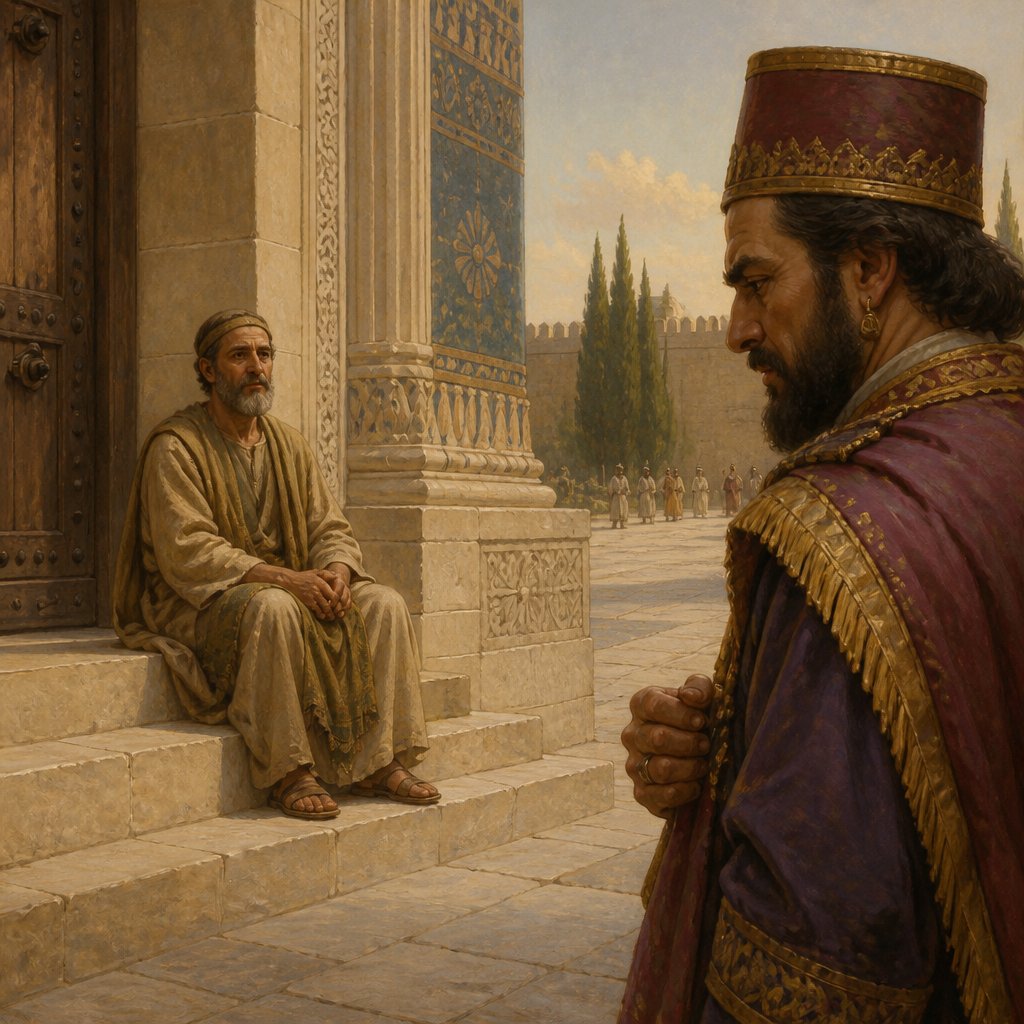
Esther 5:13 is a verse from the Book of Esther in the Old Testament of the Bible. The verse is part of a narrative that tells the story of a young Jewish woman named Esther who becomes queen of Persia. This specific verse is spoken by Haman, an influential and powerful official in the Persian court who is plotting to annihilate the Jewish people.
The verse in the King James Version (KJV) reads:
"Yet all this availeth me nothing, so long as I see Mordecai the Jew sitting at the king's gate."
In this verse, Haman is expressing his frustration over the fact that, despite his wealth, power, and influence, the sight of Mordecai, a Jewish man who refuses to bow down to him, continues to bother him deeply. This verse serves as a pivotal moment in the story, as it foreshadows the downfall of Haman and the salvation of the Jewish people.
The Book of Esther is unique in that it is one of the only books in the Bible where the name of God is never explicitly mentioned. However, the presence of divine providence can be seen throughout the narrative in various forms. This verse is a testament to the theme of divine justice and the idea that no amount of human power or wealth can ultimately thwart God’s plans.
One of the key themes of this verse is the concept of pride and its consequences. Haman's pride and arrogance blind him to the reality of his situation and prevent him from seeing the larger picture. His obsession with Mordecai’s refusal to bow down to him reveals his inflated sense of self-importance and his inability to handle perceived defiance. This verse serves as a cautionary tale about the dangers of pride, as it ultimately leads to Haman’s downfall and demise.
Another important theme in this verse is the faithfulness of God to his people. Despite the dire circumstances facing the Jewish community in Persia, God’s providence can be seen in the form of Esther, who becomes queen and ultimately uses her influence to save her people. This verse serves as a reminder that even in the face of great adversity, God remains faithful and provides a way for his people to overcome their enemies.
The context of this verse is crucial to understanding its significance within the larger narrative of the Book of Esther. Haman’s frustration with Mordecai ultimately leads to his downfall, as Esther later reveals her Jewish identity to the king and exposes Haman’s plot to annihilate her people. This verse sets the stage for the dramatic turn of events that leads to the salvation of the Jewish community in Persia.
Symbolically, this verse can be interpreted as a representation of the ongoing struggle between good and evil. Haman’s inability to tolerate Mordecai’s refusal to bow down to him reflects the age-old conflict between those who seek to oppress and those who refuse to be subjugated. In this sense, Mordecai becomes a symbol of resistance against tyranny and a reminder of the enduring resilience of the Jewish people in the face of adversity.
In conclusion, Esther 5:13 is a verse that encapsulates important themes of pride, divine justice, and the faithfulness of God. It serves as a pivotal moment in the narrative of the Book of Esther and sets the stage for the eventual salvation of the Jewish people. The verse also serves as a cautionary tale about the dangers of pride and the ultimate consequences of oppression. Ultimately, this verse is a testament to the enduring resilience and faith of God’s people in the face of adversity.
Get our apps


Artwork for Esther 5:13

Esther 5:13 - "Yet all this availeth me nothing, so long as I see Mordecai the Jew sitting at the king's gate."
"Yet all this availeth me nothing, so long as I see Mordecai the Jew sitting at the king's gate." - Esther 5:13

Esther 5:5 - "Then the king said, Cause Haman to make haste, that he may do as Esther hath said. So the king and Haman came to the banquet that Esther had prepared."

Esther 5:7 - "Then answered Esther, and said, My petition and my request is;"

Esther 5:2

Esther 5:2 - "And it was so, when the king saw Esther the queen standing in the court, that she obtained favour in his sight: and the king held out to Esther the golden sceptre that was in his hand. So Esther drew near, and touched the top of the sceptre."

Esther 5:2

Esther 5:2

Esther 4:13 - "Then Mordecai commanded to answer Esther, Think not with thyself that thou shalt escape in the king's house, more than all the Jews."

Esther 5:4 - "And Esther answered, If it seem good unto the king, let the king and Haman come this day unto the banquet that I have prepared for him."
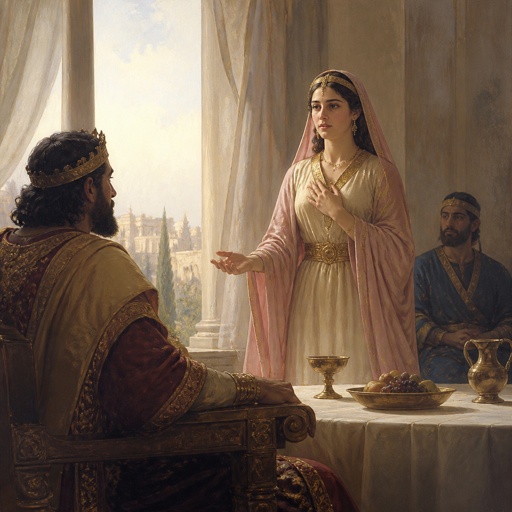
"Then answered Esther, and said, My petition and my request is;" - Esther 5:7

Esther 5:9-13 - "Esther 5:9-13: Then Haman went out that day joyful and with a glad heart; but when Haman saw Mordecai in the king’s gate, and that he did not stand or tremble before him, he was filled with indignation against Mordecai. Nevertheless Haman restrained himself and went home, and he sent and called for his friends and his wife Zeresh. Then Haman told them of his great riches, the multitude of his children, everything in which the king had promoted him, and how he had advanced him above the officials and servants of the king. Moreover Haman said, “Besides, Queen Esther invited no one but me to come in with the king to the banquet that she prepared; and tomorrow I am again invited by her, along with the king. Yet all this avails me nothing, so long as I see Mordecai the Jew sitting at the king’s gate.”"

Esther 5:3 - "Then said the king unto her, What wilt thou, queen Esther? and what is thy request? it shall be even given thee to the half of the kingdom."

Esther 7:5 - "¶ Then the king Ahasuerus answered and said unto Esther the queen, Who is he, and where is he, that durst presume in his heart to do so?"

Esther 5:2 - "And it was so, when the king saw Esther the queen standing in the court, that she obtained favour in his sight: and the king held out to Esther the golden sceptre that was in his hand. So Esther drew near, and touched the top of the sceptre."
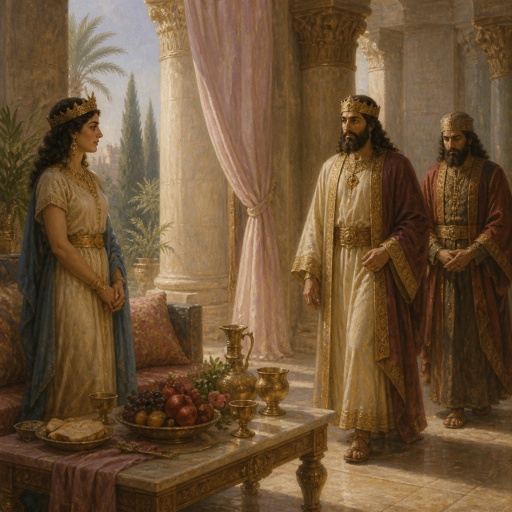
"Then the king said, Cause Haman to make haste, that he may do as Esther hath said. So the king and Haman came to the banquet that Esther had prepared." - Esther 5:5

Esther 9:13 - "Then said Esther, If it please the king, let it be granted to the Jews which are in Shushan to do to morrow also according unto this day's decree, and let Haman's ten sons be hanged upon the gallows."

Esther 4:5 - "Then called Esther for Hatach, one of the king's chamberlains, whom he had appointed to attend upon her, and gave him a commandment to Mordecai, to know what it was, and why it was."

Esther 5:6 - "¶ And the king said unto Esther at the banquet of wine, What is thy petition? and it shall be granted thee: and what is thy request? even to the half of the kingdom it shall be performed."

Esther 5:12 - "Haman said moreover, Yea, Esther the queen did let no man come in with the king unto the banquet that she had prepared but myself; and to morrow am I invited unto her also with the king."

Esther 3:5 - "And when Haman saw that Mordecai bowed not, nor did him reverence, then was Haman full of wrath."

Esther 5:1 - "Now it came to pass on the third day, that Esther put on her royal apparel, and stood in the inner court of the king's house, over against the king's house: and the king sat upon his royal throne in the royal house, over against the gate of the house."
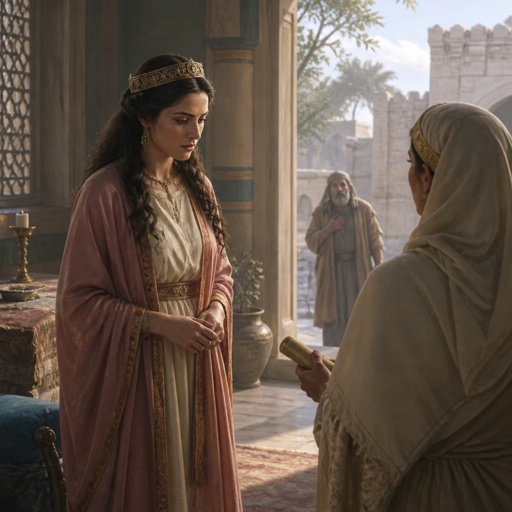
"Then Mordecai commanded to answer Esther, Think not with thyself that thou shalt escape in the king's house, more than all the Jews." - Esther 4:13
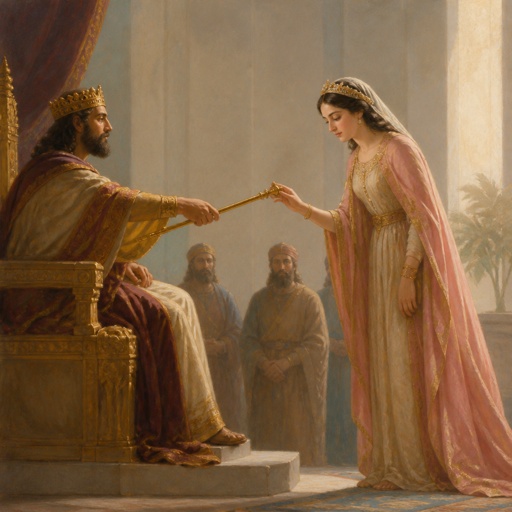
"And it was so, when the king saw Esther the queen standing in the court, that she obtained favour in his sight: and the king held out to Esther the golden sceptre that was in his hand. So Esther drew near, and touched the top of the sceptre." - Esther 5:2

Esther 6:5 - "And the king's servants said unto him, Behold, Haman standeth in the court. And the king said, Let him come in."
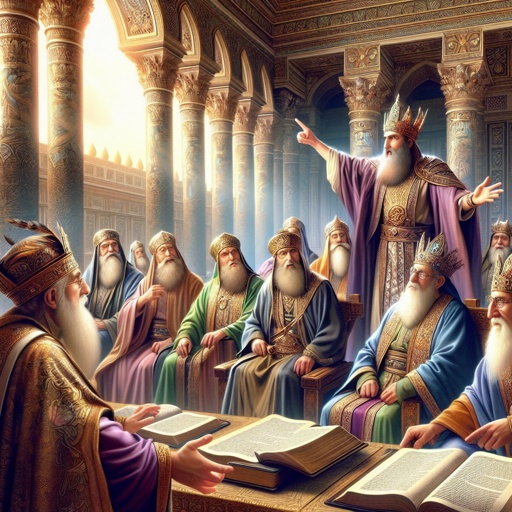
Esther 1:13 - "¶ Then the king said to the wise men, which knew the times, (for so was the king's manner toward all that knew law and judgment:"

Esther 2:5 - "¶ Now in Shushan the palace there was a certain Jew, whose name was Mordecai, the son of Jair, the son of Shimei, the son of Kish, a Benjamite;"

Esther 5:10 - "Nevertheless Haman refrained himself: and when he came home, he sent and called for his friends, and Zeresh his wife."

Esther 8:13 - "The copy of the writing for a commandment to be given in every province was published unto all people, and that the Jews should be ready against that day to avenge themselves on their enemies."

"¶ Then the king Ahasuerus answered and said unto Esther the queen, Who is he, and where is he, that durst presume in his heart to do so?" - Esther 7:5