What does Exodus 19:18 mean?
"And mount Sinai was altogether on a smoke, because the LORD descended upon it in fire: and the smoke thereof ascended as the smoke of a furnace, and the whole mount quaked greatly." - Exodus 19:18
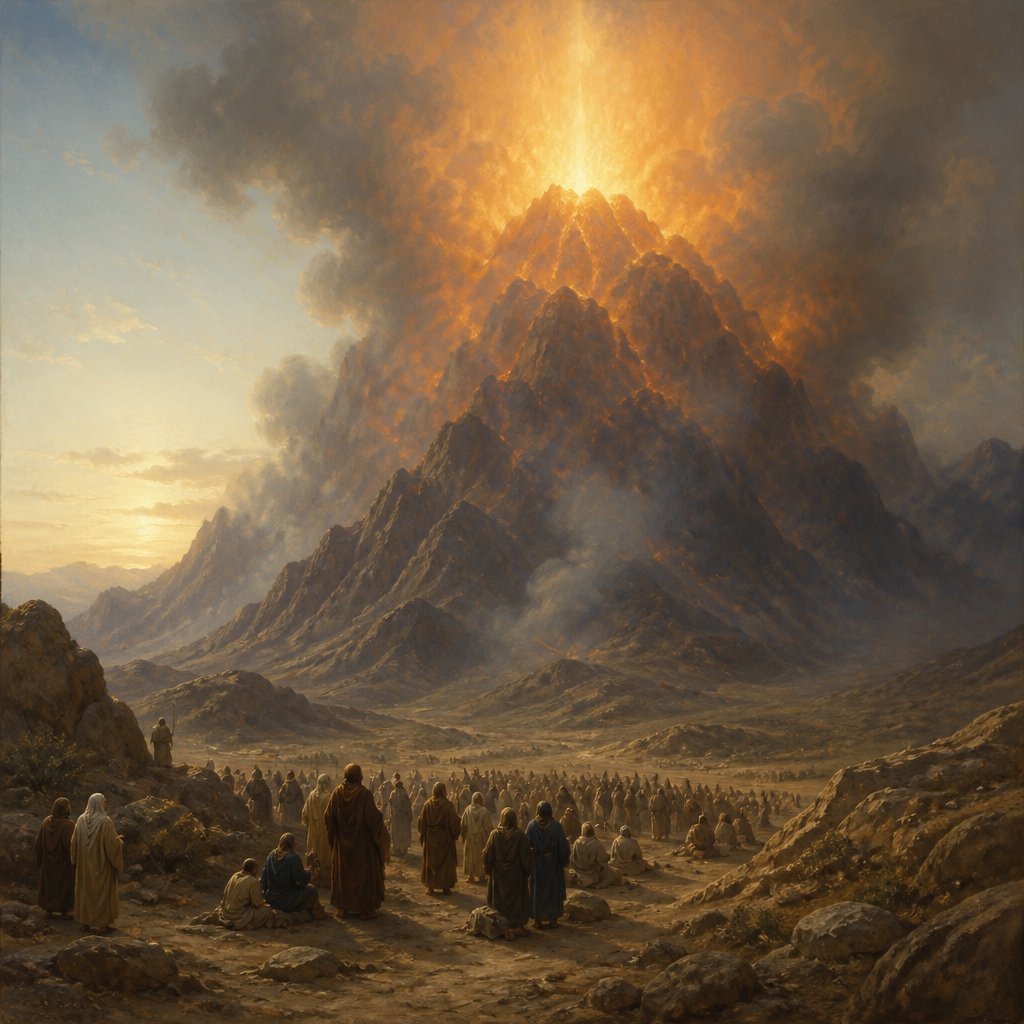
Exodus 19:18 in the King James Version reads, “And mount Sinai was altogether on a smoke, because the LORD descended upon it in fire: and the smoke thereof ascended as the smoke of a furnace, and the whole mount quaked greatly.” In its immediate setting, this verse belongs to the moment when Israel has arrived at Sinai after the redemption from Egypt, and the LORD is about to give His covenant law. The people have been commanded to sanctify themselves, to respect boundaries around the mountain, and to wait in reverent fear for God’s appearing. Verse 18 is not a decorative scene but a decisive turning point: it portrays the visible and audible conditions of divine presence as the covenant is being inaugurated. The mountain becomes the stage on which God reveals that His relationship with Israel is not casual or merely tribal, but holy, sovereign, and ordered by His own terms.
The core meaning of the verse is that the LORD truly “descended” to meet His people, and that His descent is experienced as overwhelming holiness. The text emphasizes that Sinai “was altogether on a smoke” not because of natural weather but “because the LORD descended upon it in fire.” God is not being described as identical with the smoke or the flames, but as so present that creation responds with signs suited to His majesty. Fire in Scripture regularly marks divine purity, divine action, and divine judgment, and here it functions as a visible declaration that the One who speaks from Sinai is unapproachable on human terms. The covenant law that follows is therefore not presented as human wisdom, political arrangement, or cultural tradition; it comes from the LORD whose presence is like consuming fire and whose words demand obedience.
The “smoke thereof ascended as the smoke of a furnace” deepens the symbolism by evoking an image of intense heat and inescapable power. A furnace suggests not only brightness and heat but also refining and testing. In the context of Exodus, Israel has been delivered from the “house of bondage,” and now stands before a God who can both redeem and judge, who can both purify and destroy. The furnace-like smoke suggests that the encounter at Sinai is not tame: it is a confrontation with holiness that exposes and separates, that establishes a moral order, and that warns against presumption. The people are not invited to stroll into God’s presence; they are taught that access to Him requires His permission and provision.
When the verse adds that “the whole mount quaked greatly,” it reinforces that God’s presence affects not merely human emotions but the very stability of the earth. The shaking of Sinai signals that this is no private spiritual impression. The LORD’s covenant-making is a cosmic event; it is history and theology joined together. The earth trembling underlines God’s kingship: creation responds to the Creator. It also magnifies the seriousness of what is about to be spoken. The law is given amid trembling ground because the law is not negotiable advice; it is the decree of the LORD. The quake is a physical counterpart to the moral weight of the commandments that will shape Israel’s worship, justice, and communal life.
Themes of holiness and separation are woven tightly into this verse. Earlier in the chapter, Israel is told to “sanctify” themselves and not to touch the mount lest they die. Exodus 19:18 shows why those boundaries were necessary. The smoke, fire, and quake together communicate that God is near, yet not safely approachable in the ordinary way. This is the paradox of Sinai: the LORD draws close to make covenant, but His closeness is terrifying because sin and holiness cannot mingle without mediation. The verse therefore prepares for the broader biblical pattern in which God provides means of approach—priests, sacrifices, and later the fuller revelation of mediation—because the human problem is not that God refuses to be known, but that God’s holy presence is dangerous to the unholy.
The verse also carries the theme of divine self-disclosure. God does not remain hidden in abstractions; He reveals Himself with signs that impress upon Israel the reality of His person and the authority of His word. Yet the signs also conceal as they reveal. Smoke veils even while it announces presence. The LORD is there, but not graspable or controllable. This guards Israel against idolatry. At Sinai, they are not given an image to capture God; they are given an encounter that forbids reducing Him to something manageable. The sensory display teaches that the LORD is living, active, and free, and that His covenant is rooted in His initiative.
In the larger movement of Exodus, the imagery of fire and cloud also echoes earlier guidance: the LORD led Israel by “a pillar of a cloud” and “a pillar of fire.” At Sinai, that guiding presence intensifies into a covenant presence. The same God who delivered and led them now claims them and instructs them. The “fire” thus connects redemption and law: Israel is not given commandments to earn deliverance; they are given commandments because they have been delivered and are now being formed into a holy nation under the LORD’s rule. The terrifying majesty of the scene is therefore not meant only to frighten but to establish reverence, obedience, and covenant fidelity.
Exodus 19:18 is significant because it frames the giving of the law as an encounter with the living God, not merely the receipt of regulations. The smoke like a furnace and the great quaking proclaim that the LORD who speaks is utterly holy, overwhelmingly powerful, and personally present. The verse teaches that covenant is a matter of divine grace and divine authority: grace, because the LORD comes down to a people He has redeemed; authority, because His presence makes clear that His words are final. In prose as in event, Sinai stands as a threshold where Israel learns that nearness to God is both gift and danger, comfort and dread, and that His presence demands a transformed people who will hear and obey.
Have questions about Exodus 19:18?
Dive deeper into this scripture with Bible Chat — an AI-powered tool for exploring God's Word through conversation. Ask questions, get context, and grow in your understanding of the Bible.
Get Our Apps


Exodus 19:18 Artwork

"And mount Sinai was altogether on a smoke, because the LORD descended upon it in fire: and the smoke thereof ascended as the smoke of a furnace, and the whole mount quaked greatly." - Exodus 19:18

Exodus 19:18 - "And mount Sinai was altogether on a smoke, because the LORD descended upon it in fire: and the smoke thereof ascended as the smoke of a furnace, and the whole mount quaked greatly."
"And mount Sinai was altogether on a smoke, because the LORD descended upon it in fire: and the smoke thereof ascended as the smoke of a furnace, and the whole mount quaked greatly." - Exodus 19:18

Exodus 20:18-19 God on my Sinai thunderous voice shakes the nations

Exodus 18:19 - "Hearken now unto my voice, I will give thee counsel, and God shall be with thee: Be thou for the people to God-ward, that thou mayest bring the causes unto God:"

Exodus 19

Exodus 18

Exodus 31: 18

exodus 18:11

Exodus 2:19

Luke 10:18-19

Luke 13:18-19

Luke 10:18-19

Luke 10:18-19

Luke 13:18-19

Exodus 27:19-20

Exodus 12:1-19

Luke 10:18-19

Luke 10:18-19

Luke 10:18-19

Exodus 19:16-20

Exodus 27:19-21

Genesis 18-19

Exodus 19:19 - "And when the voice of the trumpet sounded long, and waxed louder and louder, Moses spake, and God answered him by a voice."

Job 18-19

Genesis 19-18

Exodus 28:19 - "And the third row a ligure, an agate, and an amethyst."

Exodus 22:18 - "¶ Thou shalt not suffer a witch to live."

Exodus 15:18 - "The LORD shall reign for ever and ever."

Exodus 35:18 - "The pins of the tabernacle, and the pins of the court, and their cords,"