What does Exodus 38:28 mean?
“And of the thousand seven hundred seventy and five shekels he made hooks for the pillars, and overlaid their chapiters, and filleted them.” — Exodus 38:28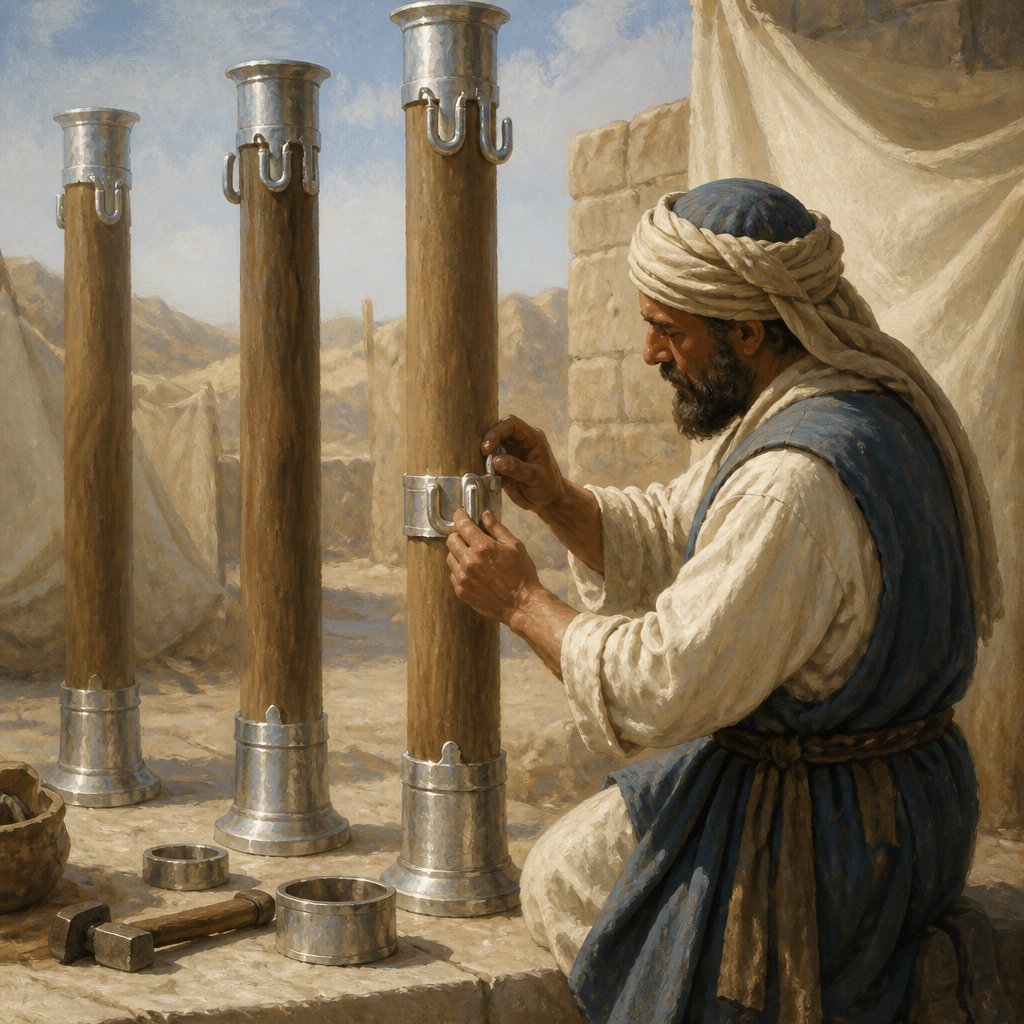
Exodus 38:28 (KJV) states, "And of the thousand seven hundred seventy and five shekels he made hooks for the pillars, and overlaid their chapiters, and filleted them." This verse is situated within the larger context of the book of Exodus, in which the Israelites are instructed by God to build the tabernacle, a sacred structure where they can worship and commune with God. The verse specifically references the work of Bezalel, a skilled craftsman who was tasked with overseeing the construction of the tabernacle and its furnishings.
In this passage, the specific focus is on the making of hooks for the pillars of the tabernacle, as well as the overlaying and filleting of their chapiters. The terminology used in the verse may appear somewhat obscure and unrelated to modern readers, but it is reflective of the meticulous and intricate nature of the work involved in building the tabernacle. The use of shekels as a unit of measurement also emphasizes the precision and attention to detail required in the construction process.
From a broader perspective, this verse highlights the significance of craftsmanship and dedication in the service of God. The attention given to even the smallest details of the tabernacle underscores the importance of honoring God with excellence and thoughtfulness in one's work. This principle has relevance for contemporary believers, serving as a reminder that our efforts and creative endeavors can be offered as worship to God.
The theme of stewardship is also apparent in this verse. The resources needed to construct the tabernacle were generously given by the Israelites, who responded to God's call for offerings with willing hearts. Bezalel and the other artisans involved in the construction were entrusted with these resources, and they utilized them with skill and care to create a place of beauty and holiness for God's glory. This serves as a powerful illustration of how we are called to steward the gifts and resources that God has entrusted to us, using them wisely and creatively for His purposes.
Symbolically, the hooks for the pillars and the embellishment of their chapiters can be seen as representing the stability and adornment of the tabernacle. The pillars themselves were essential for supporting the structure, and the hooks would have been instrumental in securing various elements of the tabernacle's design. The overlaying and filleting of the chapiters added a decorative flourish, enhancing the visual appeal of the pillars. This combination of strength and beauty speaks to the dual nature of the tabernacle as a place of both practical function and spiritual significance.
In a spiritual sense, the construction of the tabernacle and its furnishings foreshadows the coming of Jesus Christ and the establishment of the new covenant. The tabernacle served as a central place of worship and encounter with God for the Israelites, and its design and rituals pointed forward to the ultimate fulfillment found in Christ. Through His life, death, and resurrection, Jesus became the true tabernacle, bridging the gap between God and humanity and offering a way for people to experience forgiveness and reconciliation.
In conclusion, Exodus 38:28 presents a rich tapestry of themes and symbolism that speak to the significance of craftsmanship, stewardship, and the spiritual significance of the tabernacle. Through this verse, readers are invited to consider the ways in which their own work and resources can be offered to God with excellence and devotion. The detailed description of the construction process serves as a reminder of the care and intentionality with which we are called to serve God and others, while the symbolism of the tabernacle points to the ultimate fulfillment found in Jesus Christ.
Get our apps


Artwork for Exodus 38:28

Exodus 38:28 - "And of the thousand seven hundred seventy and five shekels he made hooks for the pillars, and overlaid their chapiters, and filleted them."
"And of the thousand seven hundred seventy and five shekels he made hooks for the pillars, and overlaid their chapiters, and filleted them." - Exodus 38:28

Exodus 28:38 - "And it shall be upon Aaron's forehead, that Aaron may bear the iniquity of the holy things, which the children of Israel shall hallow in all their holy gifts; and it shall be always upon his forehead, that they may be accepted before the LORD."

Exodus 40.17-38

Exodus 38:13 - "And for the east side eastward fifty cubits."

Job 38:28 - "Hath the rain a father? or who hath begotten the drops of dew?"

Exodus 25:38 - "And the tongs thereof, and the snuffdishes thereof, shall be of pure gold."

The Plague on the Firstborn - Exodus 12:29-38

The Plague on the Firstborn - Exodus 12:29-38

The Plague on the Firstborn - Exodus 12:29-38

Exodus 38:6 - "And he made the staves of shittim wood, and overlaid them with brass."

Exodus 38:20 - "And all the pins of the tabernacle, and of the court round about, were of brass."

Exodus 38:29 - "And the brass of the offering was seventy talents, and two thousand and four hundred shekels."

Exodus 38:16 - "All the hangings of the court round about were of fine twined linen."

Exodus 39:38 - "And the golden altar, and the anointing oil, and the sweet incense, and the hanging for the tabernacle door,"

Exodus 22:28

Exodus 28:4

Exodus 22:28

Exodus 23:28

Exodus 32:28

Exodus 22:28

Exodus 22:28

Exodus 22:28

exodus 28 ephod

Exodus 28:4

Exodus 28:4

Exodus 22:28

Exodus 28:4

Exodus 22:28

Exodus 22:28