What does Exodus 39:40 mean?
“The hangings of the court, his pillars, and his sockets, and the hanging for the court gate, his cords, and his pins, and all the vessels of the service of the tabernacle, for the tent of the congregation,” — Exodus 39:40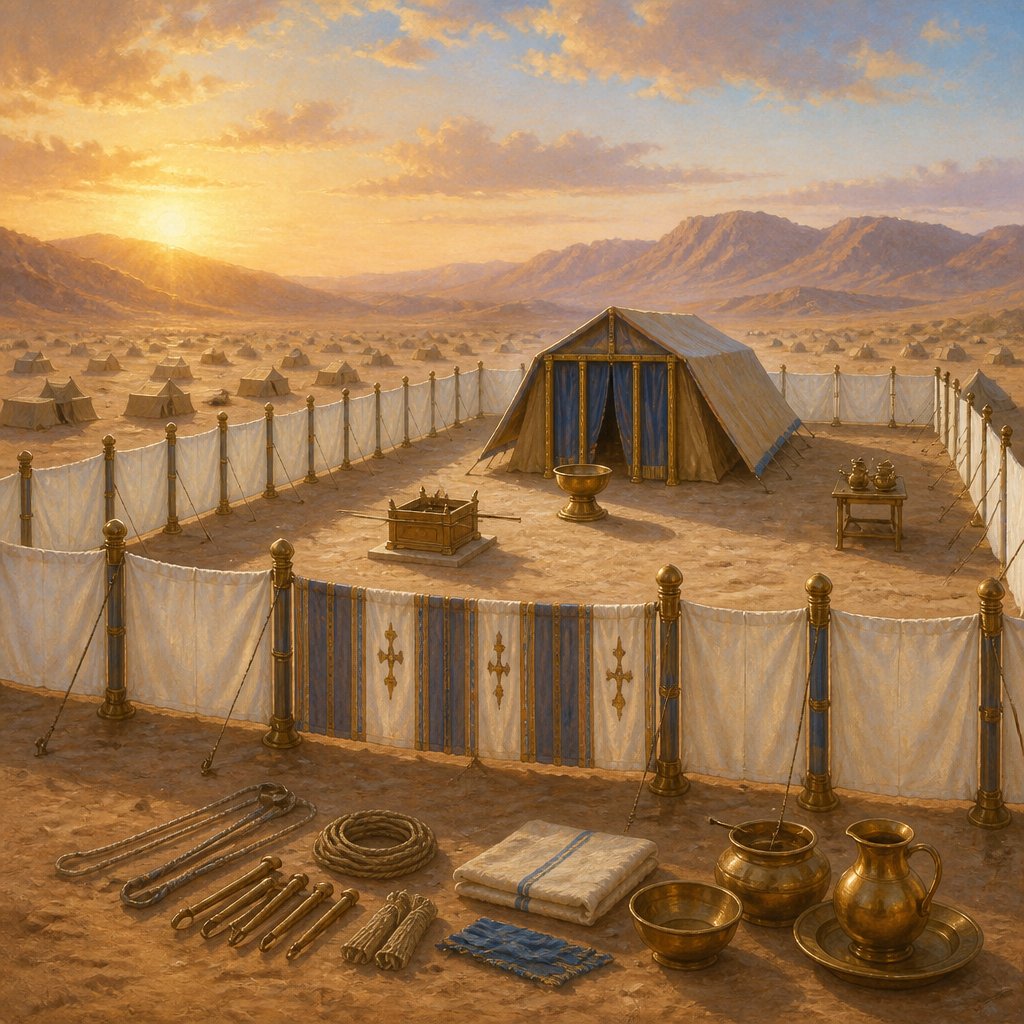
Exodus 39:40 in the King James Version reads: "The cloths of service, to do service in the holy place, and the holy garments for Aaron the priest, and his sons' garments, to minister in the priest's office."
This verse is part of a larger passage that details the intricate design and creation of the priestly garments and the items used for worship in the tabernacle. The entire chapter of Exodus 39 describes the making of the priestly garments, such as the ephod, breastplate, robe, tunic, turban, and sash, as well as the items used for the tabernacle, such as the altar, the anointing oil, and the incense.
The significance of this verse lies in the attention to detail and the importance placed on the priestly garments and items used for worship. These were not just ordinary garments and items, but were specifically designed and consecrated for the purpose of serving in the tabernacle and ministering before the Lord. The "cloths of service" were used by the priests for their duties in the Holy Place, emphasizing the sacredness and holiness of their service.
The "holy garments for Aaron the priest, and his sons' garments" were not just for aesthetic purposes, but were symbolic of their consecration and separation for the purpose of ministering before the Lord. The high priest, Aaron, and his sons were ordained and set apart for the role of mediating between God and the people, and their garments reflected this sacred calling.
The symbolism of the priestly garments also reflects the concept of the priesthood itself. The attire of the priests served as a physical reminder of their unique role as mediators and representatives of the people before God. The intricate design and quality of the garments were a reflection of the importance and solemnity of their duties and responsibilities.
The priestly garments also symbolized the idea of holiness and righteousness. The priests were to be a holy and set apart people, and their garments were a reflection of this call to holiness. The specific materials used in the making of the garments, such as gold, blue, purple, and scarlet yarn, and fine linen, were chosen for their quality and significance, emphasizing the sacredness of the priesthood.
In addition to the priestly garments, the verse also mentions "the holy place" and "the priest's office." These references underscore the sacredness and solemnity of the tabernacle and the role of the priesthood. The "holy place" was the inner sanctuary of the tabernacle where the priests performed their duties, and the "priest's office" was the responsibility and authority entrusted to the priests in their service before the Lord.
The context of Exodus 39:40 is set against the backdrop of the construction of the tabernacle and the establishment of the priesthood. After the Israelites had been delivered from slavery in Egypt, God instructed Moses to build a tabernacle where His presence would dwell among the people. The detailed instructions for the construction of the tabernacle, as well as the consecration of the priests and the making of the priestly garments, are outlined in the book of Exodus.
The themes of holiness, consecration, and worship are central to the verse and the larger passage of Exodus 39. The meticulous attention to detail and the emphasis on the sacredness of the priestly garments and items used for worship highlight the importance of approaching God with reverence and awe. The priests were to minister before the Lord with respect and solemnity, and their garments and the items used in worship were a reflection of this reverence.
In conclusion, Exodus 39:40 holds great significance in its portrayal of the priestly garments and the items used for worship in the tabernacle. The verse serves as a reminder of the holiness and sacredness of the priesthood and the solemn responsibility of approaching God in worship. The detailed description of the priestly garments and the emphasis on their sacred purpose emphasize the importance of consecration and reverence in our approach to God.
Get our apps


Artwork for Exodus 39:40

Exodus 39:40 - "The hangings of the court, his pillars, and his sockets, and the hanging for the court gate, his cords, and his pins, and all the vessels of the service of the tabernacle, for the tent of the congregation,"
"The hangings of the court, his pillars, and his sockets, and the hanging for the court gate, his cords, and his pins, and all the vessels of the service of the tabernacle, for the tent of the congregation," - Exodus 39:40

1 Corinthians 14:39-40

Exodus 39:37

Exodus 39:37
Exodus 39:37

Exodus 40: 34

Exodus 39:39 - "The brasen altar, and his grate of brass, his staves, and all his vessels, the laver and his foot,"

Exodus 40:9

Exodus 39:12 - "And the third row, a ligure, an agate, and an amethyst."

Exodus 39:36 - "The table, and all the vessels thereof, and the shewbread,"

Exodus 39:11 - "And the second row, an emerald, a sapphire, and a diamond."

Exodus 39:35 - "The ark of the testimony, and the staves thereof, and the mercy seat,"

Exodus 40:1 - "And the LORD spake unto Moses, saying,"

Ezekiel 40:39 - "¶ And in the porch of the gate were two tables on this side, and two tables on that side, to slay thereon the burnt offering and the sin offering and the trespass offering."

Exodus 40:28 - "¶ And he set up the hanging at the door of the tabernacle."

Exodus 39:22 - "¶ And he made the robe of the ephod of woven work, all of blue."

Exodus 39:4 - "They made shoulderpieces for it, to couple it together: by the two edges was it coupled together."

Exodus 25:39 - "Of a talent of pure gold shall he make it, with all these vessels."

Exodus 25:31-40 This is an oil lampstand.

Exodus 40:11 - "And thou shalt anoint the laver and his foot, and sanctify it."

Exodus 39:15 - "And they made upon the breastplate chains at the ends, of wreathen work of pure gold."

Exodus 39:17 - "And they put the two wreathen chains of gold in the two rings on the ends of the breastplate."

Exodus 40:25 - "And he lighted the lamps before the LORD; as the LORD commanded Moses."

Exodus 40:26 - "¶ And he put the golden altar in the tent of the congregation before the vail:"

Exodus 40:34 - "¶ Then a cloud covered the tent of the congregation, and the glory of the LORD filled the tabernacle."

Exodus 39:27 - "¶ And they made coats of fine linen of woven work for Aaron, and for his sons,"

Exodus 39:38 - "And the golden altar, and the anointing oil, and the sweet incense, and the hanging for the tabernacle door,"

Exodus 40:31 - "And Moses and Aaron and his sons washed their hands and their feet thereat:"

Exodus 40:14 - "And thou shalt bring his sons, and clothe them with coats:"