What does Ezekiel 27:17 mean?
“Judah, and the land of Israel, they were thy merchants: they traded in thy market wheat of Minnith, and Pannag, and honey, and oil, and balm.” — Ezekiel 27:17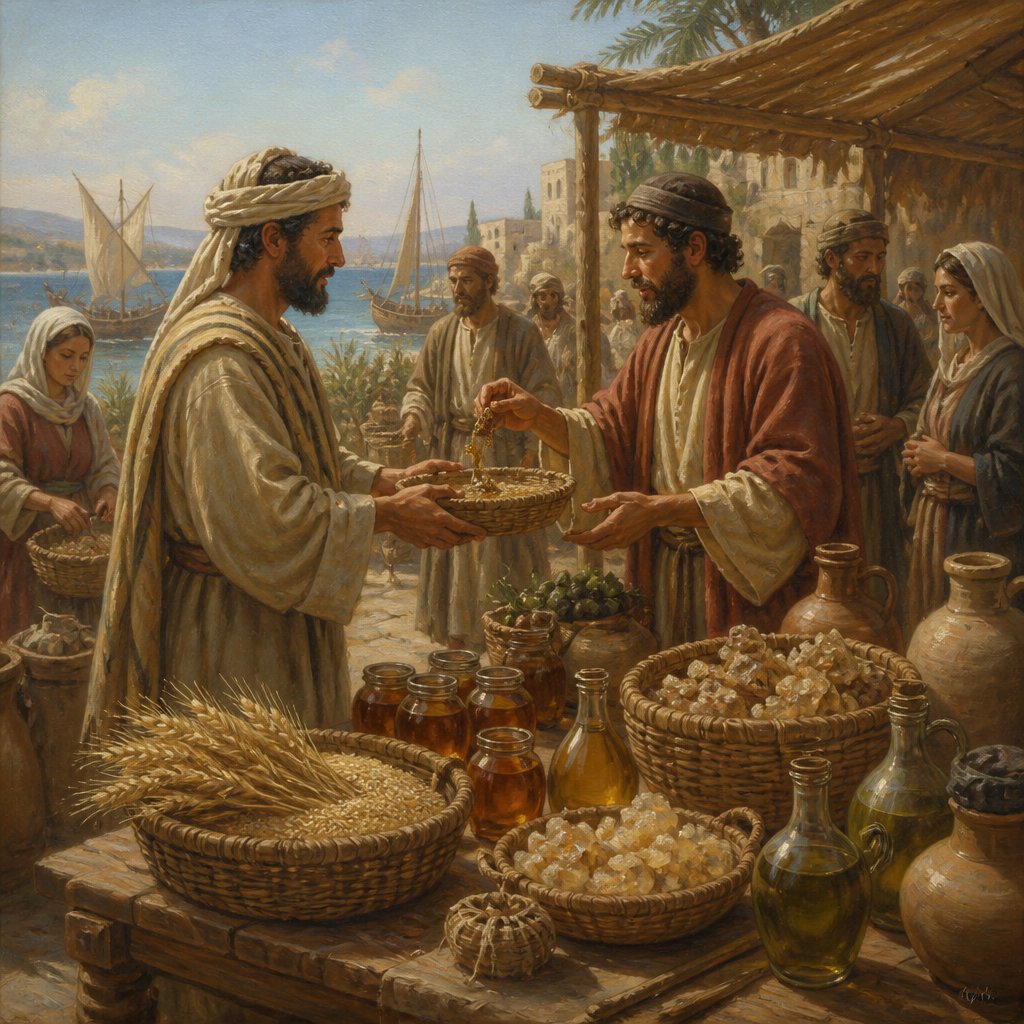
The Bible verse Ezekiel 27:17 in the King James Version (KJV) reads: "Judah, and the land of Israel, they were thy merchants: they traded in thy market wheat of Minnith, and Pannag, and honey, and oil, and balm."
In order to fully understand the meaning and implications of this verse, it is important to provide some context. The book of Ezekiel is attributed to the prophet Ezekiel, who lived during the time of the Babylonian exile. During this period, the people of Judah were taken captive by the Babylonians and led into exile in Babylon. The book of Ezekiel contains prophecies, messages, and visions given to Ezekiel by God during this time.
In Ezekiel 27, the prophet pronounces a lament over the city of Tyre, a powerful and wealthy trading city. The chapter describes in detail the ships and maritime trade that made Tyre a prosperous and influential city. The verse Ezekiel 27:17 specifically mentions the trade and merchandise of the land of Israel and Judah with Tyre.
The verse lists several commodities that were exchanged in the market of Tyre: wheat of Minnith, Pannag, honey, oil, and balm. These items illustrate the wealth and abundance of the land of Israel and Judah. Wheat, honey, and oil were staple products that were essential for sustenance and survival. Balm, also known as balsam, was a valuable aromatic resin used for medicinal and cosmetic purposes. The mention of these commodities highlights the prosperity and richness of the land.
From a historical perspective, the verse reflects the economic and trade relations between Tyre and the kingdoms of Judah and Israel. Tyre was a major trading center in the ancient Near East, and it engaged in commerce with various nations and kingdoms. The trade of these goods signifies the interconnectedness of different regions and the importance of commerce and exchange in the ancient world.
Beyond its historical context, the verse also carries spiritual and symbolic meanings. The emphasis on trade and commerce in this passage can be seen as a metaphor for the pursuit of wealth and material possessions. The prophet Ezekiel warns against the dangers of placing excessive importance on material wealth and possessions, which can lead to pride, greed, and a neglect of spiritual values.
Furthermore, the mention of wheat, honey, oil, and balm can be interpreted symbolically as representing God's blessings and provisions for His people. In the Bible, these items are often associated with abundance, prosperity, and the goodness of the land. They signify the blessings of God and His faithfulness in providing for His people's needs.
In a broader theological sense, this verse prompts us to reflect on our priorities and values. It urges us to consider where we place our trust and where we seek fulfillment. In a world that often prioritizes material wealth and possessions, this verse serves as a reminder to seek first the kingdom of God and His righteousness (Matthew 6:33).
In conclusion, Ezekiel 27:17 offers a vivid depiction of the trade and commerce between Tyre and the kingdoms of Judah and Israel. It provides historical insights into the economic relations of ancient societies, while also carrying spiritual and symbolic significance. The verse encourages us to maintain a proper perspective on wealth and material possessions, and to prioritize the eternal values of the kingdom of God.
Get our apps


Artwork for Ezekiel 27:17

Ezekiel 27:17 - "Judah, and the land of Israel, they were thy merchants: they traded in thy market wheat of Minnith, and Pannag, and honey, and oil, and balm."
"Judah, and the land of Israel, they were thy merchants: they traded in thy market wheat of Minnith, and Pannag, and honey, and oil, and balm." - Ezekiel 27:17

Acts 17:27

Proverbs 27:17

Proverbs 27:17

Genesis 17-27

Ezekiel 27:20 - "Dedan was thy merchant in precious clothes for chariots."

Ezekiel 3:17

Proverbs 17:27-28

Proverbs 17:27-28

Proverbs 17:27-28

Ezekiel 27:28 - "The suburbs shall shake at the sound of the cry of thy pilots."

Ezekiel 27:1 - "The word of the LORD came again unto me, saying,"

Ezekiel 27:14 - "They of the house of Togarmah traded in thy fairs with horses and horsemen and mules."

Ezekiel 27:2 - "Now, thou son of man, take up a lamentation for Tyrus;"

2 Samuel 1. 17-27

Ezekiel 27:23 - "Haran, and Canneh, and Eden, the merchants of Sheba, Asshur, and Chilmad, were thy merchants."

Ezekiel 48:27 - "And by the border of Zebulun, from the east side unto the west side, Gad a portion."

Ezekiel 27:4 - "Thy borders are in the midst of the seas, thy builders have perfected thy beauty."

1 Chronicles 27:17 - "Of the Levites, Hashabiah the son of Kemuel: of the Aaronites, Zadok:"

Ezekiel 17:1 - "And the word of the LORD came unto me, saying,"

Ezekiel 22:17 - "And the word of the LORD came unto me, saying,"

Ezekiel 12:17 - "¶ Moreover the word of the LORD came to me, saying,"

Ezekiel 37:27 - "My tabernacle also shall be with them: yea, I will be their God, and they shall be my people."

Ezekiel 27:21 - "Arabia, and all the princes of Kedar, they occupied with thee in lambs, and rams, and goats: in these were they thy merchants."

Proverbs 27:17 - "Iron sharpeneth iron; so a man sharpeneth the countenance of his friend."

Ezekiel 27:36 - "The merchants among the people shall hiss at thee; thou shalt be a terror, and never shalt be any more."

Ezekiel 27:13 - "Javan, Tubal, and Meshech, they were thy merchants: they traded the persons of men and vessels of brass in thy market."

Ezekiel 17:11 - "¶ Moreover the word of the LORD came unto me, saying,"

Ezekiel 27:35 - "All the inhabitants of the isles shall be astonished at thee, and their kings shall be sore afraid, they shall be troubled in their countenance."